
Introduction
What does your signature look like? Does it look similar to your printed name, or is it just a bunch of random loops and squiggles? Do you sign your name the same every time you write it?
Below are the signatures of some famous public officials. Can you tell who wrote them? If you were to see one of these signatures on a legal document, which one would you be more likely to trust as being authentic?
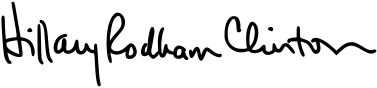


Over the past decade--or longer--cursive writing (also called longhand) has either been downgraded or completely eliminated from the educational curriculum n the United States. Why has it been minimized? And besides, what difference does it make? Isn't it enough that students know how to write in manuscript (also called printing)? Or maybe they shouldn't even have to know how to write in either manuscript or cursive as long as they can use the keyboard on a digital device.
Recently, a resurgence supporting the belief that cursive writing should be brought back into the schools, has begun. In fact, as of 2017, about 40% of the states in the United States have either adapted their academic standards to include cursive writing or mandated that cursive writing be taught in schools. These states include: Alabama, Arkansas, California, Florida, Georgia, Idaho, Illinois, Kansas, Louisiana, Maryland, Mississippi, North Carolina, Oklahoma, South Carolina, Tennessee, Texas, Utah, Virginia, and West Virginia.
This debate has come close to home. Check out these recent articles about the discussion in our own Kentucky state legislature regarding cursive writing:
An ACT related to student writing
Kentucky students would be required to learn cursive in writing in new standards
Cursive Making a Comeback? State May Add Skill to Classroom Curriculum
CCPS adding cursive curriculum
If you are hired as a new teacher, would you be ready to teach cursive to your students? This web quest will guide you through the reasoning behind the cursive writing debate and help you with some instructional strategies on how to teach it. But be ready--you may actually have to demonstrate that you know your "stuff."
This guided inquiry based web quest will take you through six steps--appropriately called the Big Six--which was developed by Mike Eisenberg and Bob Berkowitz, professors in The Information School of the University of Washington. These six steps are:
Step 1. Task Definition
Step 2. Information Seeking Strategies
Step 3. Location and Access
Step 4. Use of Information
Step 5. Synthesis
Step 6. Evaluation
Continue to the "Task" tab.
Task
Step 1. Task Definition
So, what do you need to do and where is this leading you? Since you may not have had much experience with web quests or inquiry-based learning, this structured inquiry web quest will direct you through the process.
1.1 Define the problem
You have learned about Essential Questions--that great big Higher Order Thinking question that directs you in your purpose. A web quest also needs an Essential Question, a hypothesis, or a problem to solve.
- You could ask one of these questions: What is the value of cursive writing? or Should cursive writing be included in the Language Arts curriculum?
- You could decide to support the hypothesis: It is important to teach cursive writing to elementary students.
- Or, you could take the opposite position and support the hypothesis: It is inconsequential as to whether or not students learn cursive writing.
Which of the options above will you choose? Or, is there another hypothesis statement that you wish to explore? Look at section 4.2 under the Process tab for a I-chart (inquiry chart) on which to record your question and organize your data.
1.2 Identify the information needed
Consider these guiding questions that might help you support your answer to the question or the hypothesis statement that you chose:
- How has the instruction of cursive writing changed over time?
- What do the standards say about cursive writing?
- What does the research say about cursive writing?
- How is cursive writing taught?
- What are the different styles of cursive writing?
Can you think of other questions? If so, add them to the list.
Why to you need this information?
Because, after you have located all of the information that supports your question or hypothesis statement, you will be asked to:
- Participate in a class debate and
- Respond to a prompt using cursive writing.
Go to the "Process" tab to get started.
Process
Step 2. Information Seeking Strategies
2.1 Determine all possible sources--Brainstorm.
Consider these sources:
- Content standards
- Academic standards
- Common Core Standards
- Credible websites
- Online newspapers
- Videos
- Downloadable worksheets
- Textbooks
- Charts
Can you think of other sources?
2.2 Select the best sources--Narrow your sources to those that are the most useful.
Which of the above sources might best help answer the Task Definition questions:
- How has the instruction of cursive writing changed over time?
- What do the standards say about cursive writing?
- What does the research say about cursive writing?
- How is cursive writing taught?
- What are the different styles of cursive writing?
Step 3. Location and Access
3.1 Locate your sources.
Standards:
National Council of Teachers of English and the International Reading Association Standards for the English Language Arts
Draft ELA Standards--Kentucky Department of Education, p. 15.
Research:
More States Are Requiring Kids to Learn Cursive
Many States are Bringing Back Cursive
Why Don't the Common Core Standards Include Cursive Writing?
Cursive Handwriting and Other Education Myths
The 4 Worst Arguments for Teaching Cursive in Schools
Why Write? Penmanship for the 21st Century--video
Farewell, Cursive: Handwriting in the 21st Century--video
Why You Learn More Effectively by Writing Than by Typing
How to teach cursive:
Let's Write Cursive--video
Teaching Cursive--What NOT to Do
Should you Teach Print or Cursive Handwriting First?
Styles of cursive writing:
Examples of Handwriting Styles
Can you find other sources?
3.2 Find information within the sources.
Which of the above sources help answer the Task Definition questions below and support your position? You may have to delve deep into a source to find the answer you are looking for to support your question or hypothesis statement.
- How has the instruction of cursive writing changed over time?
- What do the standards say about cursive writing?
- What does the research say about cursive writing?
- How is cursive writing taught?
- What are the different styles of cursive writing?
Step 4. Use of Information
(may be done simultaneously with Step 3)
4.1 Engage (read, hear, view)
Read the resources above to find the answers to the guiding questions that support your question or hypnosis statement. You will need to read more than one resource in order to learn more about the issue and determine whether or not your hypothesis is supported or disproved.
4.2 Extract relevant, quality information
Write down the information from Step 3 that is relevant to your question or hypnosis statement. A tool that could help with this is a "ReadWriteThink" graphic organizer called an I-chart (inquiry chart). Did your research reinforce your original stance on the topic, or did you change your mind?
Step 5. Synthesis
5.1 Organize
Organize your information.
For a different inquiry topic, you might write a report, design and/or make a presentation, create charts or graphs with supporting data, or create a product of your own choosing.
However, for this web quest, you need to take notes that support your stance on the topic of cursive writing and organize them into some type of logical order. This could be an outline, a graphic organizer, a chart, or web. This is your choice.
During class, you will be given a prompt and asked to respond to it by writing in cursive. Go to Examples of Handwriting Styles and choose a font that you think you would be most comfortable using. Practice.
NOTE: The Italic fonts at the bottom of the web page are NOT fonts that are generally taught in the schools in the United States, so do not choose one of them. The fonts that are most commonly taught in the United States are either the D'Nealian or the Zaner Bloser fonts. Check out this website to learn the differences: Zaner Bloser vs. D'Nealian. However, it will be acceptable if you choose the New American font or the Handwriting Without Tears font.
To practice your handwriting, choose a limerick from this link and copy it in cursive. Bring your limerick--written in cursive--to class with you. Label it--in cursive--with a statement identifying the style of cursive you chose. (e.g. "This was written in __________________ font.")
5.2 Present
1) There will be a class discussion/debate about this issue. Be ready to participate!

2) You will be asked to respond to a timed prompt--so practice your handwriting!
Look at the "Evaluation" tab to see how you will be scored on this activity.
Evaluation
Step 6. Evaluation
6.1 Judge the result
Your instructor will give you a "job interview" scenario to which you will have a timed response. This response is to be submitted along with the limerick you copied for practice. You will be evaluated on the following single-point rubric.
| Criteria | Points | Comments |
| Limerick is copied in cursive | 1 | |
| Prompt is answered in cursive | 1 | |
|
Cursive letters are formed correctly and in the correct proportion |
1 | |
| Slant is consistent | 1 | |
| Legible signature is on paper | 1 | |
| /5 |
6.2 Judge the process
So, what did you think about your web quest?
- Did you learn anything new?
- Do you have the same or a different opinion about teaching/learning cursive than you did at the beginning?
- Do you have a new insight into the topic?
- Do you have enough information to get started if you are instructed to teach cursive writing?
- Could you model for students correct letter formations?
Proceed to the "Conclusions" tab.
Conclusion
Teaching cursive writing can be fun and another way to expand your instructional practices. Or, it can be a drudge and just another "add on" that you, as a teacher, have to add to your professional responsibilities.
There are pros and cons regarding the issue. Whatever your belief and stance on the topic--and no matter how proficient your handwriting style is already--you need to practice and be prepared. You don't know where you will end up applying for a potential teaching position. You would not want the opportunity for a future job to be determined by the skill level of this one attribute.
Credits
An ACT related to student writing. 17 RS BR 1534. (n.d.). Retrieved March 24, 2018, from http://www.lrc.ky.gov/recorddocuments/bill/17RS/HB495/bill.pdf
Ball, P. (2016, September 08). Cursive Handwriting and Other Education Myths - Issue 40: Learning. Retrieved March 24, 2018, from http://nautil.us/issue/40/learning/cursive-handwriting-and-other-educat…
Borreli, L. (2014, February 07). Why Using Pen And Paper, Not Laptops, Boosts Memory: Writing Notes Helps Recall Concepts, Ability To Understand. Retrieved March 28, 2018, from https://www.medicaldaily.com/why-using-pen-and-paper-not-laptops-boosts…
Collaborative for Student Success. (2017, April 04). Many States Are Bringing Back Cursive Writing. Common Core Supporters Are Cool with That. Retrieved March 23, 2018, from https://forstudentsuccess.org/many-states-are-bringing-back-cursive-wri…
Datta, T., & TEDxHISD. (2016, June 08). Farewell, Cursive: Handwriting in the 21st Century. Retrieved March 25, 2018, from https://www.youtube.com/watch?v=AtCW27ak8to
Diligent, L. (2017, September 02). Teaching Cursive: Part 1 (of 25) –What NOT to Do! Retrieved March 23, 2018, from https://expattutor.wordpress.com/2011/07/06/instructions-for-teaching-c…
Draw Your World. (2011, July 10). Examples of Handwriting Styles. Retrieved March 23, 2018, from https://www.drawyourworld.com/blog/examples-of-handwriting-styles.html/
Eisenberg, M. (n.d.). Big6 Skills Overview. Retrieved March 20, 2018, from http://big6.com/pages/about/big6-skills-overview.php
Grapes, M., Parsons, E., & Towne, R. (2014). On Cursive Writing, Keyboarding, and Handwriting: An Argument of Efficacy[Scholarly project]. In Digital Commons@Cedarville University. Retrieved March 24, 2018, from https://digitalcommons.cedarville.edu/cgi/viewcontent.cgi?article=1014&…
Greutman, H. (2016, June 03). Should You Teach Print or Cursive Handwriting First? Retrieved March 25, 2018, from https://www.growinghandsonkids.com/teach-print-cursive-handwriting-firs…
Guenther, L. (n.d.). Limericks. Retrieved March 23, 2018, from http://www.kidzone.ws/poetry/limerick.htm
Inquiry Chart | Classroom Strategy. (2017, October 30). Retrieved March 27, 2018, from http://www.readingrockets.org/strategies/inquiry_chart
Littrell, S. (2017, July 10). CCPS adding cursive curriculum. Retrieved March 20, 2018, from https://www.winchestersun.com/2017/07/10/ccps-adding-cursive-curriculum/
Loewus, L. H. (2016, October 14). Why Don't the Common-Core Standards Include Cursive Writing? Retrieved March 24, 2018, from http://blogs.edweek.org/edweek/curriculum/2016/10/why_dont_the_common-c…
Kentucky Department of Education. (2017). Kentucky Academic Standards: English Language Arts. Retrieved March 29, 2018, from https://education.ky.gov/curriculum/standards/kyacadstand/Documents/201…
Matthews, K. (2017, March 06). Cursive is making a comeback in American elementary schools. Retrieved March 23, 2018, from http://www.businessinsider.com/cursive-making-comeback-american-schools…
Pinola, M. (2011, January 21). Why You Learn More Effectively by Writing Than by Typing. Retrieved March 28, 2018, from https://lifehacker.com/5738093/why-you-learn-more-effectively-by-writin…
Pot, J. (2015, August 19). The 4 Worst Arguments for Teaching Cursive in Schools. Retrieved March 24, 2018, from https://www.makeuseof.com/tag/4-worst-arguments-teaching-cursive-school…
Simply Charlotte Mason. (n.d.). Zaner Bloser vs. D'Nealian. Retrieved March 23, 2018, from https://simplycharlottemason.com/faq/zaner-bloser-vs-dnealian/
Spears, V. H. (2017, May 15). Kentucky students would be required to learn cursive writing in new standards. Retrieved March 20, 2018, from http://www.kentucky.com/news/local/education/article150644057.html
Weidmann, J., & TEDxMileHigh. (2014, July 14). Why write? Penmanship for the 21st Century. Retrieved March 25, 2018, from https://www.youtube.com/watch?v=85bqT904VWA
WKYT News Staff. (2017, May 16). Cursive making a comeback? State may add skill to classroom curriculum. Retrieved March 20, 2018, from http://www.wkyt.com/content/news/Cursive-making-a-comeback-State-may-ad…
Teacher Page
Cursive Writing Prompt
You are interviewing at Future School for a teaching position. The interview committee consists of the principal, a teacher from each grade level, and the PTO President. During the interview, the principal informs you that the state’s Legislature has proposed a bill regarding the adoption of cursive writing in the educational curriculum and that the Department of Education is currently working on writing curriculum standards (just in case the bill passes) as well as reviewing textbooks and teaching materials for instructional assistance. Meanwhile, it has been left up to the superintendents of the individual school systems to determine whether or not cursive should be taught in each district’s schools. The superintendent of Future School’s district has passed the same directive along to the principals. The principal does not indicate whether or not Future School will teach cursive writing, but does inform you that every applicant for a teaching position at the school will be asked to respond to the following questions—in cursive. The interview committee will review the sample submissions as part of the decision-making process.
You are given 15 minutes during the interview time to respond to the following questions and you can only use the space provided.
- What is your stance on the teaching of cursive writing?
- Regardless of your personal opinion on teaching cursive writing, if you are hired for a grade level that teaches beginning cursive, what style of handwriting would you teach and why?
- Regardless of your personal opinion on teaching cursive writing, if you are hired at a grade level higher than the initial handwriting instruction, how would you support the cursive writing instruction?
- How would you respond to a parent who questions the handwriting curriculum?
______________________________________
Applicant’s Signature