
Introduction

Who is this guy? What's his riz? Why's he dressed in frilly drip?
He shakes it up, he PLAYs real hard, his vocab's bomb 'cuz he's the BARD.
You must know deets, and that's no cap: so, learn about this British chap.
A quest you're beset with one small goal: to learn all about the king of ...literature?
Task
Solve the riddle and complete the quest!!!
Working in trios, practice your teamwork and collaboration skills by completing the webquest together BY THE END OF THE CLASS PERIOD. You will have to work together, teach each other, and delegate the activities below to discover who the famous person in the picture is. Be sure to use the clues in the introductory poem provided also! Your time is precious, and it has started!
Once you have figured out the full name of this person: complete the activities listed on the "Process Page". Be sure to take notes and document your answers on a separate sheet of paper...you never know when you may need these responses to the questions...say, on a quiz or test!
Again, you will have the entire class for this task, but only what you complete is what will earn you your first grade of the semester. Use your time wisely.
As you come across his works, keep in mind the audience of his time, and the audience today (you). Be ready to respond to how this may affect your reaction to his work.

Now, go to the "Process Page" to begin your quest.
Process
Let's get started!
Activity 1: Time to Know
First, head over to this site: https://www.bbc.com/timelines/z8k2p39 or watch this video below (in either order)
Use the above content that provides a timeline and information to find out the answers to the questions below.
1. Who is our next author?
2. What genre is he famous for writing, and how many is he credited for creating? Why is this a huge deal?
3. When was he born and when did he die?
4. What is unusual about his date of death?
5. How much do we know about this person's life? Why?
6. Where was he born/raised, and where did he live/die?
7. Did he ever get married? If so, to whom?
8. What did this person establish himself as (an ____________ and _________________)?
9. What did he leave his wife in his will?
10. After his death, what year did his works first get their own Folio?
11. What three categories are his plays grouped into?
12. What key events took place following his death (list three).
13. What are the two key reasons his folio is still so popular 400 years later?
Activity 2: Truths and Lies
Now that you know the time he was born, the basics of his life, and some of his works, look further into one of his most famous works: Romeo and Juliet.
Below are a list of statements about the play. These could be true OR false. You are to work out what is right and what is wrong.
Use this website to help you: https://en.wikipedia.org/wiki/Romeo_and_Juliet
1. The plot of Romeo and Juliet is based on a French tale.
2. The play is believed to have been written between 1581 and 1585.
3. The play is set in Venice, Italy.
4. It begins with a street fight between the Montague and Capulet servants.
5. Romeo first sees Juliet at a ball in the Montague house.
6. With the help of Benvolio, they are secretly married the next day.
7. Romeo kills Juliet’s cousin, Tybalt, in revenge for his killing Romeo’s close friend and ally, Mercutio.
8. For the execution, Romeo is exiled from Verona.
9. Before he leaves, he secretly spends the night with Juliet.
10. Juliet’s mother offers her a drug that will put her into a coma for ’two and forty hours’ on the night before her planned wedding to Paris.
11. When she is found, she is believed to be dead.
12. Romeo buys a gun to kill himself when he hears the news.
13. At the crypt where Juliet’s body has been laid, Romeo is met by Paris.
14. He kills him before drinking the poison.
15. When Juliet awakens from her deep sleep, she realizes Romeo is dead and, panicking, she runs away.
Activity 3: Say What?
Our bard is known as the father of our modern language because he is credited with creating roughly 1700 words and phrases that we still use frequently today.
However, a lot of his works are also written in an older English that used words such as 'thou' and 'dost', as well as many more.
These words DO have modern equivalents. In your trio, use the website below to translate the sentences, either from modern English to Shakespearean English or from Shakespearean English to modern. Read these out loud to your partners.
Shakespeare Lexicon: https://learn.lexiconic.net/shakewords.htm
1. Ye all came forth from the room.
2. Get thee to a nunnery.
3. If thou remember’st not the slightest folly.
4. Doubt that the sun doth move;
5. Let's not waste any more time; quickly, let's go!
6. I know you love me.
7. Wait, what?
Activity 4: Interpret the Insult
Our bard was known for being quick witted and sharp of tongue. His insults cut deep and continue to have his audiences who are 'in the know' rolling with laughter.
Examples include:
| Word | Definition |
|---|---|
| Jolt head | (n) - Blockhead, dolt, numskull |
| Loggerheaded | (adj) - Thick-headed, stupid, doltish |
| Lumpish | (adj) - Despondent, dejected, in low spirits |
| Mammer |
(v) - Stammer, hesitate, mutter |
In order to be 'in the know' and have a better shot at 'getting the jokes' in his works, complete the following activity with your partners.
Step 1; Read through the modern day insults listed below and determine what character or personality trait is being criticized. Try to list different traits even if some may be synonyms of each other.
Modern day insults to translate:
1. Don’t worry—the first 30 years of childhood are always the hardest.
2. Who peed in your cheerios this morning?
3. I've seen salad that dresses better than you.
4. You have a face for radio.
5. I forgot the world revolves around you; my bad.
6. Dude - where is your 'off button'?
7. I do not have the time or the crayons to explain this to you right now.
8. It is impossible to underestimate you.
9. Is there an intermission to this drama? Geez.
Step 2: Now, use the three columns below (and the instructions) to translate the negative character/personality traits from above into the Bard's own 16th century language.
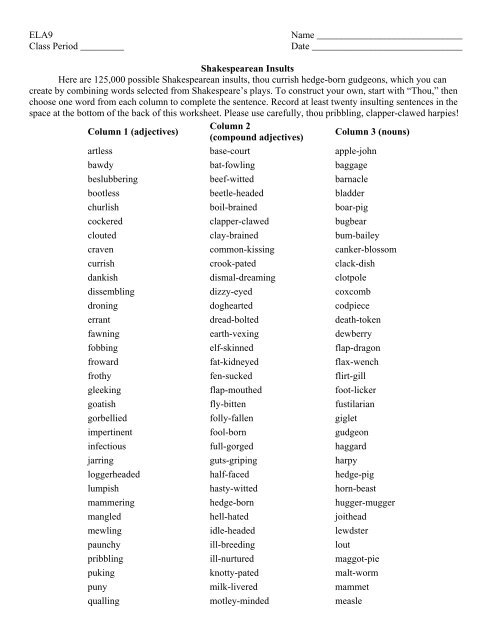
(Bonus points if you and your group can complete the extras, verbally, also)
You're the human equivalent of a participation trophy
You have the attention span of ice cream in July.
I will not have a battle of wits with someone who is unarmed.
Once you have completed all of the activities listed in this quest, go to the 'Conclusion Page' to end your journey!
Conclusion
To conclude the quest, you must ensure you have followed ALL directions of the webquest, written full names on the worksheet (legibly), ensure all of your answers are correct, verify all of your writing is legible, and make certain all members can answer any of the questions about Shakespeare's life and works at random.
ONCE you can complete the three items above successfully, bring your group's worksheet to the teacher for verification and await final instructions.
Now that you are familiar with the context of Shakespeare's works - the environment in which they were written - and the language you will engage in - you will have a better understanding of the meaning behind his words as we begin one of his most famous plays, "Romeo and Juliet".
