
Introduction
You live on a farm in Normal, Illinois near Sugar Creek. The crops that you plant are corn and soybeans, and you have many cows, pigs, and chickens on the farm as well. You use an herbicide called Roundup on your crops in order to kill off any weeds. Roundup contains the chemical glyphosate. You are also using a fertilizer that contains phosphorous and nitrogen.
After a year or so of living on the farm, you notice while fishing in the creek that the bass in the creek are very low in numbers, both the small mouth and the large mouth bass. There are also very high numbers of green sunfish, longear sunfish, and darters. You also notice that your crops are very close to the creek, so there may be runoff from your crops to the creek. Determined, you decide to figure out what is causing the bass population to decrease.
Task
During this project, you will be researching with your group what is causing the bass population to decrease in the creek. After you research and come up with an idea on what is causing the bass population to decrease, you will create a website to show your research and your claim of what is causing the change in the ecosystem. Once you determine the cause, you will need to create a solution for this problem and explain how your solution will help the ecosystem.
Process
Part 1: Creek Research
1. You need to research the creek by using the My Waterway website (https://watersgeo.epa.gov/mywaterway/search.html). Determine what factors are affecting the water quality and how they are affecting the water quality.
2. Analyze the following food web and determine what organisms are found in the creek. List each organism and show what organisms it eats, as well as what organism eats it. (http://www.combat-fishing.com/SFWOzStreamLower.JPG)
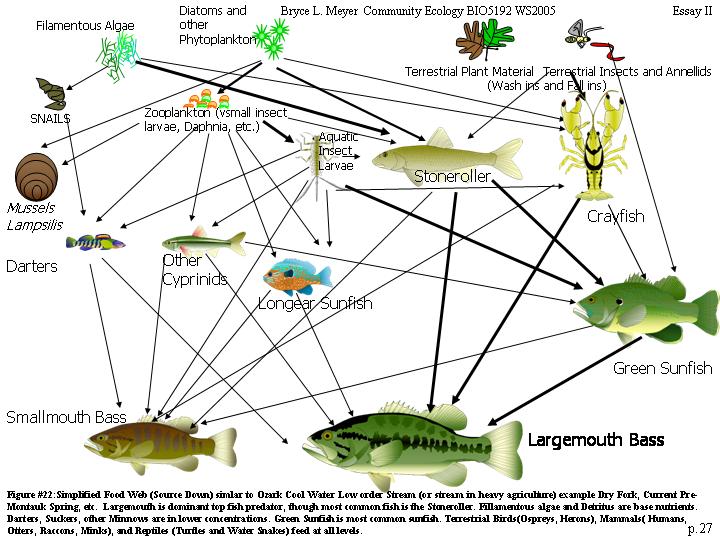
3. Fill out this Google worksheet when completing your research (https://docs.google.com/document/d/1KjdFuUdyoDy2VTUQWHjIcO6KXKaIYGfCrMjSZZAC_Go/edit?usp=sharing)
Part 2: Chemical Research
1. Research how the chemicals you are using affect wildlife in the creek. This includes the glyphosate in Roundup, your herbicide, and the nitrogen and phosphorous in your fertilizer (Start here: http://npic.orst.edu/factsheets/glyphogen.html#exposed). Find at 2 more resources about glyphosate, nitrogen, and phosphorous affecting wildlife in the creek.
- Think about how glyphosate can move from one organism to another in the food chain
2. Research how the chemicals you are using affect your crops, which are corn and soybeans (Start here: https://www.ecowatch.com/roundup-cancer-1882187755.html). Find 2 more resources about glyphosate, nitrogen, and phosphorous affecting crops.
3. Fill out this Google worksheet when completing your research (https://docs.google.com/document/d/1KjdFuUdyoDy2VTUQWHjIcO6KXKaIYGfCrMjSZZAC_Go/edit?usp=sharing)
Part 3: Determining a Solution
1. Explain what you believe is causing the population of bass to decrease and why it is making the population decrease. Reference your sources and relate back to what we have been learning in class about species interactions.
2. Once you have determined what is causing the population of bass to decrease, you will need to create a solution that will reverse the effects. Take into account what you have researched beforehand. You will need to create a plan that could be implemented to your farm almost immediately.
3. Fill out this Google worksheet when completing your research (https://docs.google.com/document/d/1KjdFuUdyoDy2VTUQWHjIcO6KXKaIYGfCrMjSZZAC_Go/edit?usp=sharing)
Part 4: Website creation
1. Use webs.com to create a website. It should have the following tabs/ pages with your research: Creek Research, Chemical Research, Cause of Population Decline, Solution, as well as a Works Cited page. Copy and paste the URL for your website in the research document in the appropriate area (https://docs.google.com/document/d/1KjdFuUdyoDy2VTUQWHjIcO6KXKaIYGfCrMjSZZAC_Go/edit?usp=sharing).
Evaluation
The rubric for grading can be found here: https://docs.google.com/document/d/1EimdOjzkIXF6e1hTdLC5W4a4_R-GLgJnl61_h71OiCA/edit?usp=sharing
Conclusion
Thanks to your help, the creek ecosystem is restored after you implement your solution! You are now able to continue to fish at the creek and catch as many bass as you would like, and your website has helped other farmers understand what to do in case this happens on their farms as well.
Teacher Page
Standards:
HS-LS2-6: Evaluate the claims, evidence, and reasoning that the complex interactions in ecosystems maintain relatively consistent numbers and types of organisms in stable conditions, but changing conditions may result in a new ecosystem.
HS-LS2-7: Design, evaluate, and refine a solution for reducing the impacts of human activities on the environment and biodiversity.
HS-LS2-4: Use mathematical representations to support claims for the cycling of matter and flow of energy among organisms in an ecosystem.
Target Learners
This activity is targeted for 9th grade biology, but it can be adapted for higher and lower grades, and can also be adapted for different communities/ towns. Students will need to have background knowledge of bioaccumulation of toxins, keystone species, and species interactions.
Unit Schedule
Students should be given one day to be introduced to the project and start researching. Students will then be given 2 more days to finish their research and create their website. Students will be working in groups of 3-4, so the work can be divided up evenly between students.
Notes for Teaching
The teacher should have a general background in whatever creek the students are researching, such as what areas of the town it runs through, and what may be affecting the water quality. The teacher should also have background knowledge of keystone species, species interactions, and bioaccumulation of toxins in an ecosystem.
a. Objectives, concepts and standards
b. Potential places to use in the curriculum
c. Implementation strategies (i.e. group size, time allotment, prior knowledge needed, etc.)
d. Rationale for this PBL