
Introduction
Hello astronomers, today we will be discovering what keeps our feet on the ground! What do you think keeps us on the ground? If we throw a ball up why does it come back down? Why do some objects take longer to return to the ground than others? These are all questions you will be discovering today while you maneuver through this WebQuest.
Click the link here
Task
Today with your partner astronomers you are going to complete a WebQuest to learn about gravitational forces and how it acts on Earth. You will watch a video and research several websites to learn all about gravitational forces. While watching the video and researching the websites, you will fill out your graphic organizer and prepare to answer 10 questions about gravitational force.
Be ready to answer questions about what you learned in the evaluation portion of ur WebQuest.
Process
Gravity is a force of attraction that pulls together all matter (anything you can physically touch). The more matter something has, the greater the force of its gravity.
That means really big objects like planets and stars have a stronger gravitational pull.
Force is the push or pull of an object. Force can change direction of an object, move an object, and change the shape of an object.
Gravitational force pulls on you in all directions and is what keeps us on the ground. Every object on Earth that has mass exerts a gravitational force. The size or strength of the gravitational pull depends on the mass of the object and its relative distance to other objects.
For example, the Sun has much more gravity than Earth, but we stay on Earth’s surface instead of being pulled to the Sun because we are much closer to Earth. The gravity of the Sun keeps Earth in orbit around it, keeping us at a comfortable distance.
❌ Photo unavailable
It is said that Isaac Newton's ideas about gravity were inspired by watching an apple fall from a tree. Newton wondered what force made the apple fall downward instead of simply floating away.
Objects would simply float away if gravity didn’t exist. Gravity is also the force that keeps the Earth in orbit around the sun, as well as helps other planets remain in orbit.
If you traveled to other planets, you would weigh more or less depending on if those planets have more or less gravity than Earth. Since gravity is related to mass, you know that you would weigh less on smaller planets and more on larger planets.
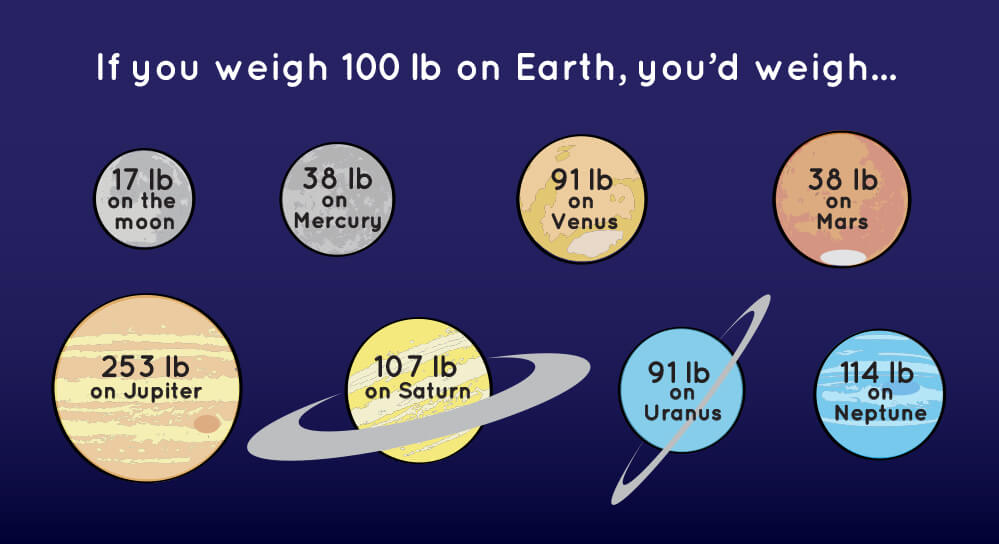
Let's do a little more research, read the following pages on the two websites linked below.
Click the link here
Click the link here
Evaluation
Complete the questions at this link about gravitational force.
Credits
Gravity Facts for Kids. Cool Kid Facts. (2021, December 25). Retrieved April 3, 2022, from https://www.coolkidfacts.com/gravity/#:~:text=Gravity%20is%20a%20force%….
Studios, A. R. (n.d.). Forces of Attraction. Physics4Kids.com: Motion: Gravity. Retrieved April 3, 2022, from http://www.physics4kids.com/files/motion_gravity.html
Crash Course Kids. (2015, March 24). Defining gravity: Crash course kids #4.1 - YouTube. Retrieved April 3, 2022, from https://www.youtube.com/watch?v=ljRlB6TuMOU
NASA. (2020, December 17). What is gravity? NASA. Retrieved April 3, 2022, from https://spaceplace.nasa.gov/what-is-gravity/en/
Teacher Page
Standard: 5-PS2-1 Support an argument that the gravitational force exerted by the Earth is directed down.
DCI: The gravitational force of Earth acting on an object near Earth’s surface pulls that object toward the planet’s center. (UE.PS2B.c)
Objective: Today the learner will be able to research different resources to gain a deeper understanding of the direction of gravitational force with 80% accuracy on the evaluation.