
Introduction
This Webquest is based on the theory of Culturally Responsive Teaching.
Group Members: Catherine, Danielle, Leslie, Catherine
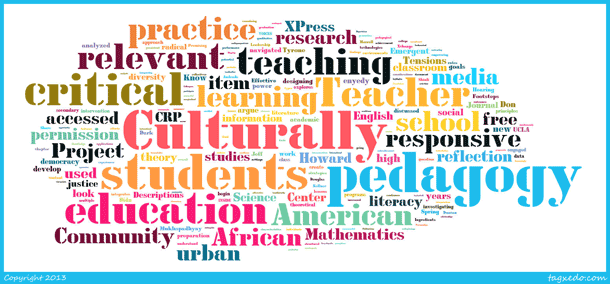
Culturally Responsive Teaching theory supports the idea of your teacher spreading cultural awareness, equalities, and practices within your classroom. Your teacher will relate what you are learning to your cultural background, and use a wide variety of instructional strategies that are connected to your learning style. Through this teaching method you will learn to recognize and praise your own cultural heritage aswell as the cultural heritage of your fellow classmates. This theory allows you to be a better human being and become a more successful learner.
The purpose of this webquest is for you to learn through a Culturally Responsive approach about the issues of gender equality. Gender is a part of our lives, and it determines many areas of an individual's culture. Around the world, being a female or male detemines your lifestyle, your personality and often times, unfortunately, how you make a living. Who we are reflects from our culture!
For more information about culturally responsive teaching, please visit:
http://www.intime.uni.edu/multiculture/curriculum/culture/teaching.htm

Questions to Discover:
- Why is it important to promote gender equality and women’s empowerment?
- How has history influenced gender issues in the United States and other parts of the world?
- What do you think are the major challenges in closing the gender gap?
Lessson Introduction:
Examples of Gender Inequality Around the World
Think about the different countries around the world today, men and women who aren't treated equally. Consider the reasons why gender equality is still an issue, an the possible solutions to resolve this cultural problem. Think of what people are trying to do to solve this issue and how you would achieve gender equality.
Design an awareness of Gender Inequality advertisement, which informs people about the gender issue as well as suggesting solutions to help of fix these inequalities.
Task
Task : "Extra! Extra! Read all about Gender Equality"
Congrats! You have just been awarded a new job as the President of the Equal Rights Oganization!
The branch you control is the Gender Equality Branch!
As your first job, you must bring awareness to the public about the reality of gender inequalities. To do so, you'll have to look for information on these inequalities, and then find meaningful ways to let people know about them.
How do your favorite advertisements look? Are they TV commericals, newletters, computer advertisements, or powerpoints? You are going to generate an advertisement for this very important issue.
First, you will do some research.
You are going to use this Webquest to find information on gender equality. There are worldwide examples of gender inequality. You will find different links and activites to help you along the process to understand this issue. Be sure to use this definition organizer to assist you throughout your research.
Second, you will organize the research.
Think about the information you want to use in your advertisement. Based on your research, make sure to define and explain gender inequality and provide information that informs the reader about the gender issue as well as suggesting solutions to help of fix these inequalities. Also, start thinking of the format of your advertisement you will be creating!
Lastly, create your advertisement!.
Use your high position as President of The Equal Rights Organization to present your adverstisement as an informational brochure! Keep your advertisement engaging as well as informing.
Process
Research Step 1: Breaking the Gender Barrier
Sometimes a group of kids do not think another kid can do something because of their gender. Boys and girls can have any job they want to, or do any activities that they want. It does not matter what their gender is. Girls were not allowed to do a lot of things in the past, it is now illegal to stop girls from doing things that boys do.
You will be reading this article that covers topics about gender equality and how important it is that we are not biased against someone's gender. Bias means that we set standards of how we feel about a group of people based on stereotypes (usually negative ones) from that group.
Before reading the article please print out this graphic organizer to take notes while you are reading.
Now click the link to read the article:
http://blogfinger.net/tag/breaking-the-gender-barrier-in-little-league-baseball/
Now that you have read this article, write a summary of your outlook on this issue. Discuss how if the Title X and the Education Amendments passed, why were women still being excluded from participation. Support your responses with the information you gathered using your graphic organizer.
Research Step 2: Music
Follow the link provided and listen to the two songs, Do you believe music can express sexism and gender equality? Explain what you think the message of this song is about.
[video:https://www.youtube.com/watch?v=Z1AzMiCXojo width:500 height:500]
[video:https://www.youtube.com/watch?v=Zu4xpDuf84A width:500 height:500]
Social justice refers to the idea of a society based on the principles of equality and solidarity, that understands and values human rights, and recognizes the dignity of every human being. Social justice also embodies a vision in which all members of a society are physically and psychologically safe. This vision is desired for all members regardless of ethnicity, culture, social and economic class, and sexual orientation.
Great! Now that you have watched the videos, answer the following questions:
- How can music provide resolutions to the inequities of social justice?
- What message is being conveyed with these lyrics?
- Explain and identify issues that may arise within these songs.
- How do these songs relate to the issue of gender equality?
- In what way does culture tie into gender equality? (Remember, music is an element of culture)
Research Step 3:
Take a few minutes to look at each of the photographs presented below.
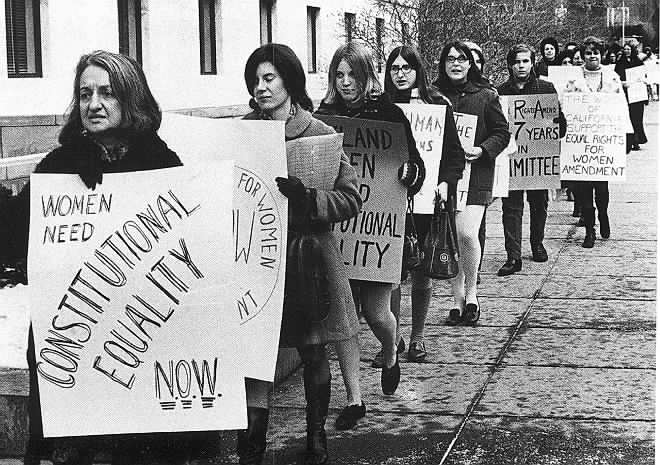
Constitutional Equality

The time is NOW

Making a stand

Equality around the world

Marching for equality
Now read this research study based on women poverty due to gender inequalities.
http://www.worldwewant2015.org/file/284178/download/308069
After observing each of the photographs and reading the research study, write a summary explaining your interpretations of the photographs and your outlook on the research study. Explain how both of these sources can form a resolution to this issue and discuss your beliefs about bringing awareness to this issue.
Research Step 4:
Click on the link and complete this lesson on gender and the media. In this lesson, you will learn more about how TV and movies affect how cultures view gender.
After finishing the lesson go to the following links to explore gender stereotypes further:
http://www.seejane.org/resources/guesswho.php
http://associationdatabase.com/aws/NCDA/pt/sd/news_article/55563/_PARENT/layout_details/true
Research Step 5: Written Response
Using your notes from the article your read, the answers to your questions following the music videos, and your experience with the online resources, write a summary of what gender equality means to you and how it is important in your classroom. Give examples of instances where genders are not treated equally and solutions so that there is equality. Make sure to include an introduction paragraph, supporting details, and a conluding paragraph.
Organize your research:
Now it is time to think about the research you have gathered and decide which key points you wish to include into your brochure. Remember to define and explain gender inequality and provide information that informs the reader about the gender issue as well as suggesting solutions to help of fix these inequalities.
Click here to use the T-Chart graphic organizer to gather information you have researched to help create your Awareness of Gender Inequality brochure.
Create your brochure:
It is time to use your high position as President of The Equal Rights Organization to present your adverstisement as an informational brochure! Remember to keep your advertisement engaging as well as informing.
Click here to use the Awareness of Gender Inequality template to complete you brochure.
Evaluation
Step 1 - Breaking the Gender Barrier Summary (Individual)
|
CATEGORY |
1 |
2 |
3 |
Score |
|
Comprehension |
Marginal awareness of topic and issue |
Adequate awareness of topic and issue |
Clear awareness of topic and issue |
|
|
Critical thinking |
Marginal ability to analyze and interpret |
Adequate ability to analyze and interpret topic/issue |
Clear ability to analyze and interpret topic/issue |
|
|
Discussion |
States opinion with few examples and minimal support |
States opinion with adequate examples and support |
States opinion with substantial examples and support |
|
Step 2 - Music (Individual)
|
CATEGORY |
1 |
2 |
3 |
Score |
|
Composition (intro, body, conclusion) |
Unclear topic sentences, supporting details, conclusion, and transitional words |
Adequate topic sentences, supporting details, conclusion, and transitional words |
Clear and concise topic sentences, supporting details, conclusion, and transitional words |
|
|
Mechanics (speech, paragraphs, subject-verb agreement, capitalization) |
Ineffective use of proper speech, paragraphs, subject-verb agreement, capitalization |
Adequate use of proper speech, paragraphs, subject-verb agreement, capitalization |
Comprehends the proper use of speech, paragraphs, subject-verb agreement, capitalization |
|
|
Comprehension
|
Marginal awareness of topic and issue |
Significant awareness of topic and issue |
Extensive awareness of topic and issue |
|
|
Critical Thinking |
Marginal ability to analyze and interpret |
Significant ability to analyze and interpret topic/issue |
Extensive ability to analyze and interpret topic/issue |
Step 3 - Photos (Individual)
|
CATEGORY |
1 |
2 |
3 |
Score |
|
Comprehension |
Marginal awareness of topic and issue |
Adequate awareness of topic and issue |
Clear awareness of topic and issue |
|
|
Critical thinking |
Limited range of ideas expressed |
Adequate range of ideas expressed |
Significant range of ideas expressed |
|
|
Discussion |
Stated opinions with few examples and minimal support |
Stated opinions with adequate examples and support |
Stated opinions with significant examples and support |
|
|
Group |
Limited respect for opinions, open communication, allowed others to speak |
Acceptable respect for opinions, open communication, allowed other to speak |
Significant respect for opinions, open communication, allowed other to speak |
|
Steps 4/5 - Questions and Written Response (Individual)
|
CATEGORY |
1 |
2 |
3 |
Score |
|
Comprehension |
Marginal awareness of topic and issue |
Adequate awareness of topic and issue |
Clear awareness of topic and issue |
|
|
Critical thinking |
Marginal ability to analyze and interpret |
Adequate ability to analyze and interpret topic/issue |
Clear ability to analyze and interpret topic/issue |
|
|
Discussion |
States opinion with few examples and minimal support |
States opinion with adequate examples and support |
States opinion with substantial examples and support |
|
Webquest Task: Awareness of Gender Inequality Brochure
|
Conclusion
Conclusion:
Learning about gender equality is essential in developing awareness of the world around us. Gender equality is a universal matter; it affects men and women all over the world. Equality is a necessary step to improve our global environment and allows both men and women to equally contribute to and profit from economic, social, cultural and political areas of society. Having acceptance and responsiveness to these issues that deal with culture is the missing link to raising awareness. It is the first step to working towards ”global” gender equality.
- Why is it important to promote gender equality and women’s empowerment?
- How has history influenced gender issues in the United States and other parts of the world?
- What do you think are the major challenges in closing the gender gap?
- How can you help to promote gender equality as a student?
- Think of how culture plays a role in gender equality. The same way cultures ranges around the world, so do gender inequalities. Give examples of 2 different country's gender inequalities you researched.
Credits
10 Examples of Gender Inequality Around the World : Discovery Channel. (n.d.). Retrieved from http://http://www.discovery.com/tv-shows/curiosity/topics/examples-gend…
Retrieved from http://www.genderequality.ie/en/GE/qsearch
ADDRESSING INEQUALITIES. (n.d.). Retrieved from http://www.worldwewant2015.org/file/284178/download/308069
Breaking the gender barrier in Little League baseball | Blogfinger. (n.d.). Retrieved from http://blogfinger.net/tag/breaking-the-gender-barrier-in-little-league-…
Culturally Responsive Teaching. (n.d.). Retrieved from http://www.intime.uni.edu/multiculture/curriculum/culture/teaching.htm
Dictionary.com - Free Online English Dictionary. (n.d.). Retrieved from http://dictionary.reference.com/
Do TV Shows and Movies Influence Careers Held by Women and Men? (n.d.). Retrieved from http://www.seejane.org/downloads/usatoday/GDlesson1SE.pdf
Geena Davis Institute on Gender in Media: Guess Who? Video Learning Series. (n.d.). Retrieved from http://www.seejane.org/education/guess-who-video-learning-series.php
Geena Davis Institute on Gender in Media: Guess Who? (n.d.). Retrieved from http://www.seejane.org/resources/guesswho.php
Gender Equality. (n.d.). Retrieved from http://www.unicef.org/gender/training/content/scoIndex.html
The National Career Development Association | Champions of Change: Girls and Women in STEM. (n.d.). Retrieved from http://associationdatabase.com/aws/NCDA/pt/sd/news_article/55563/_PAREN…
Title IX, Education Amendments of 1972. (n.d.). Retrieved from http://www.dol.gov/oasam/regs/statutes/titleix.htm
Vocabulary.com - Learn Words - English Dictionary. (n.d.). Retrieved from http://www.vocabulary.com/
WebQuest: GLOBAL EDUCATION - Gender Equality: created with Zunal WebQuest Maker. (n.d.). Retrieved from http://zunal.com/webquest.php?w=113291