
Introduction
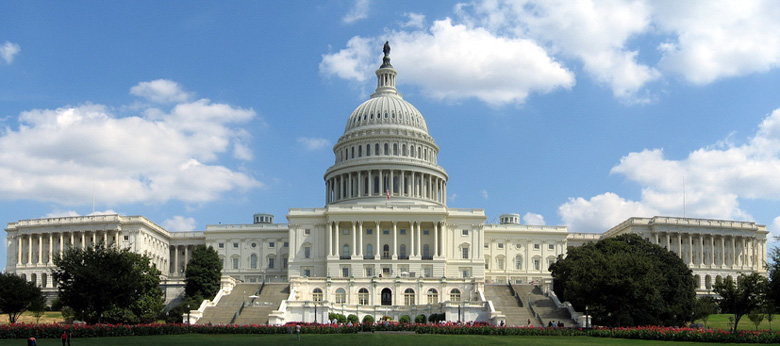
Are you passionate about an issue? Maybe you want to see animals treated with more kindness. Maybe you believe students in public schools could benefit from a longer recess. Maybe you would like more parks and museums to be built in your city. How can you let the government know how strongly you feel? You can write to your Congressman!
As a citizen of the United States, it is your Congressman's responsibility to represent you in government. Your Congressman is working for you, and if he or she doesn't do their job and make you happy, they might get voted out in the next election. The First Amendment of the Constitution says that as a citizen, you have the right to communicate with your elected representatives. Writing a letter to Congress is one of the most effective ways to influence what becomes a law in our country. Your letter could make a big difference!
Task

Project Objectives:
- To research and improve understanding of a topic through use of technology.
- To formulate and organize sound arguments based on evidence collected through research.
- To compose a formal letter following proper mechanics.
- To evaluate one's personal role as a citizen and one's responsibility of civic duty.
In this project, you will:
- Choose an issue that is personally meaningful to you.
- Research your chosen topic.
- Compose a formal letter to your Congressman explaining how you would like the United States Government to address your topic.
- Mail a copy of your letter to your Congressman.
- Complete a self-evaluation.
- Publish your project.
- Present your project to the class.
Process
What issue will you write about? Think about something you feel passionately about and would like to see changed or made into a new law. Once you have selected your topic, you will research evidence that supports your opinion.
When writing about issues that affect our country and the lives of all citizens, it is also important to consider opinions that differ from your own. You will also research evidence that conflicts with your opinion. Consider what conflicts might arise should your ideas become law. Not everyone will agree with your perspective, so it is important to consider how your viewpoint could impact everyone if your ideas become the law.
You may choose from the issues listed on the Process Tab (below) or develop your own topic (requires teacher approval). Once you have selected an issue that you feel strongly about, use the research links on the Process Tab to research and support your cause.
Search Engines:

Conservation
For thousands of years, our planet's given us energy. Lots of energy! But in the process, we've put our planet under stress. Now it needs our help. If we want to keep our planet healthy, we must find better ways of getting and using energy. (Source: energystar.gov).
- How You Can Save Energy
- EnergyStar
- EnergyQuest: Saving Energy
- Energy Kids (provides explanations of alternative fuel sources)
- EcoKids: Take Action (provides several articles and activities about different ways to conserve resources)
- National Geographic: Green Tips
- Alliant Energy Kids: Energy and the Environment
- The Environmentalist Case Against 100% Renewable Energy Plans
- The Arguments For and Against Wind Power
- Arguments Against Solar Energy

Education
Should students have longer recess, or more than one recess per day? Which is better for kids: school with a summer break, or school that operates year-round? Should students wear school uniforms, or should they be able to choose their own clothes? There are many issues surrounding public education. Choose from one of the three below, or develop your own topic!
Longer/More Frequent Recess
- Why Kids Need Recess
- Recess Makes Kids Smarter
- Recess Without Rules
- Recess Before Lunch (lists both benefits and drawbacks)
- No Time For Recess, No Need for Nap
Year-Round School
- Do Kids Really Need Recess?
- The Pros and Cons of Year-Round Schools
- Research Spotlight on Year-Round Education
- Districts Weigh Pros and Cons of Year-Round School
School Uniforms
- Should Students Have to Wear School Uniforms?
- 9 Serious Pros and Cons of Wearing School Uniforms
- Do Uniforms Make Schools Better?
- The Arguments Against School Uniforms
- Seven Critical Pros and Cons of School Uniforms
Animal Rights and Welfare
Should animals be used for testing in science and commercial activities? Should animals have rights similar to the rights of people?
- Animal Testing (lists both pros and cons)
- List of 8 Key Pros and Cons of Animal Rights
- Pros and Cons of Animal Rights
- Five Major Pros and Cons of Animal Rights
- Eco-Friendly Kids: Animal Rights
- Friends of Animals: Just for Kids
Parks and Recreation
- How Cities Use Parks to Improve Public Health
- How Cities Use Parks to Help Children Learn
- The Trust for Public Land: Economic & Health Benefits
- Learn Why Parks are Important
- Role of Parks and Recreation in Conservation
- Top 10 Issues Facing National Parks
- Big Green: On the Pros and Cons of the New City Megaparks
- A Drawback to Urban Green Spaces
Employment
- The Pros and Cons of Teen Jobs
- Should a Teenager Work - Pros and Cons of Taking a Job
- Making Money: Why Should You Work?
- The Pros and Cons of Raising the Minimum Wage
- Top Ten Arguments for Raising the Minumum Wage
- Should We Raise the Minimum Wage? 11 Questions and Answers
- Minimum Wage Debate: Meet People Living On It
- Raising Minimum Wage Would Cost a Million People Their Jobs
Evaluation
As part of your evaluation, you will complete a self-evaluation on what you learned about civic responsbility through this project.
First, view this video on global citizenship and civic responsibilities.
[video:https://youtu.be/hwENGCF7eR0 width:560 height:315 align:center]
Next, use the following links to help you complete your self-evaluation worksheet.
- The Importance of Civic Participation (click on the image to open the activity module)
- What is Global Citizenship?
- Learning to Give: Civic Responsibility
- Congress for Kids: Citizenship (click on the links on the left menu to read about the attitudes, actions, and responsbilities of citizens)
Your project and presentation will also be evaluated by your teacher according to the following rubric.
|
|
4 Exceeds Expectations |
3 Meets Expectations |
2 Approaches Expectations |
1 Area of Concern |
|
Goal/Thesis |
The goal or thesis provides a clear, strong statement of the author's position on the topic. |
The goal or thesis provides a clear statement of the author's position on the topic. |
A goal or thesis is present, but the author's position is unclear. |
There is no goal or thesis. |
|
Reasons and Supporting Evidence |
Includes 3 or more reasons (facts, statistics, examples, life experiences or personal anecdotes) that support the thesis statement. The writer anticipates the reader's concerns, biases, or arguments and provides at least 1 counter-argument and rebuttal. |
Includes 3 or more reasons (facts, statistics, examples, life experiences or personal anecdotes) that support the thesis statement. |
Includes 2 reasons (facts, statistics, examples, life experiences or personal anecdotes) that support the thesis statement. |
Includes 1 or no reasons ((facts, statistics, examples, life experiences or personal anecdotes). |
|
Facts and Examples |
All of the facts and examples are specific and relevant to the thesis and the author's position. |
Most of the facts and examples are specific and relevant to the thesis and the author's position. |
At least one of the facts and examples is relevant to the thesis and the author's position. |
Facts and examples are not relevant to the thesis or the author's position. |
|
Grammar and Mechanics |
Follows conventions of language and contains no errors in punctuation, spelling, or grammar. |
Contains 1-3 errors in punctuation, spelling, or grammar that do not interfere with meaning. |
Contains more than 3 errors in punctuation, spelling, or grammar that may interfere with meaning. |
Contains several errors that interfere with meaning. |
|
Letter Format |
Complies with all the requirements for a business letter. |
Complies with most of the requirements for a business letter. |
Complies with some of the requirements for a business letter. |
Does not follow the requirements for a business letter. |
|
Components |
The final project contains all the required components completed as instructed and with high quality: an illustrated booklet containing the research worksheet, a copy of the letter, and the self-evaluation |
The final project contains all the required components completed as instructed and with sufficient quality: an illustrated booklet containing the research worksheet, a copy of the letter, and the self-evaluation |
The final project may be missing one component, and may be lacking in quality. |
The final project is missing more than one component and quality is insufficient. |
|
Presentation |
The presentation shows all components of the project. The presenter speaks clearly, with an appropriate rate and volume, and demonstrates enthusiasm throughout the presentation. |
The presentation shows all components of the project. The presenter speaks clearly, with a satisfactory rate and volume, and shows some enthusiasm about the topic. |
The presentation omits one component of the project. The presenter speaks at an uneven volume with minimal enthusiasm about the topic. |
The presentation is unclear and omits multiple components. the presenter shows no interest in the topic, speaks at a low volume, and is difficult to understand. |
Conclusion
It's time for you to select a Congressman and mail your letter! Follow the link below to choose a Senator or Representative.
Contacting the Congress: Oklahoma
You've finished your project and written to your Congressman. Now check out some of these other activities, games, and online resources to continue your exploration of the branches of government and your civic responsibility.