
Introduction
In the recent terror attack at the office of the French satire magazine Charlie Hebdo, many of the early photos and videos emerged on Twitter and Instagram, posted by people nearby in pubs, offices and cafés.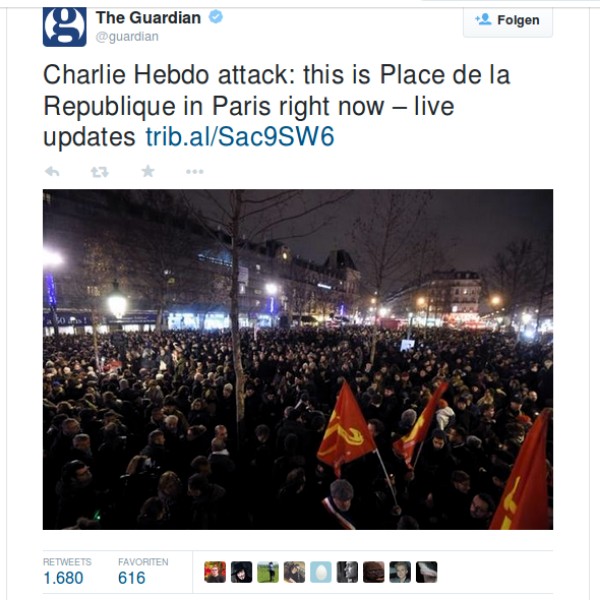
At this SubQuest you will train your listening comprehension and critically discuss the effect of eyewitness accounts in the news.

Task
Eyewittness in the wake of Charlie Hebdo
Eyewitness media has become a crucial part of how journalists report breaking news, allowing us unprecedented access to first-hand reports as events unfold.
<Task?>
Process
Eyewitness media and ethics
in the wake of Charlie Hebdo
Eyewitness media has become a crucial part of how journalists report breaking news, allowing us unprecedented access to first-hand reports as events unfold.
In the recent terror attack at the office of the French satire magazine Charlie Hebdo, many of the early photos and videos emerged on Twitter and Instagram, posted by people nearby in pubs, offices and cafés.
In this week’s podcast, Abigail Edge discusses about the ethical questions around sourcing, crediting and graphic imagery, with:
Jenni Sargent, director, Eyewitness Media Hub
Mark Frankel, assistant editor of social news, BBC
Malachy Browne, managing editor and europe anchor, Reported.ly
Listen to:
https://soundcloud.com/journalismnews/eyewitness-media-and-ethics-in-the-wake-of-charlie-hebdo
In this week’s podcast, Abigail Edge discusses about the ethical questions around sourcing, crediting and graphic imagery, with:
Jenni Sargent, director, Eyewitness Media Hub
Mark Frankel, assistant editor of social news, BBC
Malachy Browne, managing editor and europe anchor, Reported.ly
listen to:
https://soundcloud.com/journalismnews/eyewitness-media-and-ethics-in-the-wake-of-charlie-hebdo
<<Guiding Questions?>>
Evaluation
| Elements of the task | Perfect accomplishment | Average accomplishment | Basic accomplishment |
| You can ... | You can ... | You can.. | |
|
|
|
|
|
<<Finden Sie geeignete Evaluationskriterien, nach denen die fertige Arbeit der SuS ausgewertet und
bewertet werden können. (Nutzen Sie dafür die sogenannten „Rubrics“ des WebQuest und orientieren
Sie sich an den Standards des Europ. Referenzrahmens.>>
Kriterien zur Erstellung von Rubrics
- Ability to listen
- Ability to present arguments convincingly
- Ability to concentrate on substantial issues
Grammar and spelling
Organization
Formatting
Conclusion
After having worked on this topic you will be able to give a statement on the ethics of shooting pictures of riots, scene of crime or of accidents ....
You might be able to sound a bit more authentic after having listened to the podcast a couple of times and this will make you feel more at ease when contributing to the ficticious editorial meeting, which is the main task of the WebQuest Defending Democratic Rights: Freedom of Speech in the aftermath of attacks on Charlie Hebdo
Credits
Credits & Reference
(still work in progress Mar 21, 2015)
This WebQuest is part of a larger project and has been designed by Chr. Günther, M. Friderritzi, M. Bär
This research project has been created by In-Service-Teacher-Trainees of the course Fachseminar Englisch /Mai 14-15Lecturer: M.Teichmann / Zentrum für schulpraktische Lehrerausbildung Solingen Gy/Ge.
Feedback,encouragement and criticism send to Teichmannmonika@arcor.de
Sources of material:
Introduction pic: twitter.com/guardian/status/552881951141806083
Teacher Page
Erwartungshorizont – Entwurf – Stud 7 WS 6 – Eyewitness media and ethics in the wake of Charlie Hebdo –
Class Test
AFB1 - Hörverstehen
1) What is meant with the ethical question around crediting in this podcast?
geschlossene Hörverstehensaufgabe
EWH: Malachy Browne: Content needs to be verified before it gets published (online). How can this be
managed?
- Check the original source
- Check the original location (geolocated content – Instagram)
- Check the new history of the person uploading the content (twitter lists, recent instagram posts)
- Difficulties: sources who start to be defending suspects online
AFB 2 – (Textgrundlage, zB Transkription Abschnitt über graphic images)
Explain what is meant with the ethical question around graphic imagery in this podcast?
EWH: graphic images reveal cruel violence which does not need to be shown explicitly in order to protect the
audience [versus] the cruel truth has to be depicted by all means because it is fact
AFB 3
Discuss the Frankel’s decision “We took a fairly swift position on this that we were not going to use it unedited
or unfiltered because it showed a moment of contiguous violence were a police officer had been shot in the
head”
Pro:EWH:
Pro
Con
Pro
| Con
- |
<<Die Diskussionsfrage könnte auch inden PROCESSaufgenommen werden>>
-
-