
Introduction
` Task 4.
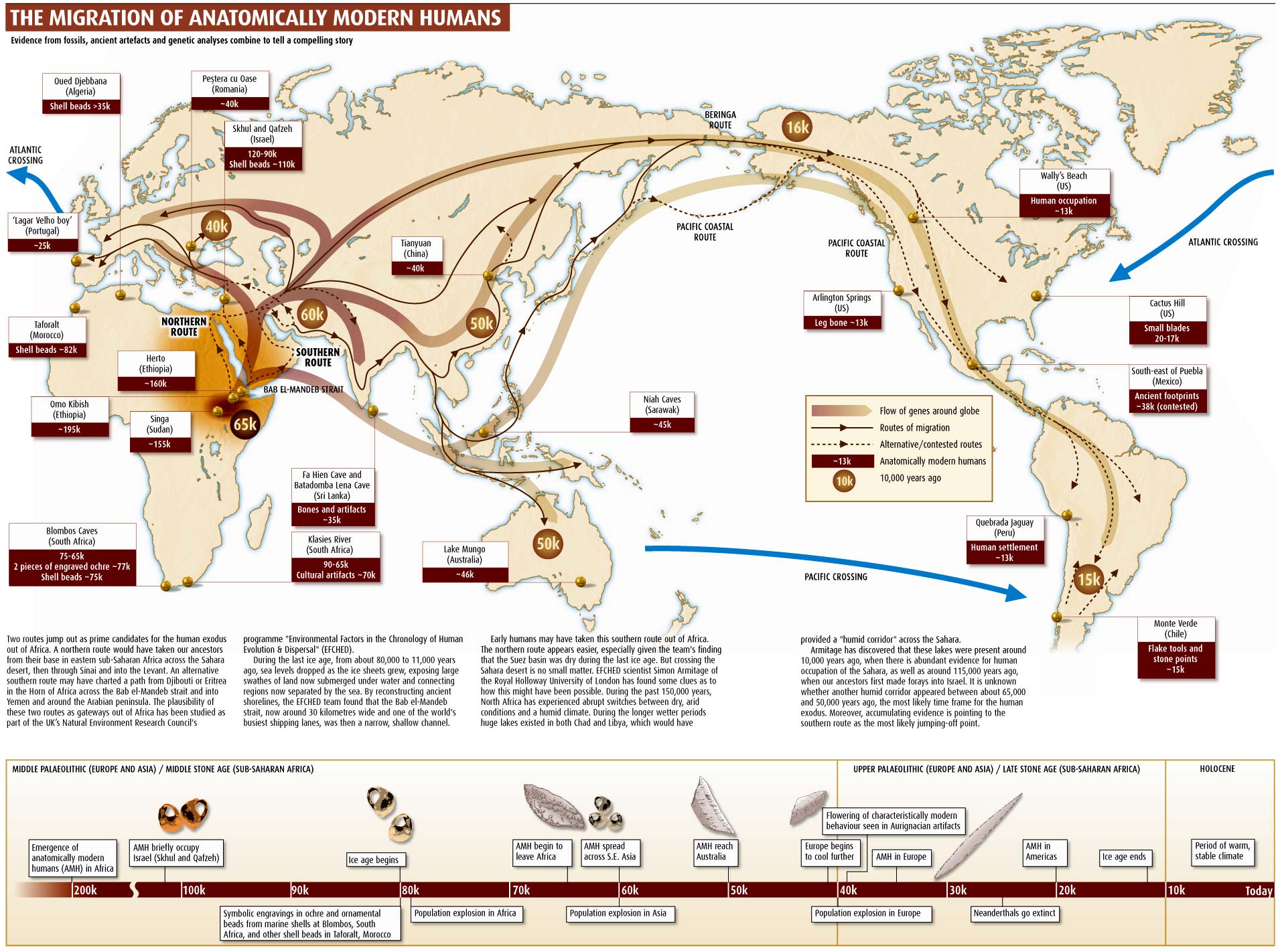
Out of Africa: Over time, place, and space, changes have lead to significant innovations.
Debatable Question
On Tuesday, we compared pieces of significant evidence within our groups. Through this sharing or inquiry about the Out of Africa Theory, our collective knowledge is growing. Each with our own perspectives, opinions,and interests, we are able to debate what we believe to be the most compelling and significant piece of evidence examined so far.
Today, we are going to be exploring Scientific Dating Methods.
It is important to date evidence found to understand how early humans changed over time and how these changes occurred over space. Archeologists and paleoanthropologists use dating techniques to determine how old evidence to understand how significant innovations occurred.
The different techniques we will be exploring have been developed with varying levels of accuracy, advantages or disadvantages, and you will use this WebQuest to inquiry and continue developing your notes.
When archaeologists and historians find objects from the past, they often need help from scientists who use the latest techniques and machinery to gather more information. Many of these techniques – known as scientific techniques – are used to assess the likely age of sources. They can tell us, for example, the ages of the skulls. Scientific techniques like the ones described below need to be used in combination with other historical techniques and evidence to provide a complete explanation of the past.
Task
Many scientific dating techniques are used to investigate the past. Some are absolute dating techniques, which allow the age of an object to be stated as precisely as possible (in years). Others are relative dating techniques, which can only determine whether an object is of an earlier or more recent date relative to (compared with) another object.
Dating looks at the process of estimating the age of ancient materials and deposits remains or determining a chronology in the Ancient Past.
Your task is to inquire throughout the WebQuest, investigating and evaluating different Scientific Dating Methods for the evidence we have been discussing in class.
Throughout you are able to reflect and evaluate websites for their usefulness, reliability and perspectives.
To assist in your inquiry, use the PMI chart to structure your note taking to evaluate the strengths, weaknesses, and interesting points to each dating techniques.
Process
Dating methods can be classified as absolute or relative.
Absolute dating methods rely on using some physical property of an object or sample to calculate its age.
Relative dating methods tend to use associations from other archaeological evidence.
Use the following websites to inquire different techniques and takes notes of their Strengths, Weaknesses and Intersting points.
Be sure to take comprehensive notes, building on your knowledge base.
You may wish to include diagrams, illustrations or images to support your notes.
Web sites to inquire
1. https://answersingenesis.org/kids/geology/answers-for-kids-dating-metho…
2. http://campusarch.msu.edu/?p=334
3. http://archaeology.about.com/od/dterms/g/dendrochro.htm
4. http://www.gns.cri.nz/Home/Learning/Science-Topics/Ice-Snow/About-Ice-C…
5. https://www.youtube.com/watch?v=phZeE7Att_s
6. http://mocomi.com/carbon-dating/
7.. http://archaeology.about.com/od/lterms/g/luminescence.htm
8. http://www.nature.com/scitable/knowledge/library/dating-rocks-and-fossi…;
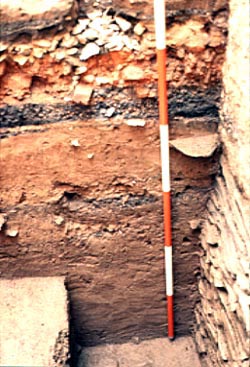
Stratigraphy involves analysing sources found in
the different strata of earth. Strata are layers marking different geological time periods. Since the layers of rocks are generally youngest on top and oldest on the bottom, items found in the lowest strata will usually
be the oldest. In an archaeological dig, scientists may know that a particular stratum (the singular form of strata) is 1000 years old. This means that the items excavated from that stratum will probably be of a similar age.
Natural disasters and geological events can change the way strata are arranged, so it is not an exact science. Stratigraphy is a relative dating technique.
Fluorine dating
Bones can be dated using fluorine dating. Bones absorb the chemical element fluorine from the soil in which they are immersed. The longer they are there, the more fluorine they absorb. Like stratigraphy, this is a relative dating technique.
Dendrochronology
Dendrochronology refers to tree-ring dating. Scientists can date a tree by studying the growth rings in a cross- section of its trunk. Each year in a tree’s life, a new ring forms. It varies in shape and width according to the conditions that year. It has two parts:
a light part (spring growth) and a dark part (summer/ autumn growth). Scientists can study these rings and can compare rings between trees to determine their age.
Sometimes experts can calculate the relative age of wooden artefacts, such as bowls or
floorboards. This is possible if they can match the ring patterns in the wood with those of local trees of the same species
Radiocarbon dating
Radiocarbon dating is a complex technology that is more accurate than stratigraphy and fluorine dating.
It is an absolute dating technique. All living things contain a particular type of carbon called C14, which is why we are called carbon-based life forms. This carbon is continuously renewed while an organism is alive. Living things stop absorbing C14 when they die. C14
is radioactive, which means that, over time, it breaks down at a known rate into a different type of carbon. Scientists use special equipment to work out how much C14 is still present in once-living organisms. Usingthat information, they can work out how long ago the organism died, and therefore how old it is.
DNA analysis
All living organisms (except some viruses) contain deoxyribonucleic acid, or DNA. DNA holds the genetic code that determines how a living thing develops and operates. It is comparable to the ones and zeros that make up computer code and tell your software what to do. DNA is sometimes preserved in the remains of once- living organisms. Scientists can learn a lot from studying DNA. They can tell what type of organism it is. They can also tell how closely related it is to other species and to other individuals of the same species. For example, they can study the DNA of ancient remains and determine how closely related they are to modern humans.
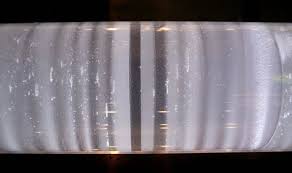
Ice-core sampling
This technique works in a similar way to stratigraphy. Ice-core samples are long cylinders of ice that have been drilled from thick ice sheets. These samples are most commonly taken in the polar ice caps of Antarctica and Greenland, or from high mountain glaciers all over the world. As ice forms in the gradually increasing build-up of annual layers of snow, lower layers are older than upper layers. This means that an ice core contains ice formed over many years. Air trapped at various sections along an ice core, such as the one shown in Source 5.24, provides evidence of what the atmosphere was like at different periods in the past. Scientists can then form conclusions about the climate at a particular time
Palynology
Palynology is the study of microscopic organic compounds (such as pollen) that are found in soil. Taking soil cores enables scientists to analyse fossilised pollen and find out how plant life in a particular area has changed over thousands of years
Evaluation
Adding to your notes, either at the back of your PMI chart or in your notebook, reflect on the following questions
1. Reflect and summarise why it is significant to date evidence relating to Ancient History and the Out of Africa Theory
2. In your opinion, which method do you believe is most accurate for dating evidence?
3. Which method do you think is open for most interpretation or different perspectives?
4. With your knowledge changing modern technology, evaluate how scientific techniques will improve with innovation.
5. Reflect and explain which website do you believe to be most useful in your inquiry.
Credits
Oxford Big Ideas Geography, History.
Investigating the Ancient Past
page 234