Introduction

You are a senior level scientist for a secret government agency. You work to ensure Australia stays safe from invaders of all kinds. This will not be an easy mission, but you are some of our best.
This is your briefing information:
Ever since people have come to Australia all sorts of species have been introduced. Even as far back as the original migration of Aboriginal people to Australia, them bringing dingos as far as we know. In more recent history there have been species of plants, animals, insects, diseases and many other forms of introduced species that have caused great imbalances to the natural environment. As scientists it is our duty to find solutions to the problems that we, as a people, have created. This about modern introduced species, mainly those that we cannot seem to get control of. Our mission is about protecting Australia's fragile ecosystem, and understanding these threats.

Task
Your Mission:
Find out as much as you can about these species; their strengths, their weaknesses, and find possible solutions to these problems. You are to evaluate current methods, and our past failures. It is then up to you to decide what works on your two chosen species. Remember that this is about protecting Australian native species, so try not to decide that the only solution is to blow it up...
Again.
This will take more than one of these allotted time slots, you will be working on your PowerPoint presentations for some time.
We have outlined the process which all agents must abide by.
Good luck agents, may you find a viable solution and help protect Australia.
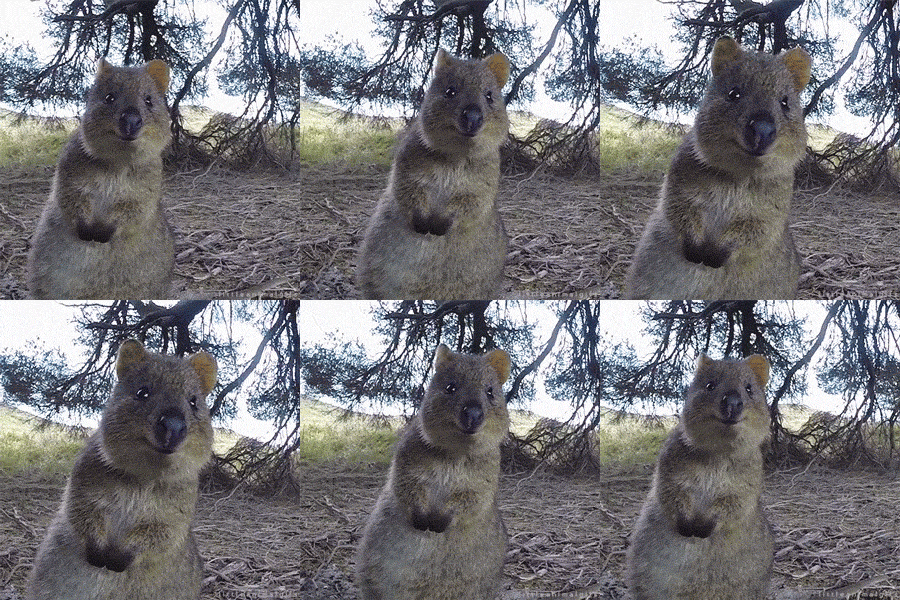
You must protect it!
Process
To complete your mission, you will need to:
1. Go to https://en.wikipedia.org/wiki/List_of_introduced_species there you will find lists of introduced species, although this is a wiki source it is a good place to start for making your list.
2. Create a PowerPoint presentation so as to inform your peers. All of the information you collect will be required to be on the slides.
3. Create a list of introduced plants and animals, including reptiles and marine animals.
4. For each species name its place of origin and the area of Australia that it inhabits, it would be wise to include maps of spread where possible.
5. Outline how these species alter the abiotic and the biotic environments. A good place to start for this is https://www.youtube.com/watch?v=Qf2DmWACjwY and this can provide assistance for later steps.
6. Identify how environmental conditions play a part in the spread of introduces species.
7. Discuss why different groups of people would have introduced these species and why different groups would consider them pests. https://www.youtube.com/watch?v=PMG9CzArGBE is a good place to start, as well as https://www.youtube.com/watch?v=spTWwqVP_2s
8. Pick one species from plants and one from animals to look in-depth. The information required includes:
- Full scientific name
- Means of arrival to Australia
- Possible reasons why it is here
- Why it is a problem
- How it impacts on the biotic and abiotic environments
- How successful a species it has become
- Previous failed attempts of eradication and current attempts, and has it succeeded
9. Define biological control. Include definitions of predator-prey, bacterial/viral parasites, and the release of sterilised males, in regards to biological control. Make sure to include the criteria that is used to determine what makes something able to be used as a biological control. For methods of control you can use https://www.environment.gov.au/biodiversity/invasive-species it will take you to a page that has a series of links, for example feral animals. Click on one of these and they will give you widespread control methods for various types of introduced species. http://www.csiro.au/en/Research/BF/Areas/Managing-the-impacts-of-invasi… The CSIRO is always a good place to start for scientific research on biological control methods, and the future use of them.
10. Now look back at the species you choose to do in-depth and compare the information you have found with the previous attempts to control these pests.
11. Provide one example of a failed biological control and a successful biological control. Discuss why they have failed or succeeded. An example of a failed biological control: http://australianmuseum.net.au/introduced-species-the-alien-invaders
12. Discuss the future of these types of methods. Include some discussion on the costs, sustainability on the ecosystem, monitoring, and the management of the program.
13. Define quarantine in regards to protecting Australian native species.
14. Identify the introduction of new species through off-loading of ballast water as an example of accidental introduction. http://www.agriculture.gov.au/biosecurity/avm/vessels/biosecurity-conce… outlines the information that you would require.
Good Luck Agents! May you find the answer!
Evaluation
| What is Required |
| Create a PowerPoint presentation that will be beneficial to other people as a means to educate them on introduced species in Australia. |
| A list of both animal introduced species and plant introduced species in Australia, with each species having a place of origin and where in Australia it can be found. |
| Outline abiotic and biotic changes caused by introduced species. |
| Identify how environmental conditions play a part in the spread of these introduced species. i.e. what kinds of environmental factors have assisted in this spread? |
| Why do different groups of people introduce these species and why do different groups consider them pests. |
| Choose one species from animals and one from plants and provide the following information for each: full scientific name, how it arrived to Australia, possible reasons why it is here, why it is a problem in Australia, how it impacts on the biotic and abiotic environments, how successful it is, previous failed attempts of eradication and current attempts and are they successful. |
| Define biological control. Include definitions of predator-prey, bacterial/viral parasites, and the release of sterilised males, in regards to biological control. Include the criteria that determine what makes something able to be used as a biological control in Australia. Compare with information that you have already collected from in-depth study. |
| Identify a successful and a failed use of biological control, and discuss why they were either a success or a failure. Discuss the future of biological controls with regards to use in Australia. |
| Identify the accidental introduction of new species through off-loading of ballast water as an example. |
Conclusion
As scientists, and agents, it is our duty to protect our native species from outside threats. We will find solutions, discover new thing, and boldly go where no one has gone before. This message terminates here.