
Introduction
What is the water cycle? It is the continuous movement of water on Earth.
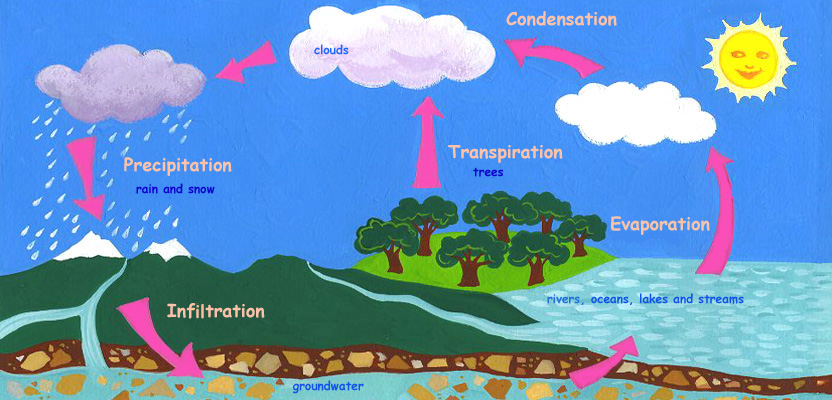
The water cycle is a vital part of our day to day life. We experience it every single day. There are three phases of the water cycle—evaporation, condensation, and precipitation. It is important to know about each phase of the water cycle and how they impact the world. The water cycle does not occur in any particular order, but one phase to study is evaporation. In evaporation, water changes from liquid to gas. Water evaporates because the energy from heat breaks the bonds that hold water molecules together. In this phase Latent Heat is absorbed. Transpiration is the form of evaporation that comes from plants, and evapotranspiration is the process of water vapor being released into the atmosphere because of transpiration. Evaporation is also useful in producing some consumer products. For example, seawater is put in evaporation ponds so that salt and other minerals will be obtained when the water evaporates. The evaporation process is constantly happening and is useful for all humans. Another phase of the water cycle is condensation, where gas becomes liquid. In this phase, Latent Heat is released. Because of condensation, clouds are formed when vapor in the atmosphere becomes liquid, and clouds are formed to hold the water. Fog is similar. It is water droplets suspended in the atmosphere near ground level; fog is essentially clouds closer to the ground. Contrails are man-made clouds. When a jet flies by and leaves water vapor in the cold atmosphere, that is a contrail. They can be used for weather forecasting. If they go away quickly, there will be good weather. That is how condensation is experienced every day. The last phase of the water cycle is precipitation, which is when water is released from the clouds in the form of rain, snow, sleet, or hail. The water in the clouds gets too heavy and drops back down to the Earth. Once water hits the ground, it soaks into the ground and becomes groundwater. Precipitation also feeds the oceans. The water falls into lakes and rivers and eventually flows into the oceans.
These are details about each phase of the water cycle. Evaporation, condensation, and precipitation happen every day. Without the water cycle, things that occur normally every day would not be able to function. The water cycle is extremely important to our world.
Task
You will have many tasks along your adventure on Water Cycle. As you go each step will be explained so that you don't have to come back to this page each time to check what you need to do next. BUT.. the MOST IMPORTANT task you will have throughout your journey is to record your progress. That means, you will need a pencil and paper to show the knowledge you are building and the progress you are making. Here we go.. make sure your pencil and paper are ready to record your progress and show off your great skills and high scores! Before you begin, click on the Evaluation link on the left to see how you can attain the highest score.
Process
Activity 1: Watch the video and then take the quiz. Record your score in your rubric guide or in the evaluation tab.
http://studyjams.scholastic.com/studyjams/jams/science/ecosystems/water…
Activity 2: Take the vocabulary Quiz. Record your score in your rubric guide or in the evaluation tab.
https://www.fcwa.org/story_of_water/html/vocabgame.htm
Activity3: Play watercycle game
http://player.discoveryeducation.com/views/hhView.cfm?guidAssetId=08777…
Activity 4: Write a reflection on what you have learned about the Water Cycle. Submit your work to me for grading.
Evaluation
| Activity | Fail | Pass | Proficient |
| Study Jams Quiz | |||
| Vocab Quiz | |||
| Water Cycle Game | |||
| Reflection | |||
Conclusion
Congratulations! You have done it!
Now, check your paper and click back to the evaluation to see if you have included all of the information you need in order to get the best grade possible!
If you have missed anything, or need more help don't hesitate to let me know. :)
Great job explorer!
Credits
Credits
Author Biography
Permissions
We all benefit by being generous with our work. Permission is granted for others to use and modify this WebQuest for educational, non-commercial purposes as long as the original authorship is credited. The modified WebQuest may be shared only under the same conditions. See the Creative Commons Attribution • Non-Commercial• Share-Alike license for details.
Teacher Page
3.9 The student will investigate and understand the water cycle and its relationship to life on Earth. Key concepts include:
a) the water cycle involves several processes;