
Introduction
This term we are focusing on training programs and their importance in improving individual performance. The sport that we will be focusing on is Triathlon. This WebQuest will aid in your understanding of training program design, in order to help and improve individual performance in physical activities. This WebQuest must be completed by all students. You will be provided with adequate time during class to complete the WebQuest, however if for any reason you have not finished or away you will need to completed for homework.

In order to complete the WebQuest there are a number of images and words that are hyperlinked to various resources to assist you in your learning process.
WebQuest by Casey Charles - Student ID: 1062642
Task
The aim of this WebQuest is to gain a greater understanding of training program design and Triathlons and how you can use utilize what you will learn in real life sporting contexts.
To do this you will need to complete the relevant research into Triathlons, training programs and components of fitness which will be displayed in portfolio form.
This task may be completed in collaboration with peers (no more then 3 students working together at any one time), however each student must provide their own individual portfolio for submittion.

Process
Your task has 4 components:
1. Conduct research into the sport of Triathlon. Identifying key aspects of each leg of the race: swim, cycle, run and transitioning between each leg. Report your findings in a word document in table form similar to the one below.
|
Components of Race |
Findings |
|
Swim |
|
|
Cycle |
|
|
Run |
|
|
Transitioning |
|
|
Other important information |
|
2. Research training programs and identify the key considerations that you would need to consider before designing a training program. Your findings must be written in paragraph form (Minimum of 500 words) with relevant headings for each consideration.
Below are some useful links to help you get started. Each link will have more than enough information for this section, however feel free to explore.
How to design your own triathlon training plan
Designing and implementing training programs
[video:https://www.youtube.com/watch?v=Y6kuo2rbZJ0 align:center]
3. Research the components of fitness and identify and apply relevant components of fitness that would be specific to triathlons. Write at least one sentence for each component identified and include specific triathlon exercises that can be applied and used to train and adapt the components of fitness identified.
4. All research must now collated and presented in portfolio form and submitted to your teacher during Friday week 3. Your portfolio must included the following: cover page, contents page, images, three sections of research (each section must be presented on a seperate page), evidence, any supporting appendicies and a reference list.
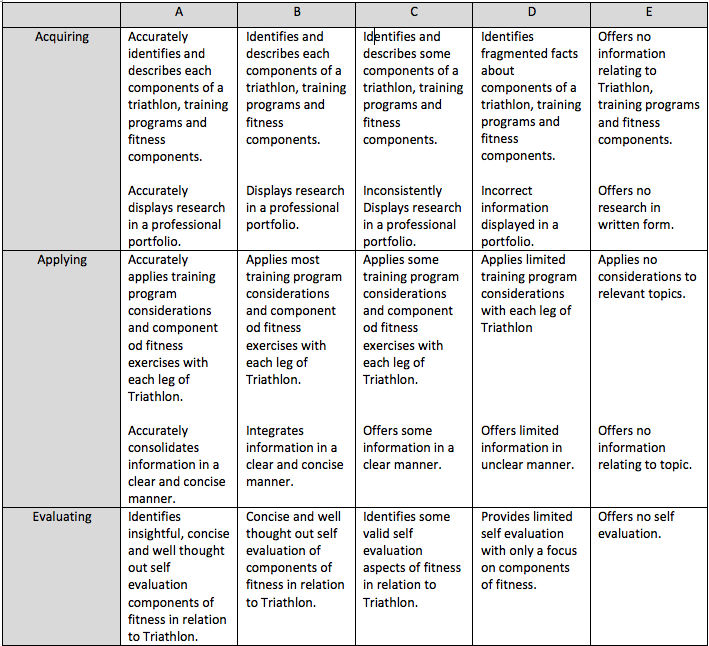
You must concluded your portfolio with an evaluation of what components of fitness, you believe you need to work on to improve you abilities within triathlons.
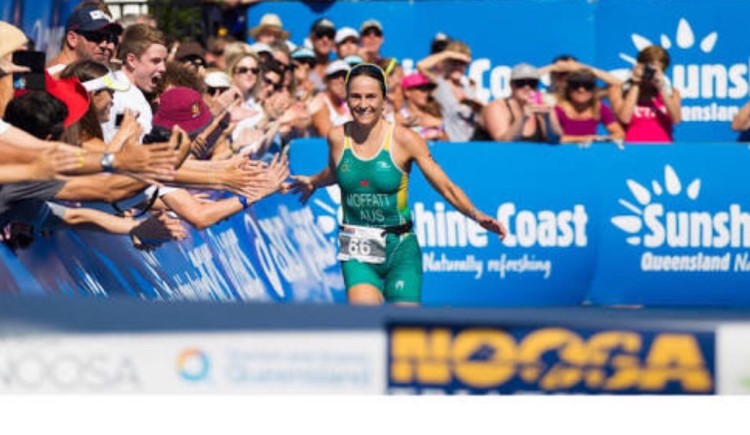
Evaluation
Conclusion
Congratulations on completing this WebQuest! Now you should have great foundation of knowledge regarding Triathlon, how each leg of the race is conducted. At this point in time you should also have a gained and understanding of what is required in training programs and specific components of fitness that should be addressed when designing a training program for different individuals.
Please remember to submit your portfolio by the due date.
For the rest of this term we will be taking a further look into training programs and how you can design a training program for yourself. This will lead into your summative assessment where you will be required to create a 4 week training program for triathlon, where you will be required to use the training program to improve your strengths and weakness and make necessary modifications and adjustments.
Enjoy this highlight video from the 2016 Rio Olympic Games - Women’s Triathlon Final!!!
[video:https://www.youtube.com/watch?v=eIMLQn2zq-o align:center]
Credits
7Olympics. (2016, August 20). Women's Triathlon Highlights | Triathlon | Olympic Games Rio 2016 | 7 Olympics. Retrieved from https://www.youtube.com/watch?v=eIMLQn2zq-o
Components of Fitness. (2016). BrianMac Sports Coach. Retrieved from https://www.brianmac.co.uk/conditon.htm
Dunne, J. (2014, June 16). Triathlon Running Technique - It's Begins with The Hips. Retrieved from https://www.youtube.com/watch?v=mSvbS0S4rJw
Engage Education Foundation. (2016). Designing a training program. Retrieved from http://wiki.engageeducation.org.au/physical-education/unit-4/area-of-study-1-planning-implementing-and-evaluating-a-training-program/designing-a-training-program/
Image taken from http://www.crowneplazamaastricht.com/event/triathlon-limburg?lang=en
Image taken from http://www.mangotreecottageeumundi.com.au/noosa-triathlon-october-30-2016/
Image taken from http://www.triathlon.org.au
International Training & Education Centre. (2003). Building a Training Program. Retrieved from http://www.go2itech.org/HTML/TT06/toolkit/curricula/print/BuildingaTraining Program.pdf
Management Sciences for Health. (2012). Designing and implementing training programs. Retrieved from http://apps.who.int/medicinedocs/documents/s19629en/s19629en.pdf
Rutland Cycling Whitwell. (2013, April 24). Triathlon training tips #2: Bike exercises and technique | Rutland Cycling. Retrieved from https://www.youtube.com/watch?v=Il98a_LVv-s
Scientific triathlon. (2016). How to design your own triathlon training. Retrieved from planhttps://www.scientifictriathlon.com/design-triathlon-training-plan/
Tri-Ya Racing. (2014, Oct 28). Triathlon Transition for Beginners. Retrieved from https://www.youtube.com/watch?v=40FNzCehbUk
Triathlon Taren. (2016, April 30). 3 Triathlon Swimming Technique Tips: Breathing for Freestyle. Retrieved from https://www.youtube.com/watch?v=lppZV1UIqwc
Tribal Triathlete. (2013, January 25). Triathlon Training and Triathlon Training Plans. Retrieved from https://www.youtube.com/watch?v=Y6kuo2rbZJ0
Wood, R. (2010). Components of Fitness. Topend Sports. Retrieved from http://www.topendsports.com/fitness/components.htm
Teacher Page
Rationale
The following WebQuest ‘Triathlons and Training Programs’ was designed for a year 12 senior Physical Education lesson. This WebQuest links directly with the current senior Physical Education syllabus which was developed by the Queensland Curriculum and Assessment Authority (QCAA) in 2010. The Physical Education senior syllabus has three key theory focus areas. The focus area for this WebQuest is focus area B which examines the “process and effects of training and exercise, how can an understanding of physiology of exercise, training and program development - improve team and individual performance?” (Queensland Studies Authority, 2010, p.12).
This WebQuest has been created for the utilisation at the start of a unit that focuses on training program design, fitness components and triathlon, each of which directly relate focus area B (Queensland Studies Authority, 2010). Furthermore, it integrates numerous aspects of the Australian Curriculum Assessment and Reporting Authority (ACARA) ICT general capabilities. Each of these capabilities are part of a framework that have distinct achievement levels for particular year levels ranging from foundation to year 10. Now although the continuum does not specifically cater for senior levels they are still just as vital in the learning process to aid in enhancing, developing and ensuring students think outside the box. This WebQuest incorporates four key elements from the ICT learning continuum each of which are categorised as sub-elements. These include; “Locate, generate and access data and information”, “Select and evaluate data and information”, “Generate ideas, plans and processes” and “Manage digital data”, (Australian Curriculum, Assessment and Reporting Authority, 2016).
Through the integration of this WebQuest in the classroom it enables students to not only be engaged through the use of Information Communication and Technology (ICT) but to consolidate there learning in a fun, engaging and self paced manner. This aids in the differentiation for those students that need more time to collect, process and analysis data. This WebQuest forces students to take responsibility for their own learning and enables students to learn in an environment that suit there needs, rather then having a structured teacher directed learning experience.
This WebQuest also incorporates the use of the theory of Bloom’s revised taxonomy. Bloom’s revised taxonomy is a two dimensional framework that is focused on knowledge and cognitive processes. The framework is made up of a hierarchy of six distinct levels including remembering, understanding, applying, analysing, evaluating and creating (Krathwohl, 2002). This hierarchy can then be further broken down into two sections lower order thinking skills (remembering, understanding, applying) and higher order thinking skills (alysing, evaluating and creating) each of which are utilized throughout this WebQuest (Krathwohl, 2002). Lower order thinking skills are used when students are required to research basic information and take notes on each topic noted. Higher order thinking skills come into play when students are asked to apply the knowledge they have justed gained to triathlon from where they then must analysis and evaluate what is suitable or not. The highest level of Bloom’s theory does not directly come into play within this WebQuest however as the WebQuest is the foundation component for the unit the information and portfolio created directly aids students in the later creation of their personalized training programs for their assessment. Therefore, this WebQuest has been designed in such a way that enhances students knowledge and understanding while making them think outside the box in a fun and engaging manner.
References
Australian Curriculum, Assessment and Reporting Authority. (2016). Information and communication technology (ICT) capability, Retrieved 2 August 2016, from http://www.australiancurriculum.edu.au/generalcapabilities/information-…- capability/continuum#layout=columns&page=5.
Krathwohl, D. R. (2002). A revision of Bloom's taxonomy: An overview. Theory into practice, 41(4), 212- 218.
Queensland Studies Authority. (2010). Physical Education: Senior syllabus, Retrieved 20th August 2016, from http://www.qcaa.qld.edu.au/downloads/senior/snr_physical_ed_10_syll.pdf.
WebQuest by Casey Charles - Student ID: 1062642