
Introduction
The Thirteen Colonies were a group of British colonies on the east coast of North America founded in the 17th and 18th centuries that declared independence in 1776 and formed the United States.
The Thirteen Colonies had very similar political, constitutional, and legal systems, and were dominated by Protestant English-speakers. They were part of Britain's possessions in the New World. In the 18th century, the British government operated its colonies under a policy of mercantilism, in which the central government administered its possessions for the economic benefit of the mother country. However, the Thirteen Colonies had a high degree of self-government and active local elections, and increasingly resisted London's demands for more control.
There were many reasons for the establishment of each of the Thirteen Colonies, and they all took on their own characteristics. Each of the Thirteen Colonies developed its own system of limited local self-government. The colonies were religiously diverse and their economic practices varied, as did their positions on slavery and servitude.
The Thirteen Colonies can be divided into three distinct regions: Southern, Middle, and New England.
-Southern Colonies included Virginia, Maryland, North and South Carolina, and Georgia.
-Middle Colonies included New York, New Jersey, Pennsylvania, and Delaware.
-New England Colonies included Massachusetts, New Hampshire, Rhode Island, and Connecticut.
Task
Attention
HELP WANTED!
Each of the thirteen colonies is looking for a skilled marketing specialist to encourage new colonists to settle there.
Help show our new travelers all there is that your colony has to offer.
Your task is to create a travel brochure for three of the thirteen original colonies (1 Southern, 1 Middle, and 1 New England). This brochure will be used to persuade travelers from England to settle in your colony. Therefore, you should become an expert in the various aspects of your colony, from economics to geography to religion.
On each of the three days you will focus on one region, and on the final day, you will present your brochures to your new colonists (classmates) to inform and persuade them to settle in your colony.
Good luck!
Thank you for assisting your fellow colonists!
Process
In order to be fully prepared to create your persuasive brochure (and ultimately to understand the differences between the three colonial regions to address the essay prompt), you should identify the following:
-Reasons for establishing the colony (including the founders and the date it was founded).
-Type of government.
-Geographical characteristics.
-Main economic output.
-Religious ideals.
-Views on slavery and servitude.
You will use this packet to keep track of your research.
While conducting your research, you must cite the sources from which you got your information. Credit will not be given to uncited information. You must use at least 5 of the 8 links listed below.
World Atlas - Original Thirteen Colonies: Map & Details
About Education - Chart of the Thirteen Colonies
Coming to America - Colonial America: The 1700s
Land of the Brave - Thirteen Colonies
Social Studies for Kids - Life in the 13 American Colonies
Gilder Lehrman - Colonization & Settlement
Smithsonian - America's True History of Religious Tolerance
Colonial Period - Links for Information for Each Colony
Your brochure should be well-organized, attractive, and simple, in order toeffectively persuasive (and earn a high score).
(Here is a template that you may consider using for your brochure. You MUST make a copy to your Drive before you begin working on it.)
Evaluation
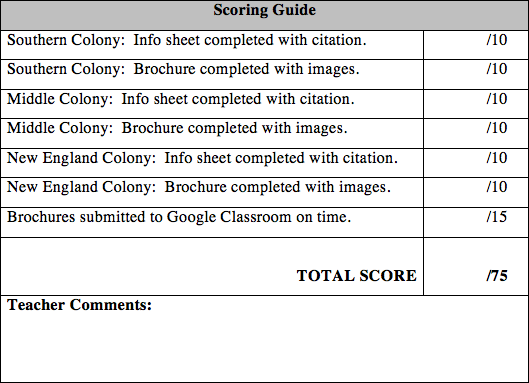
Conclusion
Thank you for your help!
We will be working on this assignment for three days - and you will complete this process for one colony in each of the regions.
Where do we go from here?
Once you have completed this assignment, you should have an idea of what the three colonial regions were like. You will use this information to contribute to a classwide essay outline (don't worry, you don't have to do it on your own).
Your final task for this topic will be to use this research to address the following prompt:
"Throughout the 17th and 18th centuries, various groups of English colonizers settled on the North American continent. There developed three distinct colonial regions – New England, Middle Atlantic, and South. Compare and contrast life in the three English colonial regions of North America."
Credits
The information on the introductory page was excerpted and adapted from the Wikipedia article "Thirteen Colonies."
Other information used for this webquest is linked to on the "Process" page.
World Atlas - Original Thirteen Colonies: Map & Details
About Education - Chart of the Thirteen Colonies
Coming to America - Colonial America: The 1700s
Land of the Brave - Thirteen Colonies
Social Studies for Kids - Life in the 13 American Colonies
Gilder Lehrman - Colonization & Settlement
Smithsonian - America's True History of Religious Tolerance
Colonial Period - Links for Information for Each Colony
The brochure template was created by Chantal Duval. All credit goes to her.
Teacher Page
United States History Standard 6205-01; Objective 0101: Examine the American colonial experience.
1. This lesson will be completed over three class periods (about 45 minutes each); and each day will cover a different colonial region.
*Day 1 - Southern Colonies
*Day 2 - Middle Colonies
*Day 3 - New England Colonies
If a student completes the day's assignment in class, they will have no homework. If a student doesn't complete the assignment in class, they must complete it as homework.
2. As students are conducting their research, they are expected to fill out their information packet. This is linked to on the "Process" page, but students will also be given a hard copy to work on in class. This packet consists of the rubric for the overall assignment, three information charts for students to fill out, and a rubric for the brochures. Students will submit their brochures through Google Classroom, and will submit their packets in class.
3. After all three sessions have been completed, the students will use their research to complete a classwide compare/contrast graphic organizer for the three colonial regions. We will then use this to complete an essay outline that answers the prompt on the "Conclusion" page.
GRASPS:
- Goal: Students' goal is to advertise their chosen colonies to persuade travellers from England to settle in one of their colonies.
- Role: Marketing Specialists who will create a travel brochure.
- Audience: Travellers from England.
- Situation: Students have been asked by the leaders of their colonies to help advertise.
- Product: A travel brochure.
- Standards: Students will be given a rubric that addresses how the brochure should be completed.
WHERETO:
- Where are we going? Why? What is expected? This webquest serves to introduce students to research on a small, controlled scale; and to get students to effectively organize and communicate evidence they have found.
- How will we hook and hold student interest? Because this is an assignment that involves some creativity, which isn't usually found in most history classes, this project sort of sneakily teaches them important historical skills.
- How will we equip students for expected performances? It is a good idea to create an example beforehand to model to students what is expected of them and what the process looks like.
- How will we help students rethink and revise? Students will be able to see each other's finished products and to collaborate with each other on the subsequent essay, allowing them to see the differences in their thinking and others'.
- How will students self-evaluate and reflect on their learning? This assignment will be graded on a rubric. It is possible that students can grade themselves based on this rubric, as well as complete a final paragraph-long reflection on the process.
- How will we tailor learning to varied needs, interests, styles? While this assignment is fairly structured, it is possible for students to vary this assignment if they want. Because of the independent nature of this assignment and the process, the teacher will be able to monitor the students' process and help those who need it.
- How will we organize and sequence the learning? This assignment is broken down day-by-day. It begins with scaffolding (with a teacher example), then daily feedback and reflection. The assignment leads really well into the whole class discussion and essay writing.