Introduction
 Welcome Students!
- Have you ever wondered just how big our Solar System is?
- Do you know how many planets we have in our Solar System?
- Is Earth the only planet with a moon?
These are just a couple of questions that will be answered on our exploration! Join us as we go on an adventure to explore our Solar System! As you make your way on your adventure you will find yourself workings on projects to help you with your webquest. We hope you enjoy all the fun facts that we have to share with you and hope you find all the information useful for your webquest expedition. Be sure to pay very close attention to all the details. Come along with us as we start our adventure together!
Task
3... 2... 1 ... BLAST OFF!
Ready to embark on a Solar System journey? Here are a few tasks for you to endeavor on this Solar System journey! As you may know Earth is just a small spec compared to the rest of our Solar System and the rest of the galaxy. As you continue on this journey there will be different websites, videos and pictures to help you to study.
After you and your group will write a short summary about the Solar System & fill out a diagram that will ask you to identify and fill in the Planets, the Sun and the Asteroid Belt. Here a couple questions that may help to get you started: How big is our Solar System? What is the Solar System made up of? How many planets are in our Solar System? By the end of this you will be a Solar System expert!
Let your journey begin!
Process
 What is the Solar System?
When thinking of the Solar System, you could compare it to a cake to better understand.
The Solar System is a system of interacting or interdependent parts that together form a complex and intricate whole.
Just like a cake, you have the flour, sugar, and flavor that make up a cake. Well, the same could be said for the Solar system. The Solar system is made up of planets, stars, moons and other independent parts. Together they make up the Solar System.
Instructions:
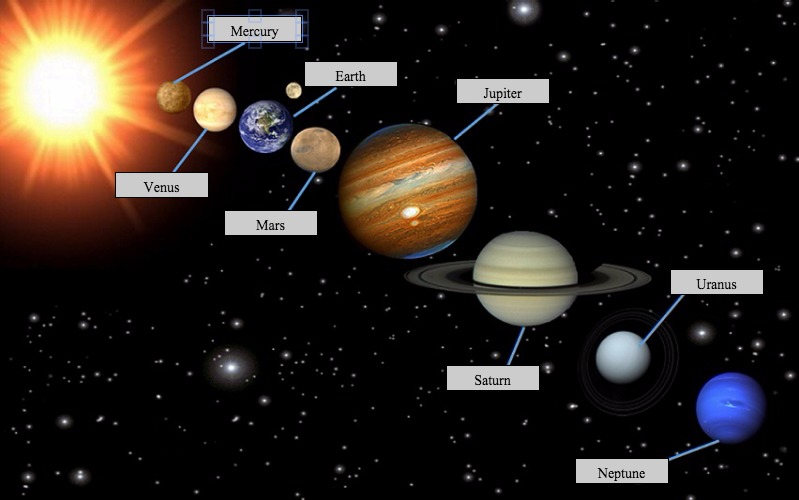
Your first task is to fill in the diagram of the Solar System, labeling the Sun, Planets, and the Asteroid belt.
Before getting started, you will want to do some research to find out more information on the Solar System. Things you may need to know before you start your diagram are:
- How many planets are in the Solar system and their characteristics.
- How many moon(s) each planet has.
- What stars are and their function.
- What the Asteroid belt is, and the planets that are separated into the Outer and Inner Planets.
Fill in the Diagram:
Click on the link below to download the diagram of the Solar System. Identify and fill in the Planets, the Sun (although it doesn't have a label), and the Asteroid Belt.
http://www.education.com/download/worksheet/89586/planets-in-solar-system.pdf
Create a Solar System Summary:
Once you have drawn the diagram, you will need to write a short summary about the following questions;
How big is our Solar System? What is the Solar System made up of? How many planets are in our Solar System, and three characteristics about each planet? What planets are separated by the Asteroid belt, and which are the inner and outer planets?
Sources for your diagram:
Watch the videos and read through the websites listed below. Each category has a description about what you can find in each source. Be sure to use these sources to gain information before you fill out your diagram and to write your summary.
- Sun:
Watch the video about the Sun to learn about what the Sun is, and its function in relation to Earth.
https://www.youtube.com/watch?v=6FB0rDsR_rc
On this website, you can read about facts of the sun.
http://space-facts.com/the-sun/
- Planets and Moons:
On this website, you will learn about the planets. Be sure to look through all the webpage. Information about the planet and its moons can be found on this website. Start with the planet Mercury, and work your way through the rest of the planets on the list on the left hand side of the website called: Learn About The Planets
http://www.kidsastronomy.com/mercury.htm
On this website, you will find addition information about each of the nine planets, including characteristics that you can use for your summary. Look on the left hand side of this webpage for the list labeled: Our Planets to be able to go through all of the nine planets.
http://www.planetsforkids.org/planet-mercury.html
- Asteroid Belt & Inner/Outer Planets:
Watch the video below to learn about what an Asteroid is.
https://www.youtube.com/watch?v=Jzyugh0dXRc
This video will help teach you about two categories of planets in relation to distance from the sun.
https://www.youtube.com/watch?v=_9LSdvuQqJc
- Stars:
Watch this video about different types of stars that are found in space.
https://www.youtube.com/watch?v=M41yLjQ2ot0
Read through the facts listed on this website to learn more about stars.
Evaluation
Your group will be evaluated on a scale of 1-3 for different areas.
1 = Unsatisfactory
2 = Marginal
3 = Excellent

This Rubric clarifies the requirements in more detail:
|
|
1 |
2 |
3 |
|
Following Directions |
I had a difficult time following directions and had a tough time figuring what to do.
|
I followed instructions, but had a hard time focusing on the task. |
I followed all instructions and had no problem with the assignment. |
|
Working with Your Group |
I didn’t work well with my group. I wasn’t much help for group. |
I had problems with working with my group, but I did helped my group. |
I had no problems working with my group. |
|
Resource Usage |
I found the resources useless. |
I manage to use some resources. |
The resources helped me to write my summary and draw my diagram. |
|
Defining Planets, Moons, & Stars |
I didn’t find enough information. |
The information was ok, but I wish I found more. |
The information was useful helped with my diagram. |
|
Diagram & Summary |
I found it hard to write a summary and my diagram was hard to recognize. |
It was decent, but could’ve been better. |
The summary was good and the diagram looked neat. |
Conclusion
Congratulations!

You have reached the end of your journey on exploring the Solar System! The distance from the Sun to Neptune is 2.795 billion mi., isn’t it amazing to know you have covered nearly everything within that distance?
Below are questions you can go through to test how well you paid attention throughout the WebQuest.
THIS PART IS NOT FOR A GRADE!
1) How hot is the sun’s core?
2) How long does it take for light from the Sun to reach the Earth?
3) How long does it take Mercury to complete the turn from day to night?
4) What is the hottest planet in the Solar System?
5) How long does it take for the Earth to orbit around the sun?
6) What is the name of the largest mountain on planet Mars?
7) What type of gases is Jupiter made of?
8) Who first saw Saturn’s rings in 1610?
9) Which planet is the smallest out of the “four giants”?
10) How many moons does Neptune have?
11) Where are most asteroids located?
12) What is the largest asteroid in the belt?
13) Are the inner planets or the outer planets denser?
14) Which orbit the sun faster; the inner planets or the outer planets?
15) How many moons does Jupiter have?
16) Which planets have rings?
17) Which star is the closest to Earth?
18) Approximately how many stars are in our Milky Way Galaxy alone?
19) Can stars range in color?
20) Do you think you’ll know the difference between a star, planet, or asteroid when looking through a telescope?
Thank you very much for participating! You’re now without a doubt a Solar System Genius! (: