
Introduction
The Solar System
Solar system is known as the sun's family. It includes the sun's planet and their moons and asteroids which travel around the sun in definite path called the orbit solar system formed billion years ago from the gravitational collapse of a giant interstellar molecular cloud.
The vast majority of the system's mass is in the sun. The four smaller inner planets Mercury, Venus, Earth, and Mars all terrestrial planet. They are primarily compound of rock and metal. The two largest planet Uranus and Neptune is compound mostly of substances with relatively high melting points compared with hydrogen and helium. All planets have almost circular orbits that lie within a nearly flat disc called the ecliptic.

Task
Your task is to identify the members of the Solar System.
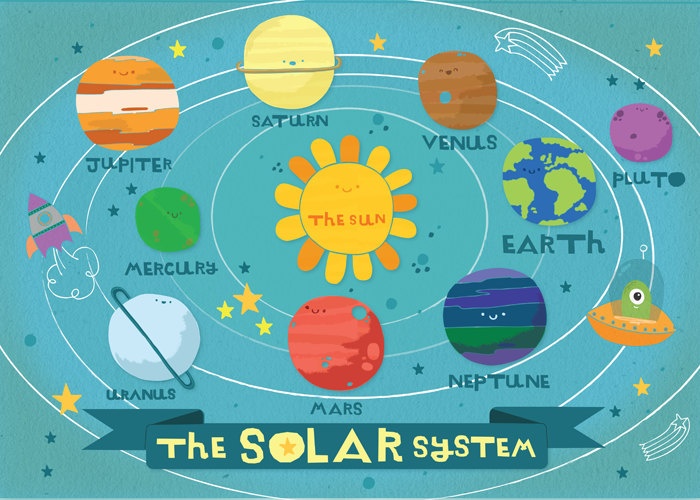
These are the things that you should do.
- Task 1
Study the illustration of the solar system.
- Task 2
Identify the members of the solar system.
- Task 3
Fill in the chart with data needed.
| Members of the Solar System in order of increasing distance from the sun |
|
1. 2. 3. 4. 5. 6. 7. 8. 9. |
Process
These following links will help you to research your answers in every task.
http://www.space.com/16080-solar-system-planets.html
http://www.theplanetstoday.com/the_planets.html
http://www.windows2universe.org/our_solar_system/planets.html
Educational Videos
Evaluation
Illustrate through a diagram how the members of the solar system revolve around the sun in the same direction as they follow their own orbit.
Your output will be graded by the following criteria:
| Criteria | PS | Score |
| Creativity | 25 | |
| Neatness | 25 | |
| Following Direction | 25 | |
| Organization | 25 | |
| Total | 100 |
Conclusion
Congratulations! You learned many things about solar system. You can now identify and describe each members of the solar system.
The solar system is a system of objects in orbit around the sun. The planets have the great range in density. Mercury, Venus, Earth, and Mars have high densities because they are made up of rocks. The densities of Jupiter, Saturn, Uranus, Neptune, and Pluto are much lower because they are largely gaseous.
I hope you had fun!
Credits
Teacher Page
Thank you for visiting my Webquest. This will help you to Explore in the Solar System. I hope you will learn and enjoy in viewing this webquest. Thank you!
This webquest was created by Veronica Louise Laqui. My goal is that the students will learn from it and had fun while learning about the solar system.
Godbless!