
Introduction
Ready. 10,9,8,7,6,5,4,3,2,1 Blast Off!

Introduction:
Ok, Astronaut Candidate! Your training is now over. If you are reading this you have successfully completed your trainging on the solar system. You have completed training at NASA, and now you are an official NASA astronaut ready to launch into outer space. Your mission: to discover fascinating information about all of the planets of our solar system. For example, which planet is the hottest? What planet has the largest body or water?Which planet spins backwards compared to the others? Which one is so light it could float in a bathtub if we could find one big enough? What would your age and weight be on Mars? What planet is farthest away from the sun! Find out all of this crucial information and more about the planets and report back to mission control in Phiadelphia with all of your discoveries. We here on earth are all counting on you...enjoy your mission...ten, nine, eight, seven, six, five, four, three, two, BLASSTOFF!!! (Click on the task link)
Task
Task: 
On this space mission, you will work in teams of five to "land" safely on each planet (that would be aweome if we really could visit outer space but were just going to gathering information from the internet!)
First of all, you will need to choose your job titles for your mission:
Commander (Crew Captain) --will supervise the group and help make any final decisions. Helps decide what jobs each person will do for each project.
Pilot (Navigator)--is responsible for navigating the internet--using the mouse, maneuvering around the websites, etc....
Data Recorder--records all data NEATLY on charts, paper, etc...
Flight (Project) Engineer--Assists on any data recording and leads any projects that deal with drawing, performing, building, etc...
Space Flight Paricipant --travel aboard space missions coordinated by those agencies who are not part of the crew but helps out in any area needed.
You will then be researching planets on the internet. You will record each planet's distance from the sun, size, temperature, rotation, revolution, and even your age and weight on each of the planets and record it on a chart!
You will also need to find out three interesting facts about each planet and present your information an oral report with drawings of the planets.You also will be researching the names of the planets and where they came from. Finally you need to present your information in one of three ways: a 3-D model of our solar system with facts labeled, an oral report with drawings of the planets, or by performing a play about the planets and sun.
At the end of this WebQuest, there will be an evaluation for each group member to fill out about themselves and their group. The teacher will also be filling out an evaluation on the projects presented by the group and how well your group worked together.
Finally, there will be a few "fun" websites to play with that deal with the solar system. Enjoy the rest of your mission. Hold on tight this will be a little rocky we are now exiting the earth's atmosphere...proceed to the next part of your trip...the "Process" part of your mission!
Process
Group Work
1.Pilot print one copy of the chart to record findings.
http://img.docstoccdn.com/thumb/orig/98810724.png

2. Team ake out a sheet of paper, and as a group, brainstorm who should take each task of looking up what.
3. Team explore space and use the chart to record your findings.
http://solarviews.com/eng/solarsys.htm
http://www.kidzone.ws/planets/index.htm
http://www.factmonster.com/ipka/A0769141.html
http://www.davidson.k12.nc.us/webquests/planets/planets.htm
http://www.manatee.k12.fl.us/sites/elementary/palmasola/psgk3ex.htm
4. Great Job the hard work is done! I cant wait to see your findings. To make it easier, to take in the new data I need you to use the link to record the information for each planet on its own sheet. So pilot print one for each planet. Commander assign plantes to everyone everyone will have to but the space flight participant but the space flight participant should help where needed.
https://s-media-cache-ak0.pinimg.com/236x/3d/0e/0b/3d0e0b14731ecca72f13d0bd1aa5f593.jpg

5. Now as a group decide how you would like to present your findings.
For some examples click the link below.
https://s-media-cache-ak0.pinimg.com/236x/70/54/cd/7054cd8ff9e5aa84940235d28f9c3418.jpg


http://msdiazgrade3.weebly.com/uploads/9/0/1/9/9019847/1872557.jpg
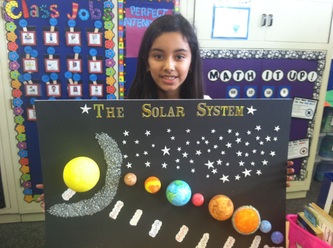
6. As a group decide who will be in charge of what for your prsentation. You will need to assign a presenter to explain the model, a speaker to present the oral portion, some one to type up the oral portion, and someone to design the model.
7. Fun Stuff (try at least some of these):
The size of our world: (This is great!)
http://www.rense.com/general72/size.htm
This is a fun calculator for making a model of the solar system to scale (we could not really do this in a classroom!) On the calculator, put the sun in as 1 inch in diameter, then see how far each model planet would have to be from each other:
http://www.exploratorium.edu/ronh/solar_system/index.html
Some great space photographs from NASA:
http://sse.jpl.nasa.gov/multimedia/gallery.cfm?&Page=23
Send a space postcard:
http://www.dustbunny.com/afk/postcards/
Solar System Games from NASA:
Planet Order: http://www.nasa.gov/audience/forkids/games/G_Solar_System_Game.html
Unscramble the Words: http://www.ueet.nasa.gov/StudentSite/games/aeronauticsjumble.htm
Tic Tac Toe: http://www.nasa.gov/audience/forkids/games/G_Shuttle_Tac_Toe.html
8. Get Ready to pack it all up and head home!
Head to the Evauation
Evaluation
Evaluation 
Great job on your projects, crew members! Now you will need to print out this group evaluation. Here you will evaluate yourself and your group members on how well everyone contributed to your group.
http://www.dailyteachingtools.com/images/500DoubleForm.jpg

Next, the teacher will evaluate you based on this rubric. You do not need to print this out. But you might want to look at it ahead of time so you know what the teacher expects of you.

Conclusion
Conclusion

Everyone gathering around....Look in the sky, here they come ready to land!
As the crew emerges, we are excited here in Philadelphia to hear about all of the great data collected on this crucial mission. So crew, did you find out which planet spins backwards? Which one would float? How much did you weigh on Mars and how old are you there? And tell us about Pluto...is it always furthest away?
We thank you for your hard work and look forward to your next mission. Maybe on the next shuttle flight you can explore further....beyond our galaxy....to white dwarf stars...to black holes...anything is possible. What would you like to explore next????? Think of three questions you may have about our whole universe, write them down, and let's explore them together as a class. Great mission, crew!
Credits
Teacher Page
Grade Level: 4th - 5th Grade
General Information: This project was designed to be used as an activity during study of the solar system.
Students will be able to:
- Study one planet in greater detail.
- Use creative problem solving skills.
- Develop reading comprehension of factual text through researching, recording, and consolitdating scientific information using technology.
Reading, Writing, Speaking & Listening:
1.1.3., 1.1.5.A-H Learning to Read Independently
1.2.3, 1.2.5.A-C Reading Critically in all Content Areas
1.4.3, 1.4.5.A & B Types of Writing (Narrative and Informational)
1.5.3, 1.5.5.A-G Quality of Writing
1.6.3, 1.6.5.A-F Speaking and Listening
1.8.3, 1.8.5.A-C Research
Science & Technology:
3.1.4.B, D Know models as useful simplifications of objects or processes & using scale
3.4.4.D Describe the composition and structure of the universe and the earth's place in it.
3.7.4.C-E Technological Devices (computer literacy)