Introduction
The year is 1942. You are a student in a very prestigious New England prep school. This is supposed to be one of the best years of your life: you are young, healthy and full of potential. You have plans for college and a lucrative career. Many things are changing, however, both all a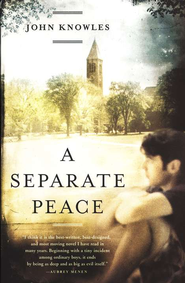 round you and within you. A war looms on the horizon, and you may be drafted. These possibilities frighten and disturb you. You continue your life of classes, football and social life, but there is always a dread in your heart, and a fear of what may lie ahead. How are you going to handle this sudden loss of innocence?
The young characters in John Knowles' A Separate Peace experience these exact feelings in their own lives at Devon school during World War II. Largely inspired by actual events from Knowles' life, the novel deals with the loss of innocence--the realization that life may not be as safe, pleasant or agreeable as it had once seemed. As a boarding-school alumnus himself, Knowles tells this story from the perspective of characters who face difficulties created not in the strict boarding-school system but within their own hearts. Therefore, it is easy for all readers to relate to the characters and events in A Separate Peace.
Task
Directions:
This webquest will familiarize you with the basic facts of WWII, the culture of this time period, and prep school life at Philips-Exeter Academy during wartime.
1. Open a Microsoft Word Document or Google Docs. Type your heading in the left hand corner (MLA format). If you are writing on a separate sheet of paper...do likewise.
First and Last Name
Teacher
English 10 (period #)
8 September 2016
2. Complete Activities 1, 2, and 3. Type or write your answers to the questions IN YOUR OWN WORDS and in COMPLETE SENTENCES WITH EXPLANATIONS (2-3 SENTENCES MINIMUM PER ANSWER) in the document.
3. Send to www.turnitin.com when you are done.
Process
Activity 1: World War II - Use the link below to "brush up" on the causes, events, and results of World War II and answer the following questions.
Go to
https://en.wikipedia.org/wiki/World_War_II
1. What were two major causes of World War II?
2. How did the United States become involved in World War II?
3. Who are the three main Axis powers? Who are the three main Allies?
4. Who are the Big Three powers?
5. What is D-Day? When and where did it occur?
6. What does the term home front refer to? What is happening on the American home front?
7. What is the Holocaust and what groups is it affecting?
8. How many casualties will result from World War II?
Activity #2:
Produce for Victory - Posters on the American Home Front
http://americanhistory.si.edu/victory/index.htm
Propagandist
View the web sites on wartime poster art to investigate how the U.S. government used this medium to rally the support for war efforts.
After viewing the posters, select one poster and answer the following questions:
9. Describe the poster.
10. Does the poster contain a hidden/implied message? What is the desired effect?
11. What emotions do the images convey? What words are chosen for impact?
12. In what ways does the poster glamorize or villainize war or the people involved?
Activity #3: High School Soldiers - The Phillip Exeter Acadamy was attended by John Knowles, the author of A Separate Peace, and was the inspiration for the novel. See what it was like to be a student dealing with usual teen issues, and facing the draft, while remaining largely isolated from the war effort on a private school campus:
Go to http://www.exeter.edu/libraries/553_4390.aspx
Then, click on “Exeter Bulletin Articles”
13. Article 2: What types of things become the focus of school and education during the 1940s at Exeter? Why?
14. Article 3: What was the purpose of the Summer Sessions and the Anticipatory Program?
15. Read articles 1 and 4. Find one thing from each article that you found interesting or strikes you as meaningful and explain why in 2-3 sentences PER ARTICLE.
Click on The John Knowles Essay. Read it and learn about his life.
16. What did he think about Exeter? How did he become a "hero for 15 minutes"?
Evaluation
If your answers are in complete sentences and are thorough in their response...you will get full credit. If not...you won't.
Conclusion
Mike Trout says.....YOU'RE DONE!!!