
Introduction
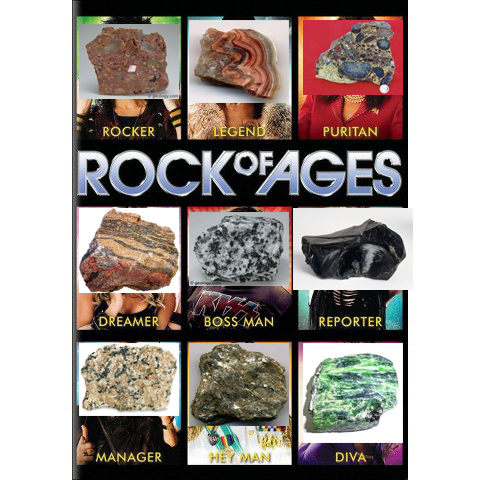 A small town rockgirl and a city rockboy meet on the Sunset Strip, while pursuing their Hollywood dreams, resulting in incredible music and a little rockbaby…
Your task, is to identify the type of rock!
In this WebQuest you will learn about the origin of sedimentary, igneous and metaphoric rocks, and the connections between them. You will go on a journey through the very fabric of the Earth, identifying characteristics of these different rock groups and putting your observational powers to the test. You will discover how different rocks form, and investigate all the ways nature and humans put them to use (both the amazing and mundane!).
To share your quest - once victorious - with the rest of the class, each quester will create a poster to display in the classroom about your special rockbaby.
Task
 Each person will be given a rock sample (this is your special rockbaby). You will work individually or with a partner – but remember you will both have your own samples to identify. You will need to use various websites to research the three different types of rock classifications (sedimentary, igneous and metaphoric), and will eventually use that research to determine the type of rock sample you have. Along the way you will need to complete diagrams, learn new terms, play games and listen to music!
Finally, you will find the person who has the same rock as you (or you can do it indivually if you prefer) to create a poster together on your rock sample to be presented and shared with the year 7 classroom.
Your poster should include:
- A description of the difference between sedimentary, igneous and metaphoric rocks
- How these types of rocks are related
- How your rock is formed, its characteristics and its identity
- What are some uses for your rock?
Remember to use your OWN words, and include pictures - posters are designed to be accurate, informative and catch the eye!
Process
Step 1: First of all we need to look at the three classifications of rocks, igneous, metamorphic and sedimentary. Go to this website for a great introduction to these new terms -
http://www.kidsloverocks.com/html/types_of_rocks.html
Choose your favourite type of rock (either igneous, metamorphic or sedimentary) and write a short description imagining how you were born. Describe what it felt like, you can be as creative as you like, as long as it is accurate!
You might like to think about including some of these terms: heat, pressure, compaction, cementation, weathering, erosion, melting, and cooling.
If you need some ideas check out the Rock Your Rock Dance story at this website -
https://mrsconte.wikispaces.com/rock+cycle+stories
Step 2: While there are three different groups we classify rocks into, they all form a relationship, called the rock cycle. This website has some interactive displays you can play with to learn about their relationship. Use it to help you complete the rock cycle handout
http://www.learner.org/interactives/rockcycle/diagram.html
Step 3: You deserve some game time! Go to this website to complete the famous rock scavenger hunt, and write your answers filling in the scavenger hunt sheet provided
https://sites.google.com/a/pvlearners.net/hbeeler/mineral-scavenger-hunt
Can you think of any Australian landmarks that could be included? What rock type is it mainly made up of? Include your idea in the worksheet space provided.
Step 4: What rock is that? Have you learnt enough along the way to find out what rock sample you have? If not, or if you want to check, have a look at this website, which will help identify your sample -
https://www.classzone.com/books/earth_science/terc/content/investigations/es0610/es0610page01.cfm
Step 5: You have been navigating around the internet so well, use these skills to find a website that can tell you a little about how your rock can be put to use!
Step 6: Create your poster! You can either find someone who has the same rock as you, or complete your poster on your own. Remember to look back at the Task page of the WebQuest to see what should be on your poster
Evaluation
| Performance level | |||
| Beginning | Developing | Achieved | |
| Following directions of webquest | Class time wasted, distraction to others, all steps not completed. | Class time used somewhat effectively, most steps completed and limited directions followed. | Class time used effectively, all steps attempted and some directions followed. Rock identified |
| Depth and breadth of understanding | Inadequate information on all points. Response demonstrates lack of understanding. | Somewhat adequate information, some points not addressed. | Adequate information presented. Response shows sufficient understanding. |
| Visual impact of Poster | Uses inadequate poster style, lack of graphics. | Some irrelevant graphics presented, sizing either too big or small. Poster layout needs work. | Appropriate well sized graphics. Good layout. |
| Presentation of poster | No attempt to use terminology, verbal skills lacking. | Attempts to use terminology, developing verbal skills. | Mostly accurate terminology used, confident verbal presentation. |
Conclusion
I hope the Rock of Ages quest has been fun and informative, did you figure out what type of rock you had?
Test out your new skills with this quick quiz, I bet you surprise yourself with how much you learnt on your journey!
https://www.learner.org/interactives/rockcycle/testskills.html
So now you know what sedimentary, igneous and metamorphic rocks are, how they contain minerals, and how they are formed!!
Can you tell your family all about the wonder of rocks at the dinner table tonight?
On your way home from school, look around at all the different types of rocks that are part of your journey home, do you have a better understanding of how they formed now?
Want to continue to rock on? Check out this song by Mr Lee, funny and informative!
Credits
Created By Phoebe Jennings