
Introduction
Navigating the Law; Using Other's Work in the Classroom
Education requires ingenuity and planning. Educators strive to incorportate lessons that are meaningful and engaging. Students sitting in today's classrooms have grown up surrounded by technology. The internet is rich with resources teachers can incorporate into the daily lessons. But the question often arises, "How much can I use?" The information in this WebQuest has been comprised to assist educators navagate the legal and ethical questions.
Task
Need information to help navagate the gray areas?
Copyright: Copyright Kids
The New York Review of Books - Does Copyright Matter?
http://www.nybooks.com/daily/2012/08/14/does-copyright-matter/
YouTube - Copyright Basics
https://www.youtube.com/watch?v=Cp1Jn4Q0j6E
Intellectual Property: World Intellection Property Organization
http://www.wipo.int/about-ip/en/
American Intellictual Property Law Association
http://www.aipla.org/about/iplaw/Pages/default.aspx
EFF - Electronic Frontier Foundation
https://www.eff.org/issues/intellectual-property
Fair Use: U.S. Copyright Office
http://www.copyright.gov/fair-use/
Stanford University Libraries
http://fairuse.stanford.edu/overview/fair-use/four-factors/
BITLAW - Fairuse in Copyright Law
http://www.bitlaw.com/copyright/fair_use.html
Personal Rights & Privacy:
Live Science - Right to Privacy
http://www.livescience.com/37398-right-to-privacy.html
American Civil Liberties Union
https://www.aclu.org/other/your-right-privacy
Family Educational Rights and Privacy Act and Regulations
Process
This toolkit has been assembled to aid teachers in finding information pertaining to the ethics and legality of using copyrighted or trademarked material for educational enrichment in the classroom. It serves as a guide to help navigate the right path concerning fair use and the creation of derivatives allowing educators to expose their pupils to music, literary creations, theatrical works, or art.
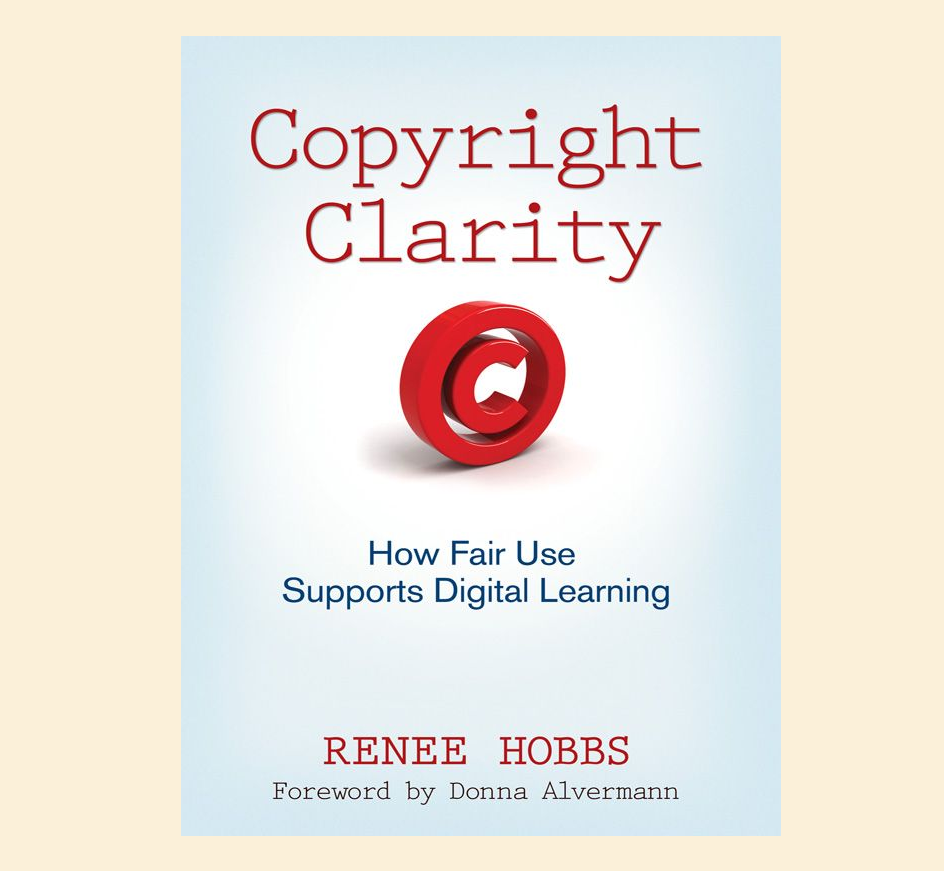
A valuable resource that has accompanied me on this journey was a book by Renee Hobbs. Copyright Clarity - How Fair Use Supports Digital Learning, lays out the ethics behind using others' work for educational use. It is a book written by an educator for educators and lays out the law in a friendly easy to undersrtand manner.
 This resource, although somewhat difficult to follow is important in understanding what requirements must be met by the institution in order to legally use other's work in the education setting. This bill signed by President Bush updates and included specific references to distance learning.
Evaluation
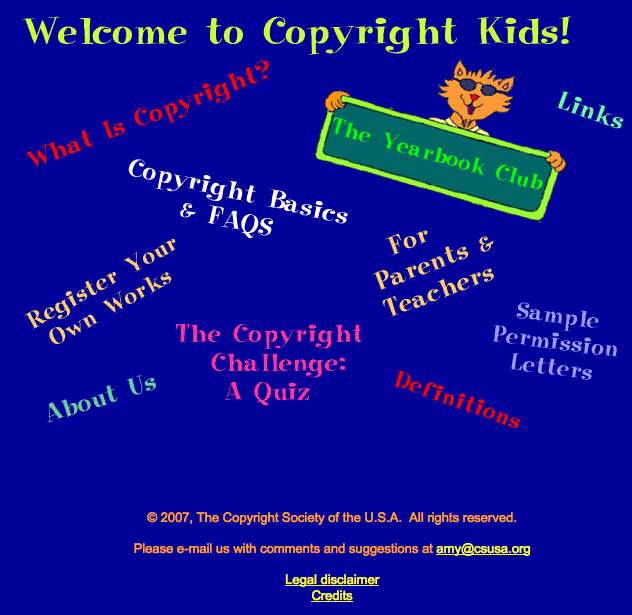
Copyright for kids is a wonderful resource that is appropriate for guiding students through the ethical issues in using someone else’s creation in their own schoolwork. This resource is unique in its target audience. Students know that they are not allowed to copy and paste directly from a web page onto a word
document. As I have found they do not know that they can build on chan
ge intellectual property. Teaching the students early on what is and is not acceptable is important and will provide for a sound foundation to build on in high school and college.
I found the YouTube videos to be extremely helpful and it was a nice variation from the reading and research. Screening the videos to make sure the information is accurate is an important step before incorporating.
Conclusion
Understanding the law and what is expected of you is important in all aspects of life in the classroom is not exception. E-Books are quickly replacing traditional books in the educational setting. Websites such as Amazon sell rights to E-Books, which can be, accessed virtually anywhere. Google was recently accused of violating legislature when it began to create massive amounts of digital books and make them available to the public (Ames, A. C., & Cushman, F. 2016).
Technological advances are rapidly changing the world of education and the only way to keep up with it is to search for the answers. Educators must be proactive in their quest to maintain ethical practices and model appropriate usage of intellectual property.
Credits
Ames, A. C., & Cushman, F. (2016). Intellectual property rights overview. Salem Press Encyclopedia,
Erbschloe, M. (2015). Copyrights. Research Starters: Business (Online Edition).
Hobbs, R. (2010). Copyright Clarity. [Kindle Version]. Retrieved from
Teacher Page
I found myself turning to the website of the United States Copyright Office and pulling up my E-Book copy of Copyright Clarity throughout this eight week course. These two resources helped me determine acceptable from not acceptable and although I am by no means an expert on the subject of copyright and fair use, I am very confident that I have the ability to search for the correct answer and apply it.
[img_assist|nid=42090|title=Happy|desc=|link=none|align=left|width=135|height=170]