
Introduction
A WebQuest for 6th Grade (Introduction to Technology)
Designed by
Victor Cherry
vcherry@richmond.k12.va.us
Introduction
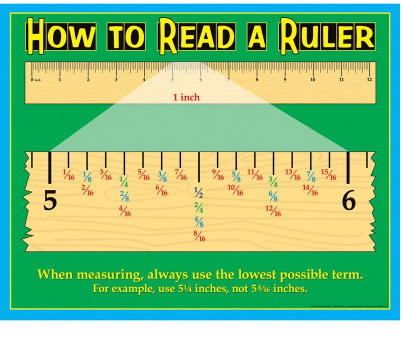
Students believe that technology only has to deal with computers and electronic devices. The students lack the skills to measure accurately when working on projects like building a drag race car of building a bridge out of balsa wood. This lesson will build and reinforce their math skills as the understanding of fractions play a pivotal role in reading the ruler and recording. This a valuable skill would likely be used on the job, in hobbies, and in everyday personal life.
Task
Students will play a game using the various unit of measures as shown. When the students have displayed a mastery of the measuring concepts they will answer the questions on the assigned project sheets.

Process
- Students go to the website http://www.rulergame.net/
Instructions:
- After you click on the button that says, "Start New Game," the name of a measurement will appear in the text box labeled, "Click on: "
- As soon as you see the measurement, click on the corresponding measurement on the ruler at the top of the screen.
- For each correct answer, you will be awarded points. Points are awarded based on the following table.
- For each incorrect each incorrect answer, you will receive a strike. After three strikes, your game is over.
- Click on the "Start New Game" button to start a new game.
- Under Preferences turn the timer off before starting your game to disable the time feature.
- To make learning easier, you can choose an increment level before starting your game and all selections will be at the chosen increment.
|
Level |
Time Limit |
Points |
|
1 |
10 seconds |
10 |
|
2 |
9 seconds |
20 |
|
3 |
8 seconds |
30 |
|
4 |
7 seconds |
40 |
|
5 |
6 seconds |
50 |
|
6 |
5 seconds |
60 |
|
7 |
4 seconds |
70 |
|
8 |
3 seconds |
80 |
|
9 |
2 seconds |
90 |
|
10 |
1 second |
100 |
Curriculum Standards
Mathematics 6.2, 6.9, 6.11, 7.4, 7.5, 8.6, 8.7, 8.8, 8.9
Science 6.1, PS.1
The student will
- investigate and describe fractions, decimals, and percentages as ratios;
- identify a given fraction, decimal, or percent from a representation;
- demonstrate equivalent relationships among fractions, decimals, and percentages; and
- compare and order fractions, decimals, and percentages.
Evaluation
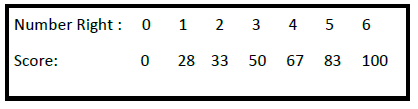
The student will complete a game sheet and the grades will be based on the number of corrects answers.
Conclusion
The most widely used application in mathematics is measurement. It can be linear, special, or fluid. Measurement activities teach everyday skills, reinforce students’ knowledge of other topics in mathematics, bridges two main areas of mathematics geometric and number.
Credits
Instructions (n.d) retrieved from http://www.rulergame.net/index.html