
Introduction
Throwing a football, hitting a baseball, shooting an arrow, launching a missile, kicking a soccer ball, and even jumping up and down all have something in common--they can be represented using a quadratic equation. The object will go up in the air, reach its peak, and then come down again. The quadratic equation of the object's motion can tell you about the path of the object along with the distance traveled.

Task
Throughout this webquest, your task will be to research several methods of solving quadratic equations. Please work with your partner as you create a list of methods along with a short description. You will then further research one method, the quadratic formula. In order to solve the problems posed in this activity, you should become familiar with the formula and its process. These practice problems will come in handy when you solve a real world situation and check it using your calculator. Lastly, and most importantly, you will research how the quadratic formula was derived. This last piece will be shared with the class. One partner will write your shared work, while the other partner will be explaining for the class.

Process
You will work with your partner throughout this process. Talking about math is a great way to assess understanding. Help each other get through each task. Please choose which partner will be the scribe and which partner will be the presenter.
Part 1.
In order to understand why the quadratic formula is not always the first method chosen, please create a list of any methods that you may be able to solve quadratic equations. Please be detailed and write a short summary of the method. Challenge question--What is the same about all methods?
In order to complete this task, there are several resources available via the internet. Please research together with your partner.
Part 2.
Now that you’ve compiled a list of methods, let’s focus on the quadratic formula. In case you are unfamiliar or need reminding, here’s a catchy tune to help you remember the formula. Use this method to solve for x in the following problems. You may use your calculator, but please show all steps in solving! Be sure to check if the equations are in the proper format to use the quad
ratic formula. There are some examples here.
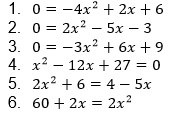
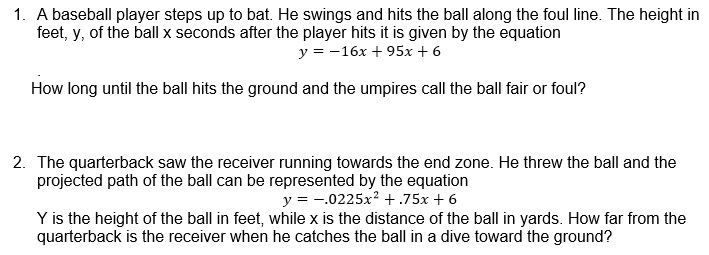
Part 3. After using the formula to practice a bit, let’s apply what we have learned. The quadratic equation could represent more than one scenario. It may represent the projected path of an object in motion which creates a parabolic path. The first two problems here show this with x as the distance and y as the height of the object. The equation may also represent the height, y, of an object after x seconds in the air. Here you will find some examples of using quadratic equations in real world situations. Solve the following problems using the quadratic formula.
Part 4. Before we move on to the last challenge, use your calculator to check all of your answers. It is important to be able to check your solutions after using an algebraic method to solve. If you are unsure about how to do this, use this website to find out how you can solve using your graphing calculator to find the roots of a function where y=0. Please write any x intercepts for each problem from parts 2 and 3.
Part 5. The last, and most important, part of our quest is to research how the quadratic formula was derived. Although it is convenient to memorize the formula with a catchy song so that you can use it when necessary, it is equally important to understand its derivation. First, review how to complete the square. Then, use the resources to create your own derivation presentation. Work together to understand describe the steps. Please have one student scribe and the other student will present when all groups have completed the web-quest.
- Derivation of Quadratic Formula
- Solving the Quadratic Equation for X
- The Quadratic Formula--Explained
Evaluation
|
Points Available: 20 |
Exemplary 4 |
Accomplished 3 |
Developing 2 |
Needs Work 1 |
No Evidence 0 |
|
Part 1. Create a list of methods to solve quadratic equations |
Detailed list of at least 4 methods is included with accurate summary of each method. |
Detailed list of 3 or more methods is included. Summaries are incomplete. |
Methods listed are not well summarized. |
Methods listed are not summarized. |
No evidence of a researched list is shown. |
|
Part 2. Solve given equations using the quadratic formula. |
Problems are accurately solved using the quadratic formula. All work is shown and no errors are made in arithmetic. |
Problems are solved using the quadratic formula. Few errors are shown or some work is left out. |
Problems are inaccurately solved or solved in a method other than the quadratic formula. Errors are apparent in the work. |
Problems are not solved using the quadratic formula and errors are made in solving. Work is not shown. |
No evidence of solving is shown. |
|
Part 3. Solving real world problems. |
Problems are accurately solved using the quadratic formula. All work is shown and no errors are made in arithmetic. |
Problems are solved using the quadratic formula. Few errors are shown or some work is left out. |
Problems are solved using the quadratic formula. Few errors are shown or some work is left out. |
Problems are not solved using the quadratic formula and errors are made in solving. Work is not shown. |
No evidence of solving is shown. |
|
Part 4. Solutions are checked on graphing calculator. |
Student uses graph to check x intercepts accurately. X intercepts are listed for each problem in proper format (x,y). |
Student does not accurately list all x intercepts for each problem in proper format. |
Student inaccurately lists many x intercepts for each problem and they are not in proper format. |
Student inaccurately lists all x intercepts for each problem and they are not in proper format. |
No evidence of solving is shown. |
|
Part 5. Students complete a derivation of the quadratic formula through research. Students present their findings. |
A complete derivation of the quadratic formula is shown from a quadratic equation. Explanation accompanies algebra. Presentation is completed. |
A complete derivation of the quadratic formula is shown from a quadratic equation. Incomplete explanation accompanies algebra. Presentation is completed. |
An incomplete derivation of the quadratic formula is shown from a quadratic equation. Incomplete explanation accompanies algebra. Presentation is completed. |
An incomplete derivation of the quadratic formula is shown from a quadratic equation. Incomplete explanation accompanies algebra. Presentation is not completed. |
No evidence of solving is shown. Students do not complete presentation. |
Conclusion
It is clear that the quadratic formula will come in handy to solve quadratic equations. These quadratic functions may represent real world situations, while others may be practice. I leave you with a short series of questions-- Is the quadratic formula the easiest or most efficient of all the methods of solving quadratic equations? Are there any problems from this quest that you would rather solve another way?
Great job and keep solving!
