
Introduction
What is personal training?

A personal trainer is a qualified fitness professional involved in exercise prescription and exercise instruction. A personal trainer aims to motivate their clientele by implementing exercise workouts towards a client’s goal (Roger, 2004). A professional personal trainer will provide feedback to their clients to enhance their client’s performance. Any person can be trained by a personal trainer whether they want to loose weight, build muscle or to simply improve their health and fitness. A personal trainer will implement an exercise plan that will progressively change over time to accommodate for the client’s improved fitness. In collaboration with this, the personal trainer will recommend foods for the client to eat in order to assist in their fitness goal.
Personal trainers can train individual clients or groups of up to 20 clients at once. Training sessions can be operated with no fitness equipment (weights, elastics), however most training sessions will include some types of training equipment. Each client usually pays an amount of money per training session. The duration of each training session and the frequency of each session will usually depend upon the clients needs or goals. The client’s goals can be specifically measured depending on their goal. If the goal was to loose weight, then the personal trainer would measure weight or BMI at the beginning of the exercise plan and then again at the end of the plan to measure performance. If the goal was to put on weight, then the same would apply. Measuring tape may also be used to measure differences around specific anatomical landmarks such as the stomach, biceps or upper thigh.
Once a client’s goal is met, personal training can still be used to maintain that level of fitness for the client.
Task
Your Task
- Your task is to effectively design a personal training plan for a client that is looking to loose weight and be healthier. Your personal training plan must use the clients goal to structure the plan. The plan must include specifically chosen exercises catered for the client’s goal and must include recommended foods for the client during the plan.
- Your client is a 30-year-old woman named Joanne Malloney and her goal is to loose weight in a bid to become healthy again. Joanne aims to work on reducing weight throughout her whole body. Joanne is 185cm tall and weighs 96 kilograms. Her diet consists of regular fast food consumption (pizza, McDonalds, SubWay) in which she will eats once a day. Joanne also consumes an average of 3 cans of soft drink per day. Your aim is to help JO!
Process
Process:
1. Carefully read the introduction and the task section of the webquest. Ensure that you thoroughly understand the information provided in each section.
2. Find Joanne’s height and weight within the task section of this webquest. Now, you must calculate Joanne’s Body Mass Index or BMI in order to find out how much weight she needs to lose. You can do this by clicking on the hyperlink below. You must enter Joanne’s height and weight into the calculator.
http://www.mydr.com.au/tools/bmi-calculator
After this, you must locate the amount of weight (Kgs) that Joanne must loose in order to be classified as healthy. You will find this under the “How much weight do I need to lose” section.
3. Read about weight loss and exercise. Keep in mind that you will have to use this information later in the webquest.
http://www.healthline.com/health/exercise-and-weight-loss#Overview1
4. Using your prior knowledge about fitness and exercising, find 6 individual exercises within the hyperlinked website, that will align with Joanne’s goal. Joanne’s Goal is to become healthy again (loose weight).
Hint: You must exercises that target her whole body.
https://www.freetrainers.com/exercise/musclegroup/buttocks/
5. Put the 6 exercises into a personal exercise plan – In accordance to these rules
- You must use the format below – as learnt in class
- Your plan must be progressive – starting with a few light workouts in week 1 and finalising with numerous strenuous exercises in week 6
- You must create your workout in a word file and submit it on schoolbox, under Assessment 2, Webquest. Follow this link. https://schoolbox.arden.nsw.edu.au/login/
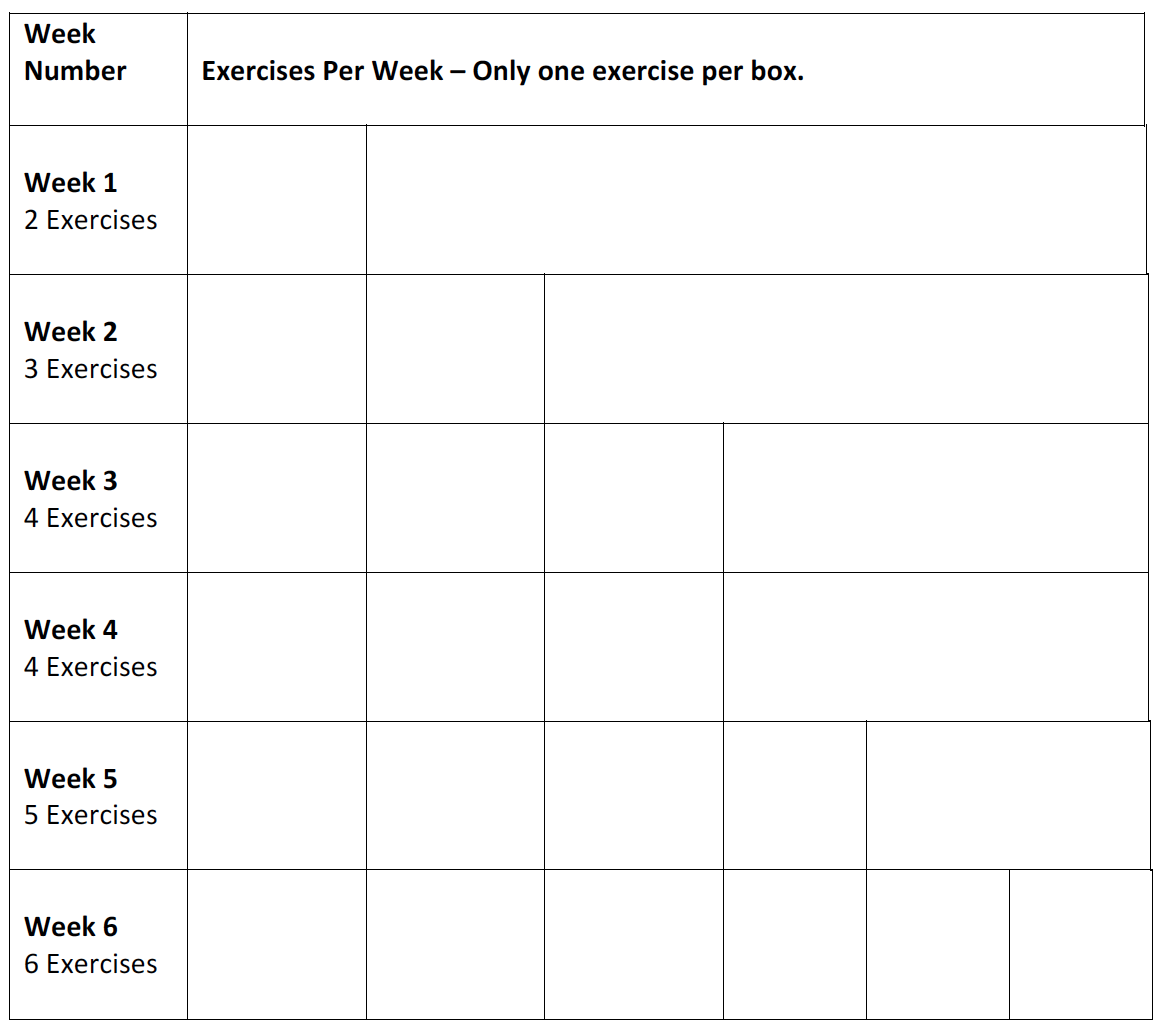
6. You must now read about healthy eating
https://authoritynutrition.com/20-most-weight-loss-friendly-foods/
7. Now write a 150 word summary about your workout plan. Justify why you have chossen the excercies you have and how they are beneficial in the client's weight loss. This summary must also include a paragraph recommending foods for the client. These foods must also be beneficial toward weight loss. You can use information from the provided websites to enhance your summary. You must also explain how you would measure the client's weight lose or progress over the 6 weeks.
Note: You must also submit this summary on your schoolbox page. Please use the same link as you used before -https://schoolbox.arden.nsw.edu.au/login/
Evaluation
Criteria Sheet:
|
|
High Distinction
|
Distinction |
Credit |
Pass |
Fail |
|
Knowledge
|
Concise and clear explanation of the exercises used within the workout and recommended food paragraph and how they are beneficial for weight loss. Makes correct and meaningful references to weblinks information Specific and relevant examples used.
|
Concise and clear explanation of the exercises used within the workout and recommended food paragraph and how they are beneficial for weight loss. Makes meaningful links to weblinks information Some specific examples used. |
Clearly written explanation of some exercises and within the workout and food paragraph. Some examples of the benefits for weight loss.
Some examples used. |
Written to a satisfactory standard with a simple explanation of both paragraphs.
No examples. |
Summary lacks clarity and depth. Writing fails to explain the use of exercises and dieting for the purpose of weight loss.
No examples provided |
|
Application
|
Effectively and correctly applies 6 exercises to the workout and appropriately recommends foods for the client.
|
Effectively and correctly applies 5-6 exercises to the workout and appropriately recommends foods for the client.
|
Applies 3-5 exercises correctly to the workout and recommends some acceptable for the client. |
Applies 0-3 exercises to the workout. Struggles to effectively recommend correct food to the client. |
Little to no application of exercises to workout. Does not recommend food to client. |
|
Decision Making
|
Demonstration of creativity and differentiation between exercises. The workout effectively meets the rules associated. |
Demonstration of creativity is evident between exercises. The workout effectively meets the rules associated. |
Evidence of structure between exercises with some mistakes in the choosing of exercises. Workout meets most of the rules associated. |
Evidence of little structure between exercises with some mistakes in the choosing of exercises. Workout meets some of the rules associated. |
No structure or creativity within workout. Mistaken choosing of exercises. Workout fails to meet any of the rules associated. |
|
Writing
|
Excellent academic writing to a year 10 standard. |
Strong academic writing. |
Good academic writing. |
Academic writing is satisfactory needs assistance. |
Writing skills no not meet the requirements of this course. |
Conclusion

Congratulations on finishing this webquest. You have successfully completed this personal training webquest. This webquest has taught you about the profession of the personal trainer. You have learnt that personal trainers are qualified fitness instructors that enable people to reach thier individal fitnesss goals. You have identified the clients goal and successfully created a workout plan for them and have also recommended weight loss foods for the client. By writing and submitting a excercise plan and 150 word summary, you have understood the importance of these two processes for personal training. Your teacher will give you some feedback about your schoolbox submittions as soon as possible.
If you are interested in gaining more information about personal training don't hesitate to explore the websites and journals below:
- http://fitness.edu.au/course/personal-trainer/
- Kraemer, WJ. Exercise Physiology: Integrating Theory and Application. Lippincott Williams & Wilkins. Ahead of print, March 2011.
- http://www.fitnessfirst.com.au/train-with-us/personal-trainers/
Credits
Reference List APA 6th Edition
Australian Curriculum,. (2016). Information and Communication Technology (ICT) Capability - Introduction - The Australian Curriculum v8.1. Australiancurriculum.edu.au. Retrieved 4 April 2016, from http://www.australiancurriculum.edu.au/generalcapabilities/information-and-communication-technology-capability/introduction/introduction
Anderson, L. (2001). A taxonomy for learning, teaching, and assessing (a revision of Bloom;s taxonomy of educational objectives). New York: Addison Wesley Longman, Inc.
Expressi, I. (2016). Expresspaid Ltd › Forum. Expresspaid.net. Retrieved 23 April 2016, from http://www.expresspaid.net/?x=forum&fid=26&sid=28&tid=12015.
Earle, Roger (2004). NSCA's Essentials of Personal Training. NSCA Certification Commission. pp. 162, 617. ISBN 0-7360-0015-1.
Schoolbox,. (2016). What is Schoolbox? - Learning management system (LMS), Portal & Intranet for K-12 schools | Schoolbox. Schoolbox.com.au. Retrieved 9 April 2016, from http://schoolbox.com.au/what-is-schoolbox/
Quick Start pt,. (2016). Blogs - Quick Start Personal Training. Quickstartpt.com.au. Retrieved 23 April 2016, from http://quickstartpt.com.au/blogs/. Image 1.
Teacher Page
Rationale
The integration of information and communication technology is a must for any learning environment in the 21st century. A Webquest is an online learning tool that enables students to learn though exploration and investigation of the internet. Webquest uses step by step instructions to encourage the student to reach an overall learning objective. This webquest guides students through a learning journey about personal training and is suited for a year 10 Health and Physical Education (HPE) class. This webquest adequately meets the requirements of ICT integration suggested by the Australian Curriculum, Assessment, and Reporting Authority’s (ACARA) ICT learning continuum. The eight cognitive steps of this webquest challenge students to think cognitively and develop an understanding about personal training.
The goal of this webquest is for students to act as a personal trainer. Students must use the webquest as a guide to assessing a client’s fitness and creating a personal training plan for them. Personal training was specifically chosen as the subject of this webquest because the study of health and fitness is adequately incorporated into the year 10 HPE curriculum. The Australian Curriculum states that students learning in the year 10 HPE subject must be critically analysing and applying health information from a range of sources to health decisions and situations (Australian Curriculum, 2016). This is clearly evident in the webquest as students need to specifically apply health and exercise information for a client with health issues.
This webquest was designed to flow effectively from one step to another by incorporating and building information from each step. The Body Mass Index segment in the ‘process’ tab, allows students to effectively calculate the client’s fat percentage and the amount of weight that this person has to loose in order to become healthy. Rather than just giving them the formula, this website, (if used correctly) it allows students to find this information in the online learning environment. Step 3 of the ‘process’ segment, incorporates information about exercise and fitness and aids as a link from the BMI calculator to the next step; exercise. This step reinforces why exercise is important for health. Throughout the information presented in the webquest, information is presented in numerical, linguistic and pictorial themes. These different themes accommodate for the needs of the diverse learners within the classroom. Gardner (2011) states that teachers need to adapt their pedagogy to accommodate for these multiple intelligences because it enables all students to reach their ‘full academic potential’.
Step 4 and 5 encourage students to find six exercises from a website and create an exercise plan with them. Creating is valued as a higher order thinking skill associated with learning. Anderson and Krathwolh (2001) state that when someone creates, they think extremely cognitively and this cognitive thinking is essential within the learning environment. By creating a workout, students learn about how to organise and implement a exercise plan for a client. This plan is assessed in the evaluation segment of the webquest. Students learn about the importance of food in the process of weight loss in step 6. This information provided by another hyperlink enables students to learn that dieting is another aspect of a personal trainers profession. Section 7 of the ‘process’ segment requires students to write a 150 word summary about their workout plan and how it aims to reduce the weight of the client. The summary must also include a small paragraph suggesting foods that will aid this person’s weight loss and why. This summary aims to assess students on their ability justify their workout and recommended food as well as their ability extract information effectively from the weblinks used within the webquest. This paragraph was to be submitted through schoolbox. Schoolbox was used because it enalbles all students to submit their summary in a structered online environement. Schoolbox also allows the teacher to immediately start reading and giving feedback to students once summaries have been submitted (Schoolbox, 2016). If schoolbox was not available at the school, this same process could be done via email.
From a pedagogical perspective, a webquest is a very effective ICT tool for teaching because it encourages students to learn through individual exlporation and investigation. A webquest will create more emphasis on the student's learning as the teacher acts as the facilitator to the learning rather then the 'teacher' of the information.
This webquest has provided an opportunity for students in year 10 HPE to effectively learn about personal training. The strategically placed 7 steps, encourages students to learn new information in a self directed learning environment. In this case, students individually developed an exercise plan and recommended food for a client who aimed to loose weight. This information is greatly beneficial for HPE students wanting to study HPE in secondary school.