
Introduction
Martina and her four friends are having a sleepover for her 12th birthday. All of the girls are around the same age. They want to share a package of Oreo cookies while they watch a movie.

Martina's mother is health-smart and doesn't want the girls to eat more sugar than their daily needs.
They all agree to study the problem and see whether this would be too much sugar or not.
Before we begin, let's answer a few questions:
1. What would be some good information to know?
2. How could you use that information to determine whether they would be eating too much sugar?
Task
R – Read and Restate
- I can restate the problem in my own words.
- I can list key words and info.
- I can ignore unuseful info.
I – Illustrate
- I can make a chart, diagram, or picture of the problem.
- I can label my chart, diagram, or picture with important information from the problem.
C – Calculate
- I can use the correct operations and strategy for solving the problem.
- I can show ALL of my work.
E – Explain
- I can write a detailed paper on how I solved the problem, using the key words and info.
- I can tell which article or picture I got the info from.
- I can tell what operations and strategy I used..
- I can explain the steps I used when getting the final answer.
- I can communicate clearly, so that my audience does not have to guess about what I did or how I did it.
| Readability ConsensusBased on 8 readability formulas, we have scored your text:Grade Level: 5Reading Level: fairly easy to read.Reader's Age: 8-9 yrs. old (Fourth and Fifth graders) |
Process
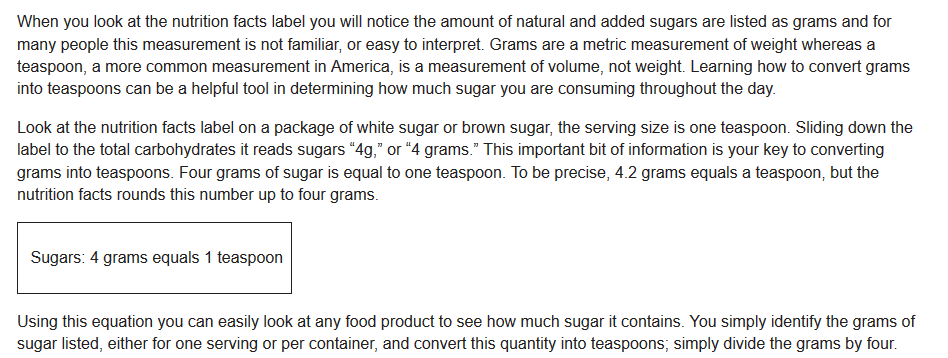
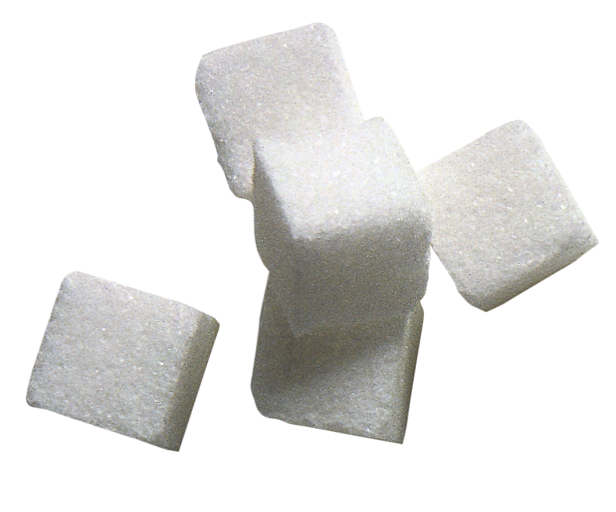
Read through these various articles and clips and try to find information that can help you figure out whether the kids would be eating too much sugar. Be sure to cite which item you got information from when you write your final piece. (Example: "According to Article 3..." or "Clip 1 shows...")
| Picture 1 |
|
|
| Article 1 |
|
|
| Article 2 |
 |
| Picture 2 |
 |
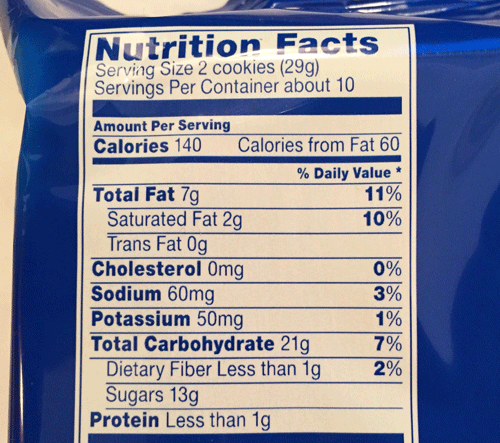
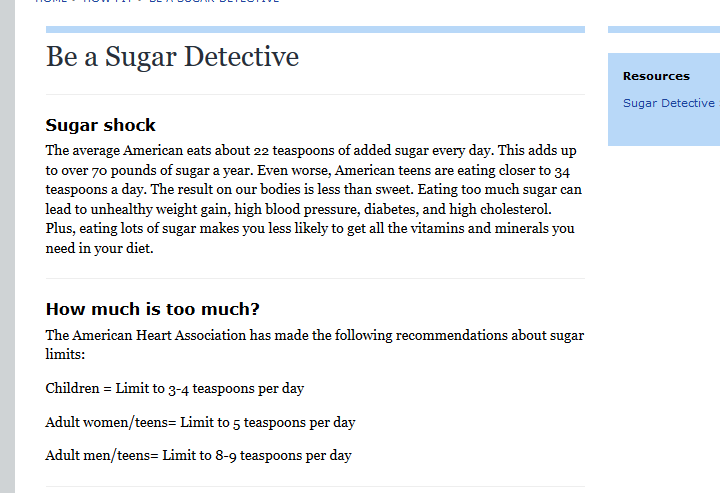
Evaluation
When you write out your final solution, keep looking back to this list. It gives the qualities of the very best papers:
1) The best math writers restate the problem in simple, "explain-it-to-grandma" terms.
2) The best math writers discuss what information they gathered to help solve the problem, and they make sure to tell where they got it.
- "According to Article 1..."
- "...which I found in Picture 5."
3) The best math writers make an illustration of the problem. It doesn't have to be a picture, either, it can be a chart, table, or diagram. You will turn in a clean illustration when you submit your final solution.
4) The best math writers are detailed. Detailed doesn't have to mean confusing, either. Don't leave your audience guessing at what you did or how you did it. When in doubt, don't leave it out!
I wish there was one single way we could all write this paper and it be done "right", but that isn't how the world works. Be creative, ask for help, and keep tweaking it until it is something you'd be proud to have your name on!
| Readability ConsensusBased on 8 readability formulas, we have scored your text:Grade Level: 5Reading Level: easy to read.Reader's Age: 8-9 yrs. old (Fourth and Fifth graders) |
Conclusion
 OPEN A WORD DOCUMENT AND WRITE YOUR FINAL PAPER.
1. Restate the problem in your own words.
2. What key information did you use? (Make sure to cite which article or picture you got the information from)
3. How did you illustrate the problem? Use Word's built-in tools, Pixlr.com, or Paint to create a copy of your illustration and include it in the document.
4. Calculate: Would the girls be eating too much sugar if they split up the bag of Oreos? How did you find out?
Sequel: If you were Martina's parent, what would you suggest they do instead of dividing up a whole bag of Oreo cookies among themselves?
Credits
Educational Fair Use: http://www.ncte.org/positions/statements/fairusemedialiteracy
Oreo Cookies package: https://foodimentaryguy.files.wordpress.com/2015/03/vk-com.jpg

Oreo Cookies nutrition label: http://www.junkfoodguy.com/wp-content/uploads/2015/01/redvelvetoreo-03…

Sugar Detective: http://yalehealth.yale.edu/sugardetective
Teaspoon to grams conversions: http://msue.anr.msu.edu/news/how_to_convert_grams_of_sugars_into_teaspo…
Sugar Cubes: https://chinampala.files.wordpress.com/2015/10/sugar-cubes.jpg

MS Word Logo: http://www.guidingtech.com/assets/postimages/2012/08/MSWord-Logo.png

Teacher Page
| [img_assist|nid=41290|title=Fishing in a Tux|desc=|link=none|align=left|width=1874098255|height=1874098255] | Mr. Kyle Berry 2016-17 marks my 14th year of teaching. I'm on a quest to bring as much nutrition awareness to youngsters as I can, including my 6th grade math students. And, yes, I've fished in a tuxedo before. Top that. |