
Introduction
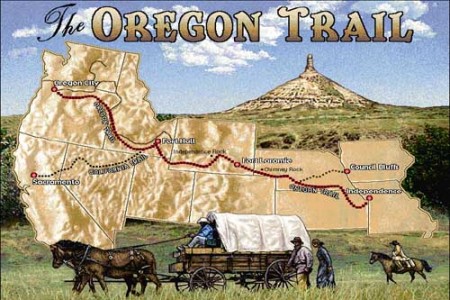
It's 1843, the Great Western Migration is under way. You are going to travel west on the Oregon Trail with a Wagon Train. The journey is very difficult, one in every 10 people died along the way, many walked the 2,00 miles from Independence, Missouri to Oregon City, Oregon barefoot. The Western Migration continued by Wagon Train for the next 25 years and more than a half-million people traveled The Oregon Trail.
Task
Goal:
Learn about traveling in the Old West, the hardships and landmarks on the historic Oregon Trail.
Task:
Student's will create a journal (created in Word) taking notes related to their journey along the Oregon Trail, then create a storyboard presentation to meet the following requirements:
- Explain how pioneers traveled west and why.
- Locate and describe landmarks along the trail.
- Plot on a map the route and landmarks.
- Describe the hardships suffered by those traveling by wagon train across the west.
- Find photos of the trail, landmarks, and wagons used in traveling the trail.
Process
You will create a journal using a Word document to take notes through each step of this WebQuest. This will help you keep organized as you move through each step.
Step 1:
Open Word and create a document titled: Journal of "insert your name". On the first page of your document create a page title labled "Journal". Save to the student drive.
Step 2:
Explore the following websites, you will use these for your research.
- The Oregon Trail
- Basic Facts About The Oregon Trail
- Oregon Trail Center
- Oregon Trail Resource Guide
- Frequently Asked Questions About The Oregon Trail
- History Bits - The Oregon Trail
- Oregon Trail Map
- Map 1843
- https://www.bing.com/images/search?q=The+oregon+Trail&FORM=HDRSC2
You may look up additional sites for reseach, if you find a credible source and use it, you will receive 2 extra credit points for each site up to 6 points.
Step 3:
Begin your journey! Starting at Independence, Missouri you will be traveling in a family of 4, your parents and a sibling.
Step 4:
- What type of wagon do you need? What animals are you going to use to pull your wagon?
- What animals are you going to use to pull your wagon?
- What supplies are you going to need for your family? How many pounds of food do you need to sustain your family for the 2,000 mile journey?
Step 5:
- Find and print an Oregon Trail Map from 1843 that you can use to mark your journey as you travel along the trail. (You will need two maps, one showing the territories at the time and a map showing the states the Oregon Trail passed through).
Step 6:
You have your wagon, animals and supplies, time to start the Wagon Train.
- Begin traveling along the Oregon Trail, trace your route on your map with a red marker.
- List each landmark you pass, mark it on your map, note in your journal it's location (which current state is it in, is it near a current city), and write a brief description of the landmark and why it was an important stop for pioneers.
Step 7:
- List and describe at least three Fantastic Facts about life on a Wagon Train?
- How many miles does a Wagon Train travel each day?
- How long did it take to make the journey from Missouri to Oregon?
- What hardships and struggles did pioneers face on the trail?
- How did the Indians of the region feel about the Wagon Trains? What tribes were they?
Step 8:
Many children made the 2,000 mile journey, what was life like for them?
- Did they attend school while on the trail?
- Did they have chores to do? If so, what were they?
- What kinds of games did kids play out on the trail?
Step 9:
You made it to Oregon! Now that you have reached the end of the Oregon Trail:
- Write a paragraph in your journal reflecting on what you think of travel during the 1800's and how it differs from traveling today.
- On the last page of your journal list the sites you used to find your information.
Step 10:
Create a storyboard showing your journey across The Oregon Trail include:
- Your map
- Photos of landmarks with brief description of each location
- Fantastic Facts
- Hardships and struggles
- Why people traveled west during the 1800's
- Brief summary of questions asked in the process steps?
- You can add photos of everyday life on the Oregon Trail
Evaluation
Your journal will be evaluated for completeness and identification of facts, your storyboard will be evaluated on completness and neatness of the facts, check the rubrics below to make sure you have included all elements required in each. The Journal will be worth 30 points, and the Storyboard will be worth 55 points.
Once you check your Journal for completness, let your teacher know so they can access it.
Journal 30 points
| CATEGORY | 10 | 5 | 3 | 1 |
| Identifies facts | Student accurately locates and gives a clear explanation of these facts | Student accurately locates and gives a reasonable explanation of these facts | Student accurately locates facts . Explanation is weak. | Student has difficulty locating facts. |
| Organizaion | Notes are well organized and in order, all step complete | Notes are reasonably organized but not in order, all steps are complete | Notes are complete but not organized or in order, not all steps are complete | Notes are incomplete and not organized, steps not complete. |
| Summarization | Student uses several sentences to accurately describe what the fact is about. | Student summarizes most of the facts accurately, but has some slight misunderstanding. | Student has great difficulty summarizing the facts. | |
| Spelling/Grammer | No grammar or spelling errors. | Fewer than 5 grammar or spelling errors. | More than 5 grammar or spelling errors. |
Storyboard 55pts
| CATEGORY | 15 | 10 | 3 | 1 |
| Use of Time | Used time well during each class period (as shown by observation by teacher, and documentation of progress in journal) with no adult reminders. | Used time well during most class periods (as shown by observation by teacher, and documentation of progress in journal) with no adult reminders. | Used time well (as shown by observation by teacher and documentation of progress in journal), but required adult reminders on one or more occasions to do so. | Used time poorly (as shown by observation by teacher and/or documentation of progress in journal) in spite of several adult reminders to do so. |
| Required Elements | Storyboard included all required elements as well as a few additional elements. | Storyboard included all required elements and one additional element. | Storyboard included all required elements. | One or more required elements was missing from the storyboard. |
| Clarity and Neatness | Storyboard is easy to read and all elements are clearly written, labeled, and in order. | Storyboard is easy to read and most elements are clearly written, labeled, and in order. | Storyboard is hard to read with rough drawings and labels, not in order. | Storyboard is hard to read and one cannot tell what goes where. |
| Spelling & Grammar | No spelling or grammatical mistakes on a storyboard with lots of text. | Few spelling or grammatical mistakes on a storyboard with little text. | Several spelling and/or grammatical errors on the storyboard. |
Conclusion
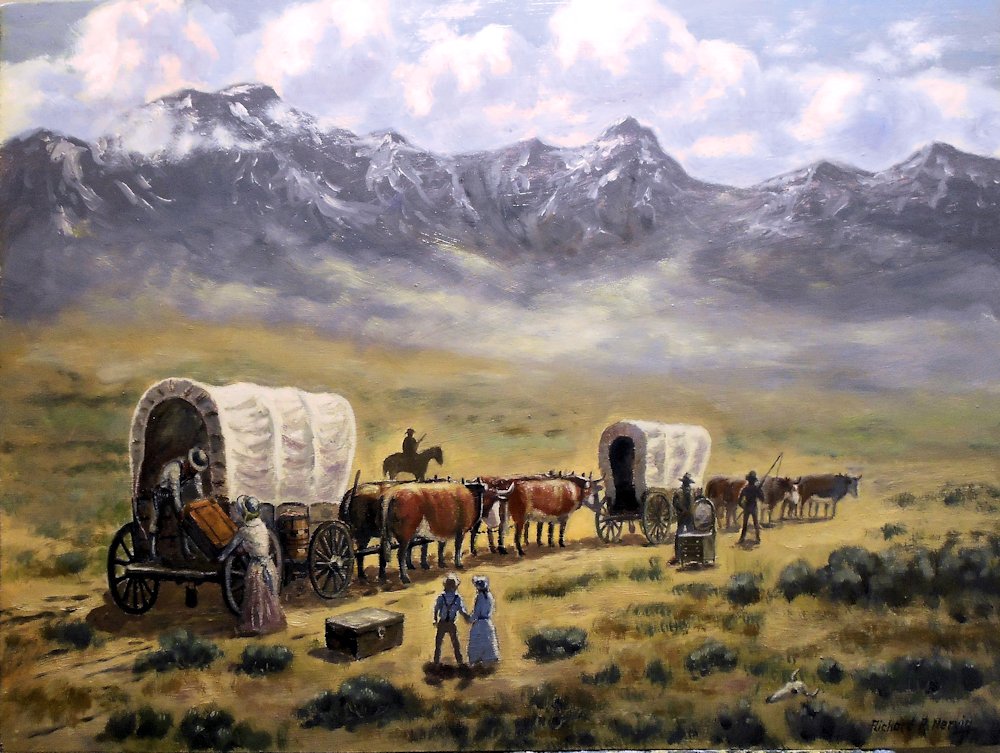 Way to go! You have finished this WebQuest on the Oregon Trail. You now have an understanding of what it was like for early pioneers as they traveled West.

