
Introduction
This lesson will focus own having students create their on narrative about a trial or hardship faced in a natural situation. Your narrative should be inspired by Ernest Hemingway's The Old Man and the Sea. As we read this semester, we learned that Hemingway's novel is about how to deal with tremendous adversity with courage and nobility.


Task
For this assignment, I want each of you to create your own narrative about surviving in a harsh climate. You can choose any country, region, or biome you choose. You will research the country and area of your choice. Since many regions have geographic features that are in other languages, you may feel free to have you character's speak in a different language or dialect as long as you provide the English translation in parenthesis. On the Credits page, you will find a link to Google Translate. Few free to use this tool to help you create a story that has authentic language for the region or geographic area you choose to depict in your narrative.
Essential Question: How does your environment effect your actions?
Process
Your task will require you to think about how humans can face and overcome adversity within a natural context.
For this WebQuest activity, there are several things you need to do in order to create a strong a convincing narrative.
First, create a character outline for at least two characters. In order to have effective dialogue in your story, you will need to have characters that seem real and compelling dialogue between those two characters.
For each of your characters come up with the following:
Name:
Age:
Race:
Gender:
Background: What do they do for a living? Are they a student in school? If so, where? What factors contributed to the character/characters being in a perilous situation.
Personality traits: What kind of person is your character? Make sure that each character has at least three specific personality traits. Are they a control freak, funny, gregarious, etc.?
What is the relationship between the two characters? Are they friends, strangers, family, or something else?
Once you have your character outline, you need to decide what sort of geographic situation you will place your characters in to challenge them to develop and overcome challenges. Remember, you must use a specific geographic region, which will test your characters’ to survive. If there is a specific country or region you are familiar with or interested in exploring, feel free to start there.
Next, find several quality texts, you may use the library to find books, articles, or websites to find information about the geographic region you will describe. You must incorporate specific knowledge of this region in your narrative, including, topography, climate (especially how that climate my change depending on the time of year), and the terrain in which you will place your characters.
Next, I would like you to create a plot outline using a plot diagram for your narrative. This will help you structure your story before you write it. Your plot diagram should look like the example below. Feel free to make it as large and detailed as you want.
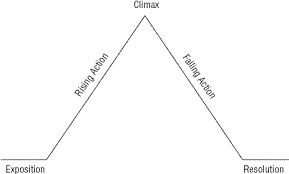
Once you have created your plot outline, you may begin writing your narrative. Make sure you look at your rubric before and as you are writing to make sure you are following all the steps. After, you have completed the story, read it to yourself and make any revisions you feel are necessary to make the story better. Make sure your language is descriptive and evocative. Do not just settle on the first word you come up with! Use a thesaurus to make the language jump off the page. When you feel you have completed your narrative, have a classmate read it and offer their perspective. As they read the story, have them fill out a blank Plot Outline. If theirs does not match yours, you will need to revise.
After completing all of these steps, be sure to go back and proofread your story at least three times. Then, if you feel satisfied with your work, begin constructing your works cited page. Make sure you include a map of the region you depicted in your story. Remember, this is an ELA class, so your works cited should be in MLA format. If have questions about it, see me or go to the “Credits” page on the WebQuest and go wot pudue.owl.edu to make sure your citations are correct. When you are completely finished, hand in your typed copy, with a printed or copied picture of the map of the region depicted along with a rubric. Congratulations, you have completed this task!
Evaluation
|
Score |
4 |
3 |
2 |
1 |
|
Characters |
There are two or more characters in the narrative that are fully developed. There is sufficient explanation of each of the character’s race, gender, background, physical appearance, and personality. |
There are two or more characters in the narrative, but they are not fully developed. One of the following elements is missing for one of both of the characters: race, gender, background, physical, appearance, or personality. |
There are two or more characters present. However, each character is not fully developed. At least one of the following attributes is missing for each character: race, gender, background, physical appearance, or personality. |
There is only one character present in the narrative. The character is undeveloped, and the description is lacking real detail. |
|
The setting |
The setting is fully described and based on a real geographic region. The following are fully described and are accurate: the terrain, the time of the year, the climate, and the topography. The detail of all the above features is clear, vivid, and present throughout the narrative. |
The setting is described to a sufficient extent. The following are fully described and are accurate: the terrain, the time of the year, the climate, and the topography of the geographic region. The detail and description is not vivid or present throughout the narrative. |
One following elements of setting are missing: the time of year, the terrain, the climate, and the topography. |
More than one of the following elements are missing: the time of year, the terrain, the climate, and the topography. |
|
Dialogue and Pacing |
The dialogue presents at least two character’s points of view and is extensively vivid and descriptive. The dialogue creates a rich portrayal of each character’s personality, motivations, and emotions. The narrative is paced well, and the reader can easily follow the plot. Pacing is used to create suspense around the central conflict, which should involve the geographic setting in which the characters are placed. |
The dialogue presents two character’s points of view adequately. The dialogue helps the reader understand each character’s personality, motivations, and emotions. The narrative is reasonably paced and is easy to follow. The events occur in a linear fashion. Pacing is used to advance the story but does not create suspense surrounding the major conflict within the story. |
The dialogue presents two character’s points of view but does not help the reader gain a better understanding of their personalities, motivations, and emotions. The diction is simplistic and shows little evidence of revision. The pacing is uneven and the events of the narrative do not follow a natural pattern for a narrative. |
The dialogue presents only on character’s point of view. The diction is simplistic and may seem inappropriate given the scenario and character backgrounds. There is no evidence of significant pacing. The narrative does not follow a linear structure and shows little evidence of proper planning. |
|
Length |
The paper is at least three full pages typed |
The paper is two pages typed. |
The paper is one full page typed. |
The paper is less than one full page typed. |
|
Structure |
The paper has a full introduction which presents at least one character’s point of view. The introduction conveys the setting as well as presents the conflict that will be developed in the narrative. The narrative has an appropriate conclusion that fully explains what happens to the characters as well as settles the main conflict of the story. |
The paper includes an introduction that presents at least one character’s point of view, present the opening setting, and conflict, but lacks some detail and description. The conclusion is adequate and provides explanation regarding how the main conflict of the story has been overcome by the characters. The conclusion lacks some detail but is sufficient. |
There is a conclusion or introduction present but not both. |
The paper lacks a conclusion and an introduction. |
|
Spelling and Grammar |
The narrative has 0 or 1 errors in spelling or grammar. |
The narrative has 2 to 3 errors in spelling or grammar. |
The narrative has 4-5 errors in spelling and grammar. |
The narrative has 6 or more errors in spelling and grammar. |
|
Sources cited |
There are at least three sources cited that indicate the student did research to inform geographical information contained in the text. Attached is a map or image of the real life region and biome depicted in the student’s narrative. |
There are at least three sources cited that indicate the student did research to inform geographical information contained in the text. There is no map or image of a real life region and biome depicted in student’s narrative. |
There are two sources cited indicating research done on a geographic location depicted in the narrative. There is no map or image of a real life region and biome depicted in student’s narrative. |
There is one or fewer sources cited in the paper. There is no map or image of a real life region and biome depicted in student’s narrative. |
Total Score: _____________________________/ 28
Conclusion
By the end of this assignment students will be able to:
1.Create a Narrative Outline
2. Understand and utilize a rubric
3.Utilize and Provide Peer feedback on Plot Organization
4. Conduct Research on a geographic region
5. Write a narrative utilizing multiple characters, dialogue, conflict, and resolution of that conflict
6.Create a References or Works Cited page for their research in MLA format.
Credits
This lesson is entirely orginal, but was partically inspired by a cohort of mine, Andrea Willson, who teaches 9th grade Environmental Science and 11th grade Biology at Effingham County High School in Springfield, Ga.
Student Resources:
Hemingway, Ernest. The Old Man and the Sea. Philadelphia: Chelsea House, 1999. Print.
Teacher Page
This lesson is meant to be used for 9th grade ELA classes.
Standards Addressed:
Write narratives to develop real or imagined experiences or events using effective technique, well-chosen details, and well-structured event sequences.
Engage and orient the reader by setting out a problem, situation, or observation, establishing one or multiple point(s) of view, and introducing a narrator and/or characters; create a smooth progression of experiences or events.
Use narrative techniques, such as dialogue, pacing, description, reflection, and multiple plot lines, to develop experiences, events, and/or characters.
Use a variety of techniques to sequence events so that they build on one another to create a coherent whole.
Use precise words and phrases, telling details, and sensory language to convey a vivid picture of the experiences, events, setting, and/or characters.
Provide a conclusion that follows from and reflects on what is experienced, observed, or resolved over the course of the narrative.