
Introduction
As we progress through our study of public health issues, we will now be looking at the issue of body image and adolescence. We will be continuing to build upon our existing knowledge of the different determinants of health to investigate what makes body image for adolescence an issue in today’s society. We will be exploring how both males and females are impacted by the issue of body image and if this has changed over the past 20 years. Finally, we will apply our previous unit of study of the Ottawa Charter for Health Promotion to create and innovative promotional campaign to spread our message that no body’s perfect.
Throughout the webquest you will find highlighted words, click on these which will take you to webpages will invaluable information
Task
Task 1
The first task will be to individually complete a worksheet through active research in to the causes of negative body image among adolescence and the impact is ahs on individuals and society. We will be working with our existing knowledge of the World Health Organisation’s determinants of health to ensure a comprehensive analysis of the issues are completed.
Task 2
The second task involves students forming groups of 4 to create and innovative promotional tool expressing our message that no body’s perfect through our previous topic of the Ottawa Charter for Health Promotion Model. Student’s may utilise any method of ICT to portray this message to other student’s within the school. Ideas may include but are not limited to; writing and recording a song, developing a flyer or poster, developing an information session or setting up a website. Others methods are encouraged however seek teacher approval first.

Process
As we are progessing through our unit of study, I have attached some resources to review and refresh on the World Health Organisations determinants of health and the Ottawa Charter for Health Promotion to assists in guiding you through task 1 and 2.
Students must submit completed answers sheets for Task 1 (a,b,c) to our class google doc
Campaigns for task 2 will be presented to the class
- TASK 1
(1A) Personal Reflection
Before we begin the webquest, think about your personal views and understandings of body image and answer the following questions
(1B) Investigation
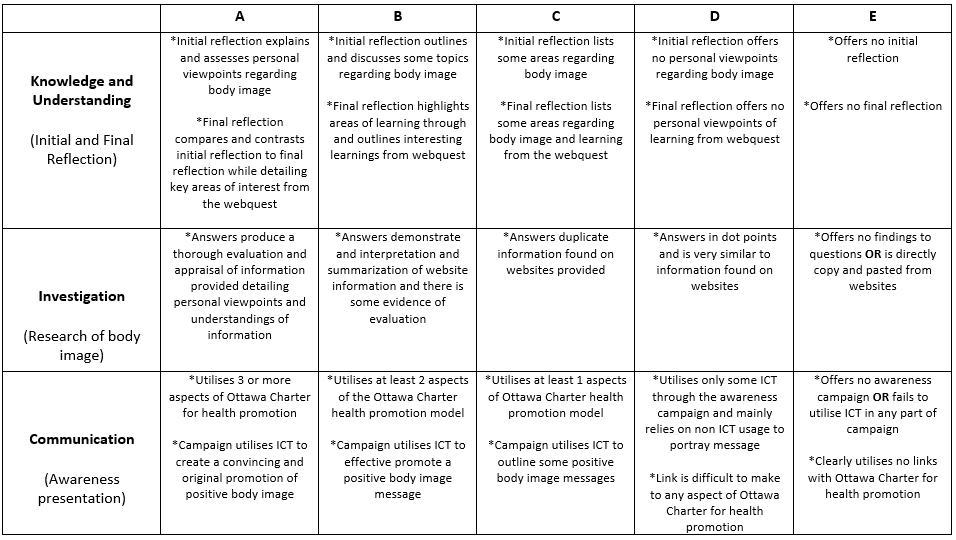
Utilising the links provided, answers the following questions in your own words. For higher grades, more detailed responses are required.
LINKS
Queensland Government Youth Health
History of Australian Body Image
(1C) Final Reflection
- TASK 2
Now that we have explored what body image is, what some of the main causes of negative body image are and how body image has evlolved over the years, your task will be to join your alloted groups and come up with an innovate cmpaign utilising ICT to spread our themed message of positive body image 'No Body's Perfect'.
Evaluation
Conclusion
Congratulations on the completion of the No Body's Perfect webquest!
We began reflecting on what we knew about body image before progressing via utilising the World Health Organistation's Determinats of Health to thoroughly investigate what causes negative body image in adolescence. We then accessed other credible external sources to develop our understanding of positive body image and the history of body image in Australia.
Through our second task, we accessed our prior knoweldge of health promotion by using the Ottawa Charter for Health Promotion to develop a campaign to promote our No Body's Perfect message utilising ICT.
We will now be progresing through our public health issue topics and begin looking in to safe and respectful relationships.
Credits
1) Australian Curriculum, Assessment and Reporting Authority. (2016). Information and communication technology (ICT) capability. Retrieved 19 April 2016, from http://www.australiancurriculum.edu.au/generalcapabilities/information-… communication- technology-capability/continuum#layout=columns&page=5
2) Queensland Curriculum & Assessment Authority. (2010). Health Education Senior Syllabus 2010. Retrieved 18 April 2016, from https://www.qcaa.qld.edu.au/downloads/senior/snr_health_ed_10_syll.pdf
3) Duchesne, S., McMaugh, A., Bochner, S., & Krause K. (2013). Educational Psychology. Victoria, Australia: Cenage Learning Australia Pty Ltd.
4) Krathwohl, D. R. (2002). A revision of Bloom's taxonomy: An overview. Theory into practice, 41(4), 212-218.
Teacher Page
The webquest ‘No Body’s Perfect’, is aimed at a senior Health class in the process of studying public health issues. At the time of this assessment, the Australian Curriculum Assessment and Reporting Authority (ACARA, 2016) has yet to develop the curriculum guidelines for senior health. As this is the case, schools in Queensland are currently continuing to follow the Queensland Curriculum and Assessment Authority (QCAA, 2010) syllabus when teaching senior health. The QCAA outlines that in senior health, students must learn about topics related to personal health issues and also health of specific populations. The QCAA outline that during the study of these topics, students must look at the determinants of health, ways in which individuals and communities can improve their health, health promotion strategies and the Ottawa Charter. There is clear evidence throughout the webquest ‘No Body’s Perfect’ that this task meets all of the above mentioned areas of the QCAA senior syllabus. Looking to the ACARA ICT general capabilities, many links can be found between the webquest meeting the capabilities. There is evidence that students meet the following areas while utilising ICT to complete the webquest; locate generate and access data information, select and evaluate data and information, generate ideas plans and processes and collaborate share and exchange.
There are numerous theoretical aspects that relate to the use of ICT in the classroom and specifically the webquest “No Body’s Perfect’. Howard Gardner’s Multiple Intelligences is one example of the pedagogical benefits to students in completing this webquest. Task 1 allows students to work at the intrapersonal level while task 2 places students in groups to work at the interpersonal level. Task 2 has been structured to allow students the choice of how they present their awareness campaign. This has been done to encourage students to select methods of delivery they feel most comfortable with and gives them freedom to work within any level of Gardner’s Multiple Intelligences. Duchesne, McMaugh, Bochner and Krause (2013) highlight the importance of not limiting student’s to one area of intelligence, however offering learning experiences that cover many aspects of Gardner’s theory to ensure all students have the opportunity to access their learning strengths while continuing to develop their other areas of learning.
All levels of Bloom’s Revised Taxonomy are evident throughout the learning tasks students engage in during the webquest. There is clear evidence that as students’ progress through the webquest, they are required to access higher order thinking skills outline by Krathwohl (2012) in the tasks they must complete. In task 1a, students are required to recall and remember what they personal know about body image while answering some simple question, clear evidence of the lower levels, remember and understand of the revised taxonomy. Students then follow provided website links to relevant information in task 1b where they need to analyse and evaluate the information in to what is relevant in irrelevant. They use these skills to answer the required questions. Task 2 places students at the highest level of the revised taxonomy, where they are required to create the awareness campaign utilising ICT tools. These examples clearly show how the use of the ICT webquest engages students at all levels of Bloom’s Revised Taxonomy enhancing the learning of students.