
Introduction
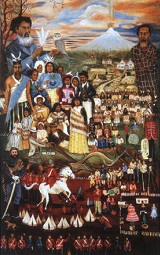 You have found much information about ANZAC Day. This is one way that people have tried to solve their problems in the past.
There have also been many people who tried to solve their problems and make big changes in non-violent ways. This WebQuest will help you to find out more about these people and to think about what they achieved.
You will be using the Multiple Intelligences that you prefer to use as you invetigate and present.
As a class, we will be talking about a success criteria rubric so that you can set goals for you and your group.
This is all part of 'LEARN, CREATE, SHARE'
Have fun and set high standards for yourself.
Task
Your task is to learn more about people in history whop have used non-violence to make change.
Use these key questions to guide you:
Q1. What happened?
Q2. Why did it happen?
Q3. What was the result?
Q4. Why it is important today?
You will then be presenting your thoughts, ideas and knowledge using 'Multiple Intelligences'. This can be done digitally or in other ways.
Process
Complete one activity from four of the 7 'Intelligences' Sections below ('Word Smart' is compulsory). 1. WORD SMART
- Write a post card and explain what happened and why. Do a suitable illustration on the back. Mail it to someone and ask for a reply.
- Create a comic strip or slide show that shows the main events. Share with others.
- Create a word search (http://tools.atozteacherstuff.com/word-search-maker/wordsearch.php) or crossword puzzle (http://worksheets.theteacherscorner.net/make-your-own/crossword/) using at least 10 words about the person and the event. Ask someone else to solve your puzzle.
2. MATHS SMART
- Create a survey to find out what the adults and the senior students at our school know about 4 different famous people who used non-violence. Present your findings.
- Create a board game using dice and counters to teach others a famous non-violent person or event. Use your game to teach others.
3. PICTURE SMART
- Paint a scene from a non-violent event from the past. Display in the library with a brief outline.
- Draw or paint a portrait of a historical non-violent figure so that they can be recognised by others. Display in the library with a brief bio.
- Create a digital collage with key words based on a non-violent event from the past. share with others.
- Look at works by Colin McCahon (http://www.mccahon.co.nz/). Create a 'word scape' in a similar style. share with the class the message of your art work.
4. BODY SMART
- With a group, act out a famous scene of non-violence from the past.
- Write and perform a rap with a non-violent message (or which tells about an event from history).
5. MUSIC SMART
- Using the tune of a song you know, change the lyrics to teach others about what happened at a famous non-violent event in history.
- Create a music theme for the news progamme in 'People Smart' and use if as part of the news broadcast.
- Write and perform a rap with a non-violent message.
6. PEOPLE SMART
- With a group, prepare a news programme about a non-violent event from the past. Imagine that it happened today. Use 'at the scene' interviews. Film and share.
- With a group, act out one of these famous non-violent events: Gandhi's salt march (http://www.history.com/topics/salt-march); Martin Luther King's march on Selma (http://www.history.com/topics/black-history/selma-montgomery-march); the unidentified man at Tianamen Square (https://www.youtube.com/watch?v=YeFzeNAHEhU); Rosa Parks and the bus (http://www.history.com/topics/black-history/rosa-parks); Anti Vietnam War Marches (http://www.teara.govt.nz/en/video/21113/anti-vietnam-war-march).
7. SELF SMART
- Imagine that you are part of a famous non-violent event. Write a series of diary entries over one week. How can you make it look realistic when you share it?
- Write your opinion about one of the major problems in the world today. Explain thoughtfully how you think that it could be solved.
HAPPY LEARNING, CREATING AND SHARING!
Evaluation
 |
|||||||||||||||||||||||||||||||||||||||||||||
 |
|
 |

Conclusion
Wow! That was a great journey.
You have explored and investigated the following:What happened at Parihaka,why it happened and why this is important today. Other people who used non-violence to achieve great things.You then presented your thoughts and ideas and knowledge in creative ways.and ....You demonstrated that you are an ENTHUSIASTIC LEARNER
Credits
'Exploring Time: A history of NZ for Children' Written by Jacquelyn Arbury. Illustrated by Terry Fitzgibbon
'New Zealand History: My History / My People' Written by Ruth Naumann
Teacher Page
 |
Social Sciences- Level 2-
Level 3-
Key Competencies:
|