
Introduction
Get ready and put on your space suits because we are going to explore the phases of the moon! Why does the moon look different on from night to night? Is it really changing? Why is it so bright? These are just a few of the questions that you will explore throughout this WebQuest. Get ready to discover all you want to know about the moon!
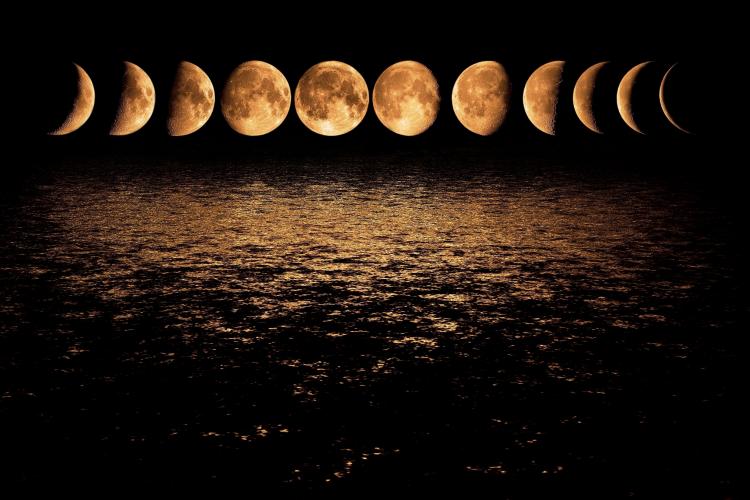
Task
Your task will be to research the names and cause of the phases of the moon. You will learn what the different phases are and why they occur throughout each month. You will use what you learn to complete different activities. This will demonstrate your understanding of the concepts explored throughout the WebQuest.
Process
1. Before the students get started they will read the following legend about the moon that was used in the Menomini Indians culture to explain the changes in the moon.
Once on a time Ke´so, the Sun, and his sister, Tipä´ke‘so, the Moon (“last-night sun”) lived together in a wigwam in the east. The Sun dressed himself to go hunting, took his bow and arrows and left. He was absent such a long time that when his sister c ame out into the sky to look for her brother she became alarmed. She traveled twenty days looking for the Sun; but finally he returned, bringing with him a bear which he had shot.
The sun’s sister still comes up into the sky and travels for twenty days; then she dies, and for four days nothing is seen of her. At the end of that time, however, she returns to life and travels twenty days more.
The Sun is a being like ourselves. Whenever an Indian dreams of him he plucks out his hair and wears an otter skin about his head, over the forehead. This the Indian does because the Sun wears an otter skin about his head.
2. The students should write a reflection in response to the following prompt. You have just read a Menomini Legend about why the moon appears to change from night to night. Think about what you have learned about how the Earth revolves around the sun. You should also think about how the moon appears to look in the sky from night to night. Write a short reflection in response to the legend. Do you think the shape of the moon changes throughout the month? Why or why not?
3. In groups of three or four begin a KWL chart. Add facts about what you know about the phases of the moon in the “K” column. Then add questions that you have or things that you would like to know about the phases of the moon to the “W” column. You will add what you learn to the “L” column throughout the rest of the WebQuest.
4. Complete the Discovery Education’s Phases of the Moon Exploration. Be sure to use the student exploration guide as you complete the exploration.
5. Watch NASA’s Phases of the Moon video. Make sure to note anything you learn on your KWL chart.
http://www.nasa.gov/multimedia/videogallery/index.html?media_id=80227191
6. Complete the Oreo Moon Phases Activity. Use the following link if you need more information.
http://science-es.discoveryeducation.com/
(Click on the "Moon, Earth, and Sun" tab. Then click on the "Moon" tab. You will see a list of reading passages, video clips, and ebooks listed)
7. Think about everything you have learned about the phases of the moon. Write a response to the following prompt. Imagine that you moved to the other side of the Earth. Would you see the same phases of the Earth that your friends would see in Georgia? Why or why not? Use the facts that you have learned throughout this WebQuest to support your thoughts.
8. Place all of your learning activities into your Science WebQuest folder and submit to the teacher.
Evaluation
|
You will be assessed on all portions of this WebQuest. You will include all activities in your Phases of the Moon WebQuest folder. Please use the rubric below to rate your own work before you submit your work to the teacher. Make sure that your work is satisfactory. |
||||||||||||||||||||||||||||||||||
| Evaluation Rubric | ||||||||||||||||||||||||||||||||||
|
|
||||||||||||||||||||||||||||||||||
|
Conclusion
You have now discovered everything you need to know about the phases of the moon through your research. You now understand the true reason that the moon's appearance changes throughout the month.
Teacher Page
This WebQuest should help students understand the phases of the moon and to clarify any of their misconceptions. The students should have learned a few basic concepts before the participating in this WebQuest activity. They should understand the following concepts: the Earth revolves around the sun, the sun does not move, and the Earth constantly rotates on an imaginary axis as it revolves around the sun