
Introduction
Lesson 1
In this first lesson you will be playing some card games to help develop your mathematical language. The words that you are to focus on in the game are:
Could happen - an event that may or may not happen.
Will happen - an event that will definitely happen.
Won't happen - an event that will definitely not happen.
The mathematical language that you will be learning is in relation to 'Chance' and this is a section of Statistics and Probability. You will notice these are words that you probably hear on a daily basis, not just at school.
Task
Task to Achieve Goals
- In your groups discuss what the terms could, will and won't mean to you, and where you may have heard them before.
- Looking at the cards you have been given you will notice they are of everyday activities or events. Using the table provided, type the activity, or event, into one of the 3 columns of the chance of the activity or event happening tomorrow. This step will be done on your own, by clicking on edit you will be able to put the activities into the right column.
- Press save and your results will be stored.
- Then get back into your group to discuss your answers.
- We will then get together as a class to do some comparisons.
- It is important to know that there is no right or wrong answer, it will be based on your experience.
Process
Cards and Table
|
Could |
Will |
Won’t |
|
|
|
|
|
|
|
|
|
|
|
|
|
|
|
|
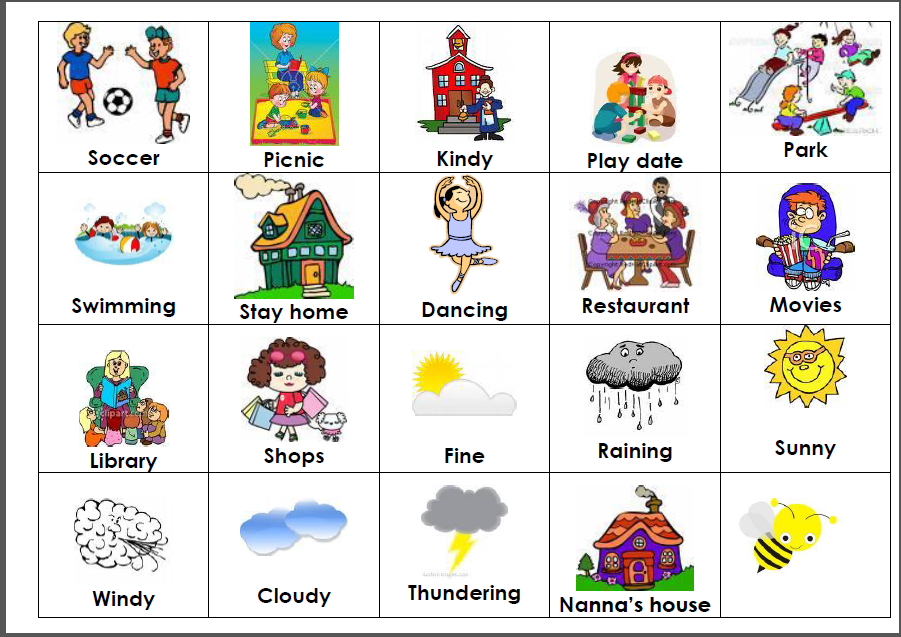
Evaluation
Discuss Results
Getting back into your groups, I want you to all go through what you each put for your cards. Take note of what other members of your group recorded, as many of you would have recorded different cards in different groups. Make sure you give reasons for why you put your cards where you did and have the members of your group to give you theirs also.
As a class we will then all get together and go through what you recorded. Everyone will choose one of their own, giving the reason why it was put where it was. You will also mention who from your group put the same card in a different column, and what their reason was.
Conclusion
What we learnt
In completing this lesson you are starting to use mathematical language, it's language that is dependant on your personal situation so at this stage there will be a good mixture of answers in the classroom. You are beginning to use the language of chance and linking the right answer with, the right outcome.
Credits
https://thecreativemummy.files.wordpress.com/2012/07/cards.png
First Steps in Mathematics: Chance and Data: Developing Probability and Statistics.
The Australian Curriculum: Mathematics
Teacher Page
The Australian Curriculum: Mathematics
In the first lesson, the students have begun to learn about describing everyday events and the chances of them occuring (ACMSP092). Also recording information in a manner that they can compare and share with fellow students (ACMSP).
Content structure: Statistics and Probability
Proficiency strand:
Understanding - students developing an understanding of the connections between school life and everyday life. Also commonalities between their own answers and why they are different from some of their class mates.
Reasoning - students starting to develop logical thought and the ability to compare and contrast with fellow students.