
Introduction
INTRODUCTION
Long ago that humans propose the need to replace works requiring excessive physical force, and that they could not do.
We have thousands examples: move huge rocks, raise car to repair, transport objects or people over long distances, apple cider extract, cut trees, solve many problems in a short time ...
To solve these great challenges are invented:
MACHINES
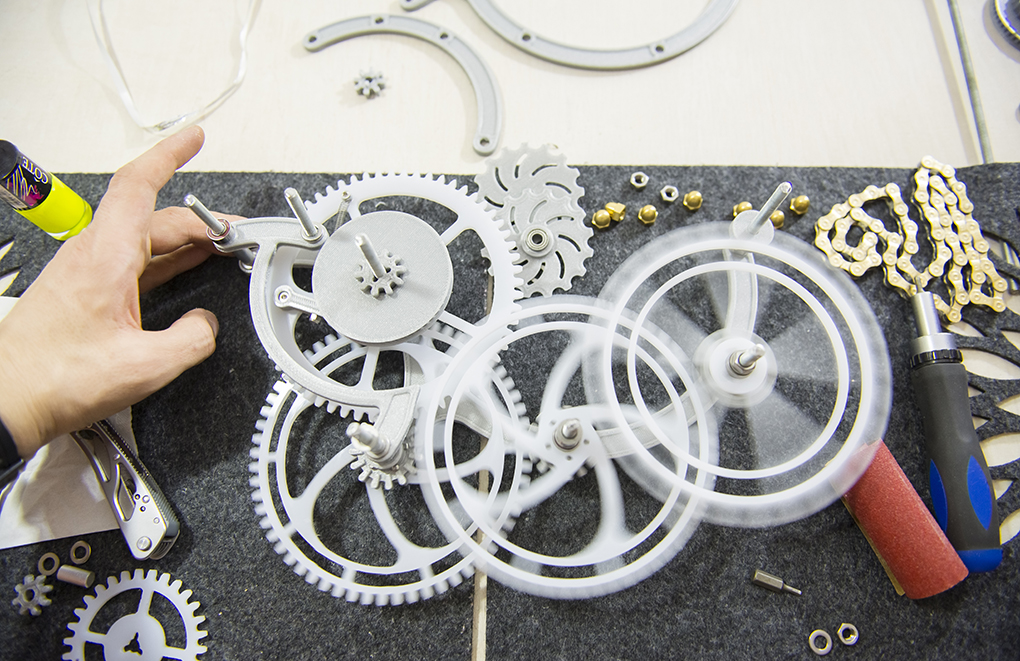
a crane or an excavator are machines; but so are a bicycle, or space rockets; not forgetting the simple knife, the scissors essential, the beloved computer or stairs.
They are all common machines and have at least one thing: they are all human inventions aimed at reducing the effort required to perform work. Almost any object can become a machine simply by giving the appropriate utility.
In this webquest you will find everything you need to learn about machines and mechanisms, its operation, classification, utility, etc.
To do this you will have to navigate through it, discovering for yourself the basic mechanisms to understand how more complex mechanisms work. All this you will discover and reflect it in the document must write and present.
I hope you take advantage of the opportunity and discover everything you concerned about the operation of machines and mechanisms.
Watch the video
and have a nice WALK !!!!!
click task to continue
Task

TASK
To carry out your task, you should make groups of 5 students, in order to elaborate the following tasks.
Task 1: Theorical work
Each group makes a presentation, separately, responding to the following questions or points:

a) Machine and Mechanism Concept.
b) Name types of machines and briefly discussed as is the performance of each.
c) Name and describe the elements of mechanisms.
d) Mechanisms: Name and explain the types of movements
Here you have some extra videos which will help you a little bit.......
Task 2: Practical work
Work in the same group you have in the previous task and choose a pair of simple machines and detect the mechanisms are present in performance.
now with the right material (cardboard, expanded polystyrene, paper, cloth, wire, wood ...)
Build the machine with the mechanisms have you detected!!!!!
Ready... steady... go....!!!!!!!

Build it!!!
then you present them to your colleagues, showing the main features and functions, applications, etc ...
Good luck!!!!
Process
HOW WILL WE WORK???
To perform the work will form groups of 5 students in each group will play a manager of each of the following roles:
- An engineer will search the Internet for different types of machines.
- A wise to seek the technical basis of each machine.
- An operator will be responsible for describing the construction of each machine.
- A patron who calculated the cost of the machine.
- An artist who created the Power Point presentation of the work.
The engineer will look for different types of machines and among all YOU WILL CHOOSE one invent. Once chosen ingenuity will have to talk to your teacher to check that no other group has taken it. Obviously you can work all at once, but when you have finished your work should help to go further back.
For practical work, the same machine, which will have to be built with the right materials.
the following links will help you to choose an option.
Bicycle: https://youtu.be/WQEbXD4Kqwc
Da vinci inventions: https://youtu.be/r66E6QLsMLg
Polley: https://youtu.be/LiBcur1aqcg
Others: https://youtu.be/0gjyVqwrf3E
mecanismos tecnologia secundaria
You can also watch YouTube videos on machines and mechanisms
Evaluation
EVALUATION

THE GROUPS WILL EVALUATE EACH PROJECT FOLLOWING THE RUBRIC ABOVE
|
3 POINTS |
6 POINTS |
8 POINTS |
10 POINTS |
|
|
ATTITUDE |
The group is not interested in the task. |
The group has a positive attitude and do what it should. |
The group shows interest in the activity and ask questions to the teacher. |
The group is amazing about the task, the teacher asks questions and wants to know more. |
|
CONTENT |
The content does not conform to the order or is incorrect. |
The content is accurate and complies with the order but contains some errors. |
The level of the above is good and has minor errors |
The level of the above is excellent and even superior to the course and no error |
|
PRESENTATION |
The presentation is poorly made and not attract attention |
The presentation is correct but has failures |
The presentation is good and attractive |
The presentation is very well done, interesting and attracts attention |
|
TEAMWORK |
Each member is not interested in making the other members or hinder the task of others |
The group tasks cohesive and no tensions. When a member terminates his own helping others |
The atmosphere is good and collaborative task is distributed smoothly |
The atmosphere is relaxed and there are no tensions, each member does his job but helps others when others ask. |
Conclusion
CONCLUSION
As you may have appreciated the machines appear from the earliest times, with the sole purpose of facilitating requiring tary force. The machines are present in most of our daily activities are based on the use of simple mechanisms which combined make the work to be performed require less effort.
You also may have noticed that the mechanisms are very simple and should be well designed for proper operation.
Finally I hope you have the basic knowledge so that in the future you are able to design your own machines and make life easier.
Reflect on these conclusions and prepare the exposure you should do in class on the final day.