
Introduction
.gif)
Coral reefs are diverse underwater ecosystems held together by calcium carbonate structures secreted by corals. Coral reefs are built by colonies of tiny animals found in marine waters that contain few nutrients. Most coral reefs are built from stony corals, which in turn consist of polyps that cluster in groups. The polyps belong to a group of animals known as Cnidaria, which also includes sea anemones and jellyfish. Unlike sea anemones, corals secrete hard carbonate exoskeletons which support and protect the coral polyps. Most reefs grow best in warm, shallow, clear, sunny and agitated waters.
Often called "rainforests of the sea", shallow coral reefs form some of the most diverse ecosystems on Earth. They occupy less than 0.1% of the world's ocean surface, about half the area of France, yet they provide a home for at least 25% of all marine species, including fish, mollusks, worms, crustaceans, echinoderms, sponges, tunicates and other cnidarians. Paradoxically, coral reefs flourish even though they are surrounded by ocean waters that provide few nutrients. They are most commonly found at shallow depths in tropical waters, but deep water and cold water corals also exist on smaller scales in other areas.
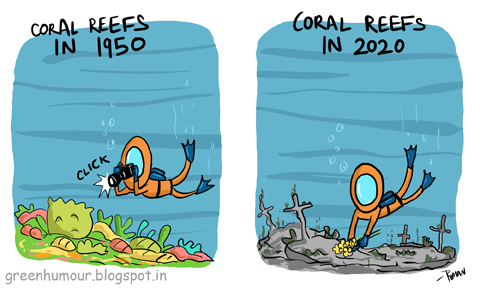
Coral reefs deliver ecosystem services to tourism, fisheries and shoreline protection. The annual global economic value of coral reefs is estimated between US$29.8-375 billion. However, coral reefs are fragile ecosystems, partly because they are very sensitive to water temperature. They are under threat from climate change, oceanic acidification, blast fishing, cyanide fishing for aquarium fish, sunscreen use, overuse of reef resources, and harmful land-use practices, including urban and agricultural runoff and water pollution, which can harm reefs by encouraging excess algal growth.
Retrieved from https://en.wikipedia.org/wiki/Coral_reef
Task
Your task will be to research and create a bill to protect and to raise awareness about the demise of the coral reefs and oceans.
1. Use the links found under the "process" tab and begin researching.
2. Take notes on the blank lined paper found in your folder.
3. According to your marine interest, create a bill.
* Your final draft of the bill needs to be written on the ballot paper*
* Your group needs to be prepared to share your bill to the class*
Process

Use the links below and begin researching a topic of your interest.
Websites:
- Sunscreen damaging Coral reefs Across the World (2015)
-
Coral Reef Alliance (2014).
-
U.S. Department of Commerce http://coralreef.noaa.gov/deepseacorals/about/facts/dsc_important.htm
- Coral Reefs :Threats By WWF. Retrieved from http://wwf.panda.org/about_our_earth/blue_planet/coasts/coral_reefs/coral_threats/
-
Exploring the Coral Reef: Learn about Oceans for Kids - FreeSchool https://www.youtube.com/watch?v=J2BKd5e15Jc.
- President Obama Protects our Oceans and Coasts
- Destruction of Coral Reefs Project (2014).
https://www.youtube.com/watch?v=X43MaT2wMRI.
- Community Saves Mexican Coral Reefs By Philippe Cousteau, for CNN (2012). http://www.cnn.com/videos/world/2012/09/15/going-green-mexico-reef.cnn
- Coral Reef Protection
http://environmentallaw.uslegal.com/specific-issues/coral-reef-protection/
Step 2. Investigate how much and how fast the coral reefs are being destroyed.
1. What is the effect of having a dying or dead coral in the ocean?
Resources
-
Caribbean Coral Reefs Mostly Dead, IUCN Says By Christine Dell'Amore (2012). http://voices.nationalgeographic.com/2012/09/06/caribbean-coral-reefs-mostly-dead-iucn-says/
Step 3. Investigate how coral reefs affect the ocean/world.
How do coral reefs help the environment?
How do humans benefit from coral reefs?
Websites:
-
What Are Coral Reefs And What's Their Purpose? (2009). https://www.youtube.com/watch?v=eIul2ObvKV8
-
Fast Facts: Why Coral Reefs are Important to People By WWf http://wwf.panda.org/about_our_earth/blue_planet/coasts/coral_reefs/coral_facts
Step 4. Define and analyze the problem from different perspective.
1. Does sunscreen damage coral reefs?
2. How does Global Warming affect coral reefs?
3. Is fishing a major threat to coral reefs?
4. Does run-off affect coral reefs?
5. Does picking up trash and debris at the beach help maintain coral reefs?
6. How important is coral conservation?
7. What is coral bleaching?
Step 5. Develop a solution.
What can be done to cure dying coral reefs?
-
Nurseries Bring Coral Reefs Back to LIfe By Jennifer Gray, for CNN (2015). http://www.cnn.com/2015/07/07/us/coral-reef-restoration-florida-keys/index.html
-
Electrified Coral Marks New Life for Reef By Eoghan Macguire, for CNN (2012). http://www.cnn.com/2012/01/26/world/biorock-coral-regeneration/index.html
-
How to Save the World's Coral Reefs By Caleb McClennen (2015). http://www.huffingtonpost.com/caleb-mcclennen/how-to-save-the-worlds-coral-reefs_b_7487980.html
- The Key to saving Caribbean Coral Reefs Maybe These Fish, researchers Say By Sara Gates (2014).
Evaluation
If there is time, investigate the following questions:
1. Are there different types of Corals?
2. Where are coral reefs located?
3. What type of species live near coral reefs?
4. How long does it take for a coral and reef to form?
5. How big do corals and reefs get?
6. What are corals made of?
7. Why are coral reefs important?
8. What are some of the things that damage coral reefs?
9. How can we protect coral reefs?