
Introduction
You will be looking at 3 different sections.
- Steel
- Oil
- Transportation
Each of these are general contributions to industry in the late 1800s.
Remember, the Civil War is over, and Reconstruction was hardly successful. More and more people will be coming to America for a new life. How will America transform after the Civil War?
Task
You will need to fill out a comprehensive organizer to help you understand the mechanics of each category.
Process
STEEL:
Images: 

The video: [video:https://www.youtube.com/watch?v=OW5qYmY11_0]
The reading:
STEEL
The rise of the steel industry in the United States drove America's growth as a world economic power. Although ironworks had been established in the North American colonies shortly after European settlement began, it wasn't until the 19th century, when technological advances decreased the cost and increased the quality, that steel manufacturing became a dominant industry. With the abundant iron ore deposits around Lake Superior, the rich coal veins of Pennsylvania and the easy access to cheap water transportation routes on the Great Lakes, the Midwest became the center of American heavy industry. In the years after the Civil War, the American steel industry grew with astonishing speed as the nation's economy expanded to become the largest in the world. Between 1880 and the turn of the century, steel production increased from 1.25 million tons to more than 10 million tons. By 1910 America was producing more than 24 million tons, by far the greatest of any country.
Iron has been a vital material in technology for well over three thousand years. But until the Industrial Revolution, its mining, smelting, and working were largely done by individuals and small groups. Each mine, forge, and blacksmith usually employed only a few dozen men at most.
Iron mining and working began in British North America almost as soon as settlement began, the first ironworks being set up at Jamestown, Virginia, in 1621. John Winthrop, Jr., established an ironworks on the Saugus River in Lynn, Massachusetts, as early as 1646. It was an elaborate enterprise for its time and place, but it was never a profitable business and soon collapsed into bankruptcy.
Known since ancient times, steel is made by alloying iron with carbon to produce a harder, stronger metal that will take a much keener edge. But steel was very expensive to manufacture by the primitive methods then available, and its use was largely confined to high-value specialty products such as swords and precision instruments. The United States imported almost all its steel until after the Civil War.
The coming of the steam age transformed the iron industry. The demand for rolled iron for boilers increased exponentially. And between 1830 and 1861 more than thirty thousand miles of railroad were built in the United States, providing an enormous market for iron rails and allowing the creation of a national market for manufactured goods. This vast increase in demand caused iron mills to grow quickly into major enterprises.
In 1844 U.S. government surveyors discovered the first of the great iron ore deposits in the Great Lakes states. By the late 1850s these were being aggressively exploited. The abundance of rich iron ore around Lake Superior, the anthracite of Pennsylvania, and the cheap water transport available on the Great Lakes ensured that this area would be the center of the American iron and steel industry thereafter. As the production of iron and steel became the driving force of the Industrial Revolution, the Midwest became the center of American heavy industry.
In 1856 the British engineer Henry (later Sir Henry) Bessemer developed the Bessemer process for making steel. Two years later the Siemens-Martin open-hearth method was developed. Once perfected, these processes greatly lowered the cost of steel production and allowed the increasingly lavish use of steel for railroads, construction, and other industrial purposes.
The first Bessemer converter in the United States was established in 1864. Four years later Abram S. Hewitt built the first open-hearth furnace, which was better suited to most American iron ore. Steel production increased rapidly thereafter. In 1873 the United States, which had produced no steel rails before the Civil War, produced nearly 115,000 tons, one-eighth of all American rail production. As the price of steel continued to drop, iron rails, brittle and requiring frequent replacement, disappeared. The iron age was over.
The industry also consolidated during this era as mill owners sought economies of scale, guaranteed sources of raw materials, and stable market conditions. Andrew Carnegie, Henry Clay Frick, Charles Schwab, and others shaped the modern industry in these years. The period was also often wracked by violent labor disputes such as the Homestead strike in 1892, and the industry would not be fully unionized until the 1930s.
In 1901, under the leadership of J. Pierpont Morgan and Elbert H. Gary, the United States Steel Corporation, the largest industrial enterprise on earth, was established. Capitalized at $1.4 billion, it controlled more than 60 percent of the American market.
RAILROADS:
The map:


The video: [video:https://www.youtube.com/watch?v=1VDS6pZXezo]
The reading:
Binding the Nation by Rail
Give Me a Brake
After the Civil War many rail problems were solved. GEORGE WESTINGHOUSE invented the air brake and trains could stop more reliably as a result. Railroad firms agreed on a standard width between tracks to reduce transfers. The PULLMAN CAR COMPANY produced sleeper cars and dining cars to make travel more comfortable.
The Transcontinental Railroad
Soon after the railroad made its appearance in the U.S. in the 1830s, Americans dreamed of linking the Atlantic and Pacific Oceans by rail. A TRANSCONTINENTAL RAILROAD would allow for settlement of the west, open new markets for eastern manufacturers, and bring relief to overcrowded eastern cities.
Some even believed that it was divinely intended that Americans should control the whole of the continental U.S. In 1845, a Democratic journalist named JOHN L. O'SULLIVAN coined the phrase "MANIFEST DESTINY."
Steaming locomotives would hasten western settlement, spread democratic values, and increase the size of the United States (Arizona, Oklahoma, New Mexico etc., were not yet states, only TERRITORIES). Western SETTLEMENT was a paramount national interest. As such, the federal government awarded the contract to link the coasts by rail to two companies, the UNION PACIFIC and the CENTRAL PACIFIC.
The Golden Spike
The government declared that the two lines would merge at PROMONTORY SUMMIT near Ogden, Utah. On May 10, 1869, LELAND STANFORD, representing the Central Pacific Railroad, was provided the honor to hammer a golden spike into the ground that marked the completion of the coast-to-coast line. Celebrations erupted across the land. Even the Liberty Bell tolled once again to commemorate the occasion.
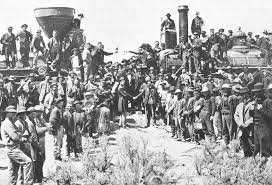
Soon, other transcontinental lines were constructed and travel across the continent became worlds simpler, less expensive, and much faster, than by the old Conestoga wagon.
On the Right Track
The engineering achievement was monumental. The costs of the operation to railroads were enormous. Tens of thousands of workers had to be paid, sheltered, and fed. Tons of steel and wood were required.
However, the economic incentives to railroads were enormous. The government offered generous loans to companies who were willing to assume the risk. The greatest reward was land. For each mile of track laid by the Central and Union Pacific Railroads, the companies received 640 acres of public land. In other rail projects, state governments often kicked in additional acres for a growing number of rail companies.
The Interstate Commerce Commission
All in all, the railroads received nearly 200 million acres of land from the U.S. government for fulfilling contracts. Directors of some railroads made fortunes. Foremost among the RAILROAD TYCOONS were CORNELIUS VANDERBILT, JAMES J. HILL, and JAY GOULD.
But freight railroad abuses grew rampant. Money lined the pockets of greedy public officials who awarded generous terms to the railroads. Railroad companies set their own shipping rates.
Sometimes it was more expensive for a small farmer to ship goods to a nearby town than to a faraway city. Because the companies kept their rates secret, one farmer could be charged more than another for the same freight transport.
To reduce competition, railroad companies established pools. These were informal arrangements between companies to keep rates above a certain level. Consequently, the public suffered. Finally, in 1887, Congress responded to public outcry by creating the INTERSTATE COMMERCE COMMISSION to watch over the rail industry. This was the nation's first REGULATORY AGENCY. Due to in concise wording in its enabling legislation, the ICC was largely ignored until the early 20th century.
But the public also reaped great benefits. Eastern businessmen could now sell their goods to California citizens. As a result of improved transportation all Americans had access to more goods at a cheaper price. The westward movement was greatly accelerated. Those seeking a new start in life could much more easily "go west".
No industrial revolution can occur without a transport web. The nation was now bound together by this enormous network and its citizens were ready to reap the rewards.
OIL:
The chart:
| U.S. Field Production of Crude Oil (Thousand Barrels) |
| Decade | Year-0 | Year-1 | Year-2 | Year-3 | Year-4 | Year-5 | Year-6 | Year-7 | Year-8 | Year-9 |
|---|---|---|---|---|---|---|---|---|---|---|
| 1850's | 2 | |||||||||
| 1860's | 500 | 2,114 | 3,057 | 2,611 | 2,116 | 2,498 | 3,598 | 3,347 | 3,646 | 4,215 |
| 1870's | 5,261 | 5,205 | 6,293 | 9,894 | 10,927 | 12,163 | 9,133 | 13,350 | 15,397 | 19,914 |
| 1880's | 26,286 | 27,661 | 30,350 | 23,450 | 24,218 | 21,859 | 28,065 | 28,283 | 27,612 | 35,164 |
| 1890's | 45,824 | 54,293 | 50,515 | 48,431 | 49,344 | 52,892 | 60,960 | 60,476 | 55,364 | 57,071 |
| 1900's | 63,621 | 69,389 | 88,767 | 100,461 | 117,081 | 134,717 | 126,494 | 166,095 | 178,527 | 183,171 |
| 1910's | 209,557 | 220,449 | 222,935 | 248,446 | 265,763 | 281,104 | 300,767 | 335,316 | 355,928 | 378,367 |
| 1920's | 442,929 | 472,183 | 557,531 | 732,407 | 713,940 | 620,373 | 770,874 | 901,129 | 901,474 | 1,007,323 |
| 1930's | 898,011 | 851,081 | 785,159 | 905,656 | 908,065 | 993,942 | 1,098,513 | 1,277,653 | 1,213,254 | 1,264,256 |
| 1940's | 1,503,176 | 1,404,182 | 1,385,479 | 1,505,613 | 1,677,904 | 1,713,655 | 1,733,424 | 1,856,987 | 2,020,185 | 1,841,940 |
| 1950's | 1,973,574 | 2,247,711 | 2,289,836 | 2,357,082 | 2,314,988 | 2,484,428 | 2,617,283 | 2,616,901 | 2,448,987 | 2,574,590 |
| 1960's | 2,574,933 | 2,621,758 | 2,676,189 | 2,752,723 | 2,786,822 | 2,848,514 | 3,027,763 | 3,215,742 | 3,329,042 | 3,371,751 |
| 1970's | 3,517,450 | 3,453,914 | 3,455,368 | 3,360,903 | 3,202,585 | 3,056,779 | 2,976,180 | 3,009,265 | 3,178,216 | 3,121,310 |
| 1980's | 3,146,365 | 3,128,624 | 3,156,715 | 3,170,999 | 3,249,696 | 3,274,553 | 3,168,252 | 3,047,378 | 2,979,123 | 2,778,773 |
| 1990's | 2,684,687 | 2,707,039 | 2,624,632 | 2,499,033 | 2,431,476 | 2,394,268 | 2,366,017 | 2,354,831 | 2,281,919 | 2,146,732 |
| 2000's | 2,130,707 | 2,117,511 | 2,096,588 | 2,061,995 | 1,991,394 | 1,892,095 | 1,856,606 | 1,853,243 | 1,830,416 | 1,954,241 |
| 2010's | 1,998,583 | 2,057,608 | 2,370,114 | 2,720,782 | 3,182,583 |
The video:[video:https://www.youtube.com/watch?v=Nmo4HT-C5OQ]
The reading:
The 19th century was a period of great change and rapid industrialization. The iron and steel industry spawned new construction materials, the railroads connected the country and the discovery of oil provided a new source of fuel. The discovery of the Spindletop geyser in 1901 drove huge growth in the oil industry. Within a year, more than 1,500 oil companies had been chartered, and oil became the dominant fuel of the 20th century and an integral part of the American economy.
Many of the early explorers of America encountered petroleum deposits in some form. They noted oil slicks off the coast of California in the sixteenth century. Louis Evans located deposits along the eastern seaboard on a 1775 map of the English Middle Colonies.
Settlers used oil as an illuminant for medicine, and as grease for wagons and tools. Rock oil distilled from shale became available as kerosene even before the Industrial Revolution began. While traveling in Austria, John Austin, a New York merchant, observed an effective, cheap oil lamp and made a model that upgraded kerosene lamps. Soon the U.S. rock oil industry boomed as whale oil increased in price owing to the growing scarcity of that mammal. Samuel Downer, Jr., an early entrepreneur, patented “Kerosene” as a trade name in 1859 and licensed its usage. As oil production and refining increased, prices collapsed, which became characteristic of the industry.
The first oil corporation, which was created to develop oil found floating on water near Titusville, Pennsylvania, was the Pennsylvania Rock Oil Company of Connecticut (later the Seneca Oil Company). George H. Bissell, a New York lawyer, and James Townsend, a New Haven businessman, became interested when Dr. Benjamin Silliman of Yale University analyzed a bottle of the oil and said it would make an excellent light. Bissell and several friends purchased land near Titusville and engaged Edwin L. Drake to locate the oil there. Drake employed William Smith, an expert salt driller, to supervise drilling operations and on August 27, 1859, they struck oil at a depth of sixty-nine feet. So far as is known, this was the first time that oil was tapped at its source, using a drill.
Titusville and other towns in the area boomed. One of those who heard about the discovery was John D. Rockefeller. Because of his entrepreneurial instincts and his genius for organizing companies, Rockefeller became a leading figure in the U.S. oil industry. In 1859, he and a partner operated a commission firm in Cleveland. They soon sold it and built a small oil refinery. Rockefeller bought out his partner and in 1866 opened an export office in New York City. The next year he, his brother William, S. V. Harkness, and Henry M. Flagler created what was to become the Standard Oil Company. Flagler is considered by many to have been nearly as important a figure in the oil business as John D. himself.
Additional discoveries near the Drake well had led to the creation of numerous firms and the Rockefeller Company quickly began to buy out or combine with its competitors. As John D. phrased it, their purpose was “to unite our skill and capital.” By 1870 Standard had become the dominant oil refining firm in Pennsylvania. Pipelines early became a major consideration in Standard’s drive to gain business and profits. Samuel Van Syckel had built a four-mile pipeline from Pithole, Pennsylvania, to the nearest railroad. When Rockefeller observed this, he began to acquire pipelines for Standard. Soon the company owned a majority of the lines, which provided cheap, efficient transportation for oil. Cleveland became a center of the refining industry principally because of its transportation systems.
When product prices declined, the ensuing panic led to the beginning of a Standard Oil alliance in 1871. Within eleven years the company became partially integrated horizontally and vertically and ranked as one of the world’s great corporations. The alliance employed an industrial chemist, Hermann Frasch II, to remove sulfur from oil found at Lima, Ohio. Sulfur made distilling kerosene very difficult, and even then it possessed a vile odor—another problem Frasch solved. Thereafter, Standard employed scientists both to improve its product and for pure research. Soon kerosene replaced other illuminants; it was more reliable, efficient, and economical than other fuels.
Eastern cities linked to the oil fields by rail and boat boomed also. The export trade from Philadelphia, New York, and Baltimore became so important that Standard and other companies located refineries in those cities. As early as 1866 the value of petroleum products exported to Europe provided a trade balance sufficient to pay the interest on U.S. bonds held abroad.
When the Civil War interrupted the regular flow of kerosene and other petroleum products to western states, pressure increased to find a better method of utilizing oil found in such states as California. But Standard exhibited little interest in the oil industry on the West Coast before 1900. In that year it purchased the Pacific Coast Oil Company and in 1906 incorporated all its western operations into Pacific Oil, now Chevron.
Edward L. Doheny located Los Angeles’s first well in 1892, and five years later there were twenty-five hundred wells and two hundred oil companies in the area. When Standard entered California in 1900, seven integrated oil companies already flourished there. The Union Oil Company was the most important of these.
Operating difficulties plus the threat of taxation on its out-of-state properties led to the creation of the Standard Oil Trust in 1882. In 1899 the trust created Standard Oil Company (New Jersey), which became the parent company. The trust controlled member corporations principally through stock ownership, an arrangement not unlike that of the modern-day holding company.
The tremendous growth of Standard did not occur without competition. Pennsylvania producers engineered the creation of an important competitor, the Pure Oil Company, Ltd., in 1895. This concern endured for more than a half century.
In 1901 one of the largest and most significant oil strikes in history occurred near Beaumont, Texas, on a mound called Spindletop. Drillers brought in the greatest gusher ever seen within the United States. This strike ended any possible monopoly by Standard Oil. One year after the Spindletop discovery more than fifteen hundred oil companies had been chartered. Of these, fewer than a dozen survived, principally the Gulf Oil Corporation, the Magnolia Petroleum Company, and the Texas Company. The Sun Oil Company, an Ohio-Indiana concern, also moved to the Beaumont area as did other firms. Other oil strikes followed in Oklahoma, Louisiana, Arkansas, Colorado, and Kansas. Oil production in the United States by 1909 more than equaled that of the rest of the world combined.
Many smaller companies developed outside the Northeast and the Midwest where Rockefeller and his associates operated. Oil found at Corsicana, Texas, in the 1890s attracted a remarkable Pennsylvanian, Joseph S. (“Buckskin Joe”) Cullinan, who organized several small companies. He later moved to Spindletop where he became instrumental in the organization of the Texas Company, soon a major competitor of Standard. Henri Deterding, creator of the Royal Dutch-Shell Group in Holland and Great Britain, moved into California in 1912 with his American Gasoline Company (Shell Company of California after 1914).
As Standard Oil grew in wealth and power, it encountered great hostility not only from its competitors but from a vast segment of the public. Standard fought competition by securing preferential railroad rates and rebates on its shipments. It also influenced legislatures and Congress through tactics that, though common in that era, were unethical. Nor was the company’s handling of labor any better.
Increasing sales of gasoline first for automobiles and then for airplanes in the early 1900s came as oil discoveries across the United States mounted. The oil industry had a vast new market for what had been for many years a useless by-product of the distilling process. As soon as the internal combustion engines created demand, refiners sought better methods to produce and improve gasolines.