
Introduction
Instructions: In your notebook, write your responses to the bold tasks.
 It was a crisp fall morning and I was running late for work. I turned off my battery operated alarm clock, quickly brushed my teeth, made a smoothie, grabbed clean clothes from the dryer, checked the mail and headed out the door for work. In less than one hour, I had turned on and off several motors just to get myself ready for work. Indeed motors are all around us.
Think of a motor as anything that converts electrical energy into mechanical/kinetic energy- nearly everything that has moving parts is driven by a motor.
Make a list of ten common household items that have an electric motor in them.
Continue to the task section to learn how a simple motor works.
Task
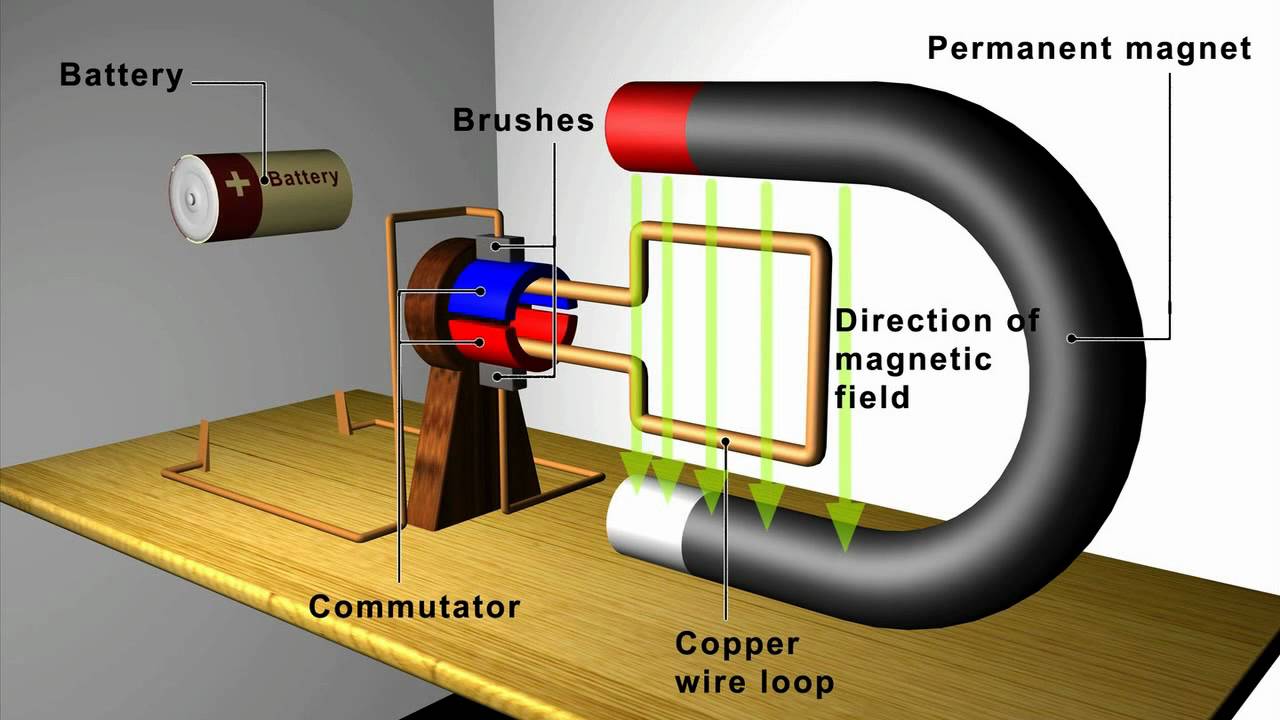
Electric motors are comprised of an current carrying coil of wire placed between magentic poles. Opposite magnetic poles are attracted and create an invisible force called a magnetic field. The magnetic field exerts a force on the electric current and produces rotary motion. This video is a simple electric motor, using a battery, magnet and copper wire.
[video:https://www.youtube.com/watch?v=94RpbYopUdI align:center]
The diagrams below show a basic motor with a battery as the electrical source. Have you have built a simple electric motor before?
Take a look at the diagrams below and discuss building a motor with your partner.
Follow the steps in the process section to learn how motors led to the discovery of generators.

Process
1. Go to https://www.nde-ed.org/EducationResources/HighSchool/Magnetism/electricmotor.htm
Explain why magnetism is important to the operation of an electric motor.
2. Michael Faraday discovered that an electric current generates a magnetic field in 1821. In 1831, Michael Faraday used this discovery to invent the electric motor. Watch the video clip to learn about Faraday's early life and his first discovery.
[video:https://www.youtube.com/watch?v=TEVEBzNSwTU align:center]
3. Go to https://www.nde-ed.org/EducationResources/HighSchool/Magnetism/electricitymagnet2.htm
Describe how a galvanometer works.

4. Define electromagnetic induction and relative motion.
5. Watch the video at the following link. Describe alternating and direct current.
6. What is the main difference between a motor and a generator?
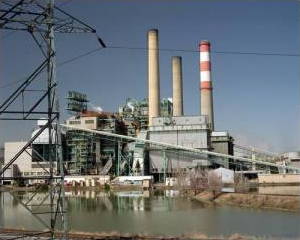
7. You now know what it takes to generate electricity. Below is a photo of a coal power plant. In Canada, 12.6% of electrical energy is generated by burning coal. Draw a diagram to show how energy is converted from coal to a form of mechanical energy (ie. vacuum, electric lawn mower) in your home.
9. So you have learned that generators transform mechanical energy into electrical energy. Now make a list of six different sources of mechanical energy that can be converted into electrical energy. Check out the link for ideas http://www.nrcan.gc.ca/energy/electricity-infrastructure
10. What is the difference between renewable and non renewable sources of energy? Give at least three examples of each.
11. Read then explain why we need to use renewable sources of energy to generate electricity.
http://education.nationalgeographic.com/encyclopedia/non-renewable-energy/
12. Generate eight questions that someone could answer after reading this article.
Two questions should come from each of the four categories of questions: searching, explain, connect and relate to self. Searching answers can be found directly in the text. Explain answers require the ability to synthesize the information. Connect answers relate the material in the article to prior knowledge about the topic. Relate to self answers include a personal viewpoint related to the topic. Make sure your questions fit into these categories.
13. Write a summary that responses to these questions.
- According to the law of conservation of energy, energy cannot be created or destroyed. How does a generator create energy?
- What materials would you need to build a generator?
- What could power your generator?
- What renewable energy sources can be harnessed to generate electricity?
Evaluation
CHALLENGE
Once you have submitted your written part you will be given the following materials.
- 35 mm film canister
- Thin insulated copper wire
- Magnets that just fit in canister
- Scissors or wire cutters
- Sandpaper
- LED light buib
- Electrical tape
Your group challenge is to create a simple generator that will provide electricity to power an LED light bulb.
You are allowed to search the internet for ideas. Your group must submit a 2 minutes video that shows the process of designing, building and testing your generator. The video must include an explanation of how a generator works.
Each group member needs to assume a role in the process of designing, building and testing your generator.
Researcher: You are the lead person for the design of your generator. You direct the research process.
Camera Operator: You are in charge of the technology and making edits.
Builder: You are in charge of construction the generator when recording the video. Keep in mind that your partners will help you design and test the generator.
Script Writer: You are in charge of writing and reading the script. You may choose to type of the script or have commentary.
Your video will be assessed on the following criteria---
- Knowledge: Do you explain the scientific concepts related to building a generator?
- Simplicity: Is your explanation clear and concise?
- Demonstration: Do you demonstrate the steps in a sequential order?
Each category will be given a maximum of 10 points for a total score out of 30.
GOOD LUCK!!
Teacher Page
This self-directed study would be implemented at the end of the unit on fields. The students will have learned about magnetic, gravitational and electric fields, and electric circuits.
Curriculum Outcomes
Nova Scotia Grade 12 Physics
Generators and Motors (4 hours)
- Compare and contrast the ways a motor and generator function, using the principles of electromagnetism (328-9)
- Describe and compare direct current and alternating current (ACP-4)