
Introduction
This term in year 12 Physical Education we will be looking at biomechanical principles and Athletics. In order for you to be able to enhance your athletic performance you must be able to first understand the biomechanical principles. This WebQuest is an introduction into your practical and theory topics. Each student must complete the WebQuest. Click on the hyperlinks to access the different resources. Class and home time will be required.

Context: In the first practical class of the term you conducted a series of pretests relating to Athletics including seeing how far you could throw a javelin. Your aim is to identify which biomechanical principles you could use to improve the distance you threw the javelin. You will be given class time to put these principles into practice before conducting a posttest.
Ashleigh Kaye
SID: 1059344
Task
The aim for this WebQuest is for you to gain an understanding of how biomechanical priciples can improve an individual's athletic performance.
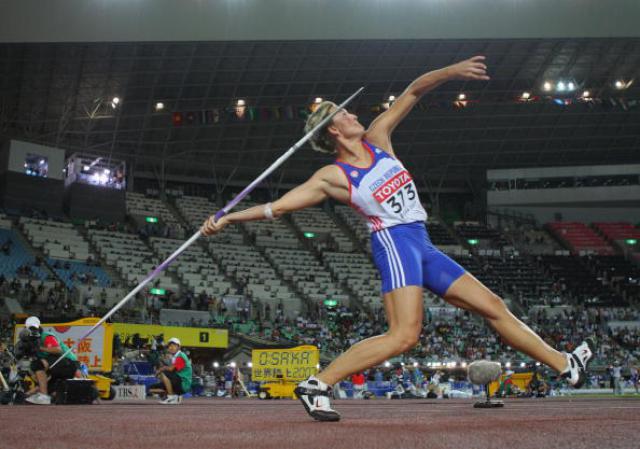
To do this you will look at professional javelin throws, research biomechanical principles and write two short paragraphs on two principles that you could use to improve your own javelin throw. This will be what you are marked on.
This is an individual activity.
Process
Your task has 4 parts:
1. Research the Athletics Australia website. Have a look at Australian records. Also have a look at the Under 18 men's and women's world records. How far off was your distance?
[video:https://www.youtube.com/watch?v=sdfmagI8NK4 align:center]
_______________________________________________________________________________________________________________
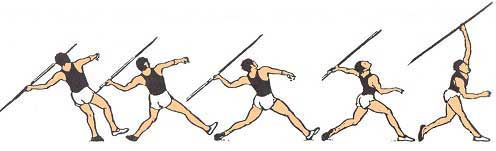
2. Research the correct javelin throwing technique. Do you follow all the steps in order?
_______________________________________________________________________________________________________________
3. Research biomechanical principles.
_______________________________________________________________________________________________________________
4. Choose two biomechanical principles and write a paragraph on each explaining how you could adjust your technique, based on these principles, to improve your throw.

Evaluation
Conclusion
Congratulations, you've now finished the webquest! Don't forget to submit your two paragraphs to the class DropBox. Over the coming weeks we will look further into biomechnical principles and determine which principles can be applied to enhance your performance in other athletic events. Remember to apply what you have learnt to your training for the remainder of the training period. Your post-tests will be conducted in week 9 as your results will be used for your summative assessment task in week 10.
Don't forget to keep an eye out for the athletic events in the up coming Rio Olympics. You never know, that might be you one day!
[video:https://www.youtube.com/watch?v=jZMxjRSL7dw align:center]
Credits
References
Athletics Australia. (2016a). Athletics Australia. Retrieved from http://athletics.com.au
Athletics Australia. (2016b). Australian Outdoor Records as at 20th April 2016. Retrieved from http://athletics.com.au/LinkClick.aspx?fileticket=Bv-yUGpSJyk%3d&portal…
BrianMac Sports Coach. (2016). Javelin. Retrieved from http://www.brianmac.co.uk/javelin/
International Association of Athletics Federations. (2016a). Under 18 Outdoor Javelin Throw (700g) Men. Retrieved from https://www.iaaf.org/records/toplists/throws/javelin-throw-700g/outdoor…
International Association of Athletics Federations. (2016b). Under 18 Outdoor Javelin Throw (500g) Women. Retrieved from https://www.iaaf.org/records/toplists/throws/javelin-throw-500g/outdoor…
International University Sports Federation. [FISUTV]. (2014, September 16). Athletics Women's Javelin Throw Final - 27th Summer Universiade 2013 - Kazan (RUS) [ video file ]. Retrieved from https://www.youtube.com/watch?v=jZMxjRSL7dw
Wood, D.K., (2016). Principles about Projectiles in Sports. Retrieved from http://www.sports-training-adviser.com/projectiles-in-sports.html
World Athletics Championships 2015. (2016, August 26). Julius Yego winner 92.72m WL Men's Javelin Final | IAAF World Athletics Championships BEIJING 2015 [ video file ]. Retrieved from https://www.youtube.com/watch?v=sdfmagI8NK4
Teacher Page
The WebQuest How Far Can You Throw? is aimed at Senior Physical Education students. WebQuests are a fun, exciting and alternative way to present information to students. Educational learning theories support the use of WebQuests in the classroom. Additionally, the use of WebQuests assists in students reaching the various levels of the ICT General Capabilities Learning Continuum.
Educational learning theories such as Bloom’s Revised Taxonomy support the use of WebQuests in the classroom. Both lower and higher order thinking skills are utilised as students progress through the WebQuest (Anderson et al., 2001). As the WebQuest links in with a practical unit of study students are initially required to remember and understand the skill sequence to successfully throw a javelin as per task 1 of the WebQuest. They are required to analyse and evaluate their own performances in addition to analysing and evaluating biomechanical principles in order to decide upon two that could assist in improving their performance. Finally task 4 requires students to identify, describe, explain and justify the two biomechanical principles chosen. Research has shown that the use of higher order thinking skills in the classroom assists in forming a deeper understanding of the content knowledge (Killen, 2013). As the WebQuest encourages the use of higher order thinking skills, Bloom’s Revised Taxonomy supports the use of WebQuests in the classroom.
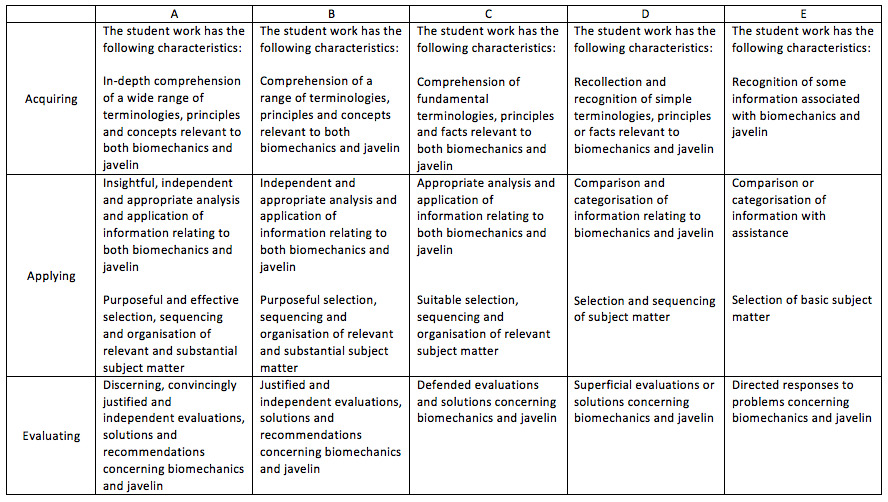
Students are provided with opportunities throughout the WebQuest to explore sub-elements of the ICT General Capabilities Learning Continuum. For example, sub-elements such as “generate ideas, plans and processes” and “generate solutions to challenges and learning tasks” are relevant to the learning experience (ACARA, n.d.). The WebQuest assists in students meeting learning objectives from Focus Area A: Learning Physical Skills of the Queensland Physical Education Senior Syllabus. Specifically, through the completion of the WebQuest and by the end of the unit students should be able to describe how projectile motion can enhance performance, and modify physical performance responses based on biomechanical decision making (QSA, 2010). The evaluation rubric has also been derived from Queensland Physical Education Senior Syllabus’ Standards Matrix (QSA, 2010, p. 29-31).
WebQuests are a suitable way to incorporate information and communication technology (ICT) into the classroom. They assist in developing an inquiry-based classroom therefore becoming an integral part of modern day pedagogy. Additionally, research has shown that WebQuests are a suitable way to provide students with a sound knowledge of the topic being studied and assists teachers in scaffolding learning (Gorrow, Bing & Royer, 2004; Beyerback & Burrel, 2004). The inclusion of a WebQuest in the classroom provides students with the opportunity to meet and further enhance their skills as per the ICT General Capabilities Learning Continuum.
References
Anderson, L. W., Krathwohl, D. R., Airasian, P. W., Crikshank, K. A., Mayer, R. E., Pintrich, P. R., et al. (2001). A taxonomy for learning, teaching, and assessing: A revision of Bloom's Taxonomy of Education Objectives. New York: Longman.
Australian Curriculum, Assessment and Reporting Authority (ACARA). (n.d.). Information and Communication Technology Capability learning continuum. Retrieved 21 July 2016. http://www.acara.edu.au/_resources/General_capabilities_-_ICT__learning…
Beyerbach, B., & Burrell, M. (2004). Preservice teachers response to a Webquest on culturally relevant teaching. Paper presented at the Society for Information Technology and Teacher Education International Conference 2004, Atlanta, GA.
Gorrow, T., Bing, J., & Royer, R. (2004). Going in circles: The effects of a WebQuest on the achievement and attitudes of prospective teacher candidates in education foundations. Paper presented at the Society for Information Technology and Teacher Education International Conference 2004, Atlanta, GA.
Killen, R. (2013). Effective Teaching Strategies Lessons from Research and Practice (6th ed.). South Melbourne, VIC, Australia: Cengage Learning.
Queensland Studies Authority (QSA). (2010). Physical Education Senior Syllabus. Spring Hill, Queensland. Accessed via Queensland Curriculum and Assessment Authority https://www.qcaa.qld.edu.au/senior/subjects/hpe/physical-education-2010