
Introduction
Proofs
History on proofs:
- proofs can be dated back to 624 BCE
- Proofs first started being used heuristic (enabling a person to discover or learn something for themselves) devices such as pictures and analogies to prove mathematical problems.
- It arose from land measuring primarily from the Egyptian.
- Proofs were also used from ancient Greek mathematical people
People Of History:
Thales: 624-546 BCE created theorems in Geometry
Eudoxus: 408-355 BCE came up with theorems but weren't able to fully prove them.
Theaetetus: 417-369 BCE also came up with theorems but weren't able to prove them further.
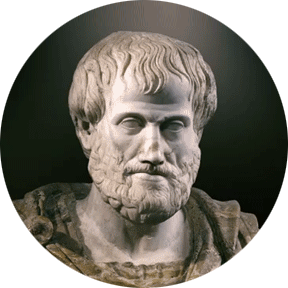
Aristotle: 384-
322 BCE definiton decribed concept, definition of other concepts known.
Questions:
1. Who began using proofs into their everyday lives?
2. Throughout the years many have created theorems but who of the named weren't able to prove their theorems?
3. In your own words what does heuristic mean? And how does it incorporate into the history of proofs?
Task
Importance of Proofs
Proofs are used in math and everyday life without even knowing it. Proofs are a way of percisely checking your thought process with justable reasons.
Proofs can be seen as an argument or justification, therefore answering the questions of "why?"
With all that said, proofs are just a way of summarizing how we got something and stating why we did.
Generally, we only see proofs in math problems but they can be seen everywhere such as driving. Do you stop at a stop light or are you allowed to turn right if there's a sign, but if there's people crossing do you wait until the light is green or turn before that? With what ever you do at a stoplight there's a reason why.
In math we gain skills while doing process such as these.
Logic- Knowledge is retained by doing similar problems over and over again.
Benefiting from accumulated knowledge of two thousand mathematicans we also many terms that can give a percise name for a reason some examples being cpctc, sas, or reflexive poc.
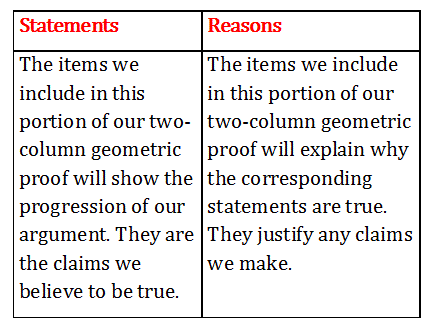
In geometry we use the standard two-column proofs
Process
The Process of proofs depends on the problem assiciated with it.
You can determine how to solve a real life problems (proof) you must use logic and figure out if and how you'll do it will work effectively.
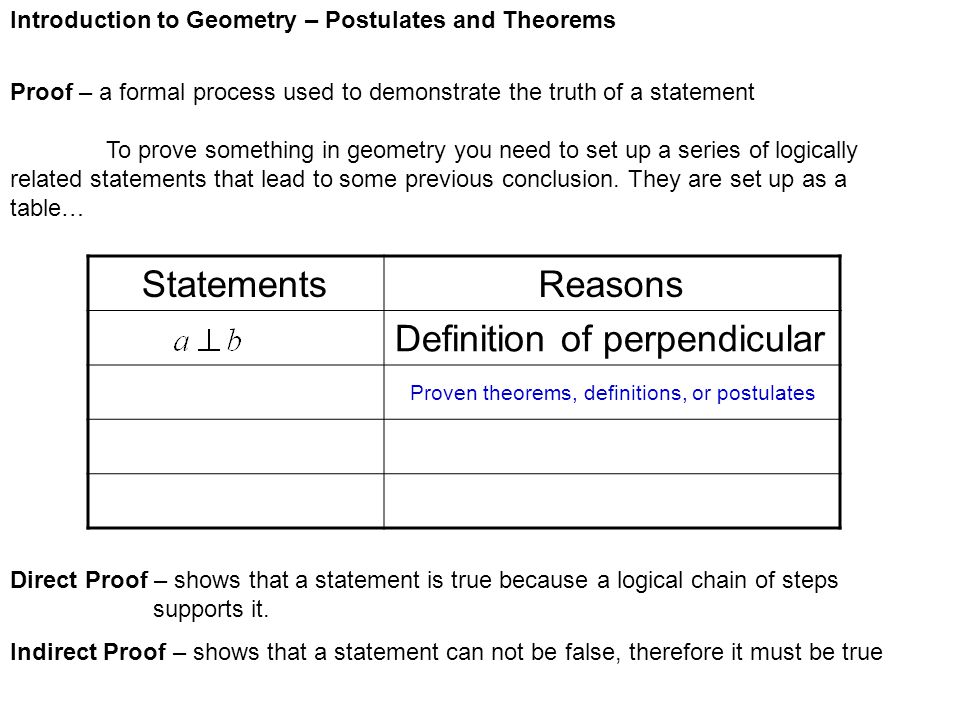
But, using a proof in a geometry problem you must use theorems, definitions, and postultes. If you use the wrong reason the rest of the proof can be invalid and will have to be redone.
You must always start with the given, the given will always be given hense the name, the given also can be used through out a proof.
The amount of steps don't matter because many problems can be solved with few steps or more steps.
Evaluation
Questions/answers:
1. Ancient Egyptians and Greeks
2. Eudoxus and Theaetetus
3. Devices used to prove mathematical problems (definitions will vary). It incorporates in the history of proofs because it helps prove problems with justable answers.
4. In what way do proofs help verify our math problem?
-proofs are a precise way to check and understand the process
5.What skills do you gain from using a proof?
-you develop skills like logic.
6.For some people proofs can sound horrible and hard what other name can it have?
-(Names will Vary) Step by Step proble solving
7.In what real life situation can a proof be demonstrated?
-Proofs can be used when learing to drive.
8.Why is it useful to do proofs more than once?
-Proofs have various of theorems, statements, postulates therefore to know them correctly we need to use them more than once.
9. What type of proof is usually used in geometry?
- Two Column proof
10. What is the earliest sign of a proof?
-Land Measuring
11.What are informal proofs?
- they are used in the majority of mathematics
12. Proofs have been available for many years, how have we benefitted for them?
- Accumulated knowledge of two thousands years
13. What other ways can proofs be seen as?
-Seen as an argument or justification
14. Following the question of 13 what question does a proof always have to answer?
- Answer the question of why?
15. What theorems are you familiar with?
-Reflexive POC
16. What year was Aristotle born in? Year of death?
- 384 BCE, 322 BCE
17. In a standard geometry proof what two columns are always needed?
-Statement, Reason
18. In a geometry proof what is it called that is usually given? And can it be used more than once?
-The given, yes it can.
Conclusion
Proofs have always been important for the common student mainly because it states a reason why we got the answer we have. Although it isn't always used in math it can be used in real life situations one that relates to me is deciding what to do at a stop light if there's a sign that allows turns but do you turn if there's pedestrians walking or do you wait until the timer is done? Some proofs are simpler than others and have no set number of steps. With proofs you also have reasons to support your statement. Proofs have always been a way to justify and further improve our skills.