
Introduction
Female reproductive system
The female reproductive system (or female genital system) contains two main parts: the uterus, which hosts the developing fetus, produces vaginal and uterine secretions, and can pass sperm through to the Fallopian tubes; and the ovaries, which produce the female's egg cells. These parts are internal; the vagina meets the external organs at the vulva, which includes the labia,clitoris and urinary meatus. The vagina is attached to the uterus through thecervix, while the uterus is attached to the ovaries via the Fallopian tubes. At certain intervals, the ovaries release an ovum, which passes through the Fallopian tube into the uterus. If, in this transit, it meets with sperm, a single sperm can enter and merge with the egg, fertilizing it. Corresponding equivalent among males is the male reproductive system.
Task
Answer the following questions. And pick the correct answer.

Question 1 : Number 4 is pointing to the ...
cervix
uterus
vagina
Question 2 : The endometrium is indicated by number ...
3
8
6
Question 3 : Number 2 indicates the ...
Vagina
Uterus
Cervix
Question 4 : Which number is pointing to the
fallopian tubes?
7
5
6
Question 5 : Number 7 is pointing to the ...
testis
ovary
fimbriae
Question 6 : The uterus is indicated by
number ...
4
2
1
Question 7 : Number 5 indicates the ...
fimbriae
Ovary
Fallopian Tube
Question 8 : The cervix is indicated by
number ...
1
2
4
Process
Female reproductive system
During the reproductive process, the egg is not a passive recipient, but rather an active participant in the fertilization process. It releases certain molecules that are essential to guiding the sperm which allow the surface of the egg to attach to the sperm's surface. The egg can then absorb the sperm and fertilization begins.The fertilization usually occurs in the oviducts, but can happen in the uterus itself. A zygote will then divide over enough generations of cells to form a blastocyst, which implants itself in the wall of the uterus, where it begins the processes of embryogenesis and morphogenesis. When developed enough to survive outside the womb, the cervix dilates and contractions of the uterus propel the fetus through the birth canal, which is the vagina.
Parts of rthe Female Reproductive System
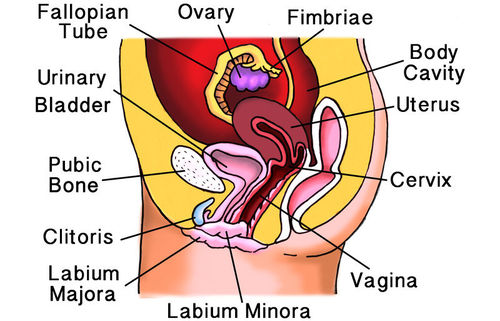
Internal
The female internal reproductive organs are the vagina, uterus, uterine tubes (Fallopian tubes, oviducts) and ovaries.
Vagina
The vagina is a fibro-muscular tubular tract leading from the uterus to the exterior of the body in female mammals, or to the cloaca in female birds and some reptiles. Female insects and other invertebrates also have a vagina, which is the terminal part of the oviduct. The vagina is the place where semen from the male penis is deposited into the female's body at the climax of sexual intercourse, a phenomenon commonly known as ejaculation. The vagina is a canal that joins the cervix (the lower part of uterus) to the outside of the body. It also is known as the birth canal.
Cervix
The cervix is the lower, narrow portion of the uterus where it joins with the top end of the vagina. It is cylindrical or conical in shape and protrudes through the upper anterior vaginal wall. Approximately half its length is visible to the naked eye, the remainder lies above the vagina beyond view. The vagina has a thick layer outside and it is the opening where the fetus emerges during delivery. The cervix is also named the neck of the uterus.
Uterus
The uterus or womb is the major female reproductive organ of humans. The uterus provides mechanical protection, nutritional support, and waste removal for the developing embryo (weeks 1 to 8) and fetus (from week 9 until the delivery). In addition, contractions in the muscular wall of the uterus are important in pushing out the fetus at the time of birth.
Fallopian tube
The Fallopian tubes or oviducts are two tubes leading from the ovaries of female mammals into the uterus. On maturity of an ovum, the follicle and the ovary's wall rupture, allowing the ovum to escape and enter the Fallopian tube. There it travels toward the uterus, pushed along by movements of cilia on the inner lining of the tubes. This trip takes hours or days. If the ovum is fertilized while in the Fallopian tube, then it normally implants in the endometrium when it reaches the uterus, which signals the beginning of pregnancy.
Ovaries
The ovaries are small, paired organs that are located near the lateral walls of the pelvic cavity. These organs are responsible for the production of the ova and the secretion of hormones. Ovaries are the place inside the female body where ova or eggs are produced. The process by which the ovum is released is called ovulation. The speed of ovulation isperiodic and impacts directly to the length of a menstrual cycle.
After ovulation, the ovum is captured by the oviduct, after traveling down the oviduct to the uterus, occasionally being fertilized on its way by an incoming sperm, leading to pregnancy and the eventual birth of a new human being.
The Fallopian tubes are often called the oviducts and they have small hairs (cilia) to help the egg cell travel.
External
The external components include the mons pubis, pudendal cleft, labia majora, labia minora, Bartholin's glands, and clitoris.
Click here to see the functions of the different parts of female reproductive system.
http://www.eschooltoday.com/human-reproduction/the-female-reproductive-organ.html
Evaluation
❌ Photo unavailable
Draw the Parts of the Female Reproductive System and give the functions of its parts.
Your score is based on the following Criteria:
|
Category |
Score |
|
Neatness (15 points) |
|
|
Creativity (45 points) |
|
|
Content (40 points) |
|
|
Total Score: 100 |
Score: |
Conclusion
In conclusion, the organs of the female reproductive system are specialized for the following functions:
- Produces eggs (ova)
- Secretes sex hormones
- Receives the male spermatazoa during
- Protects and nourishes the fertilized egg until it is fully developed
- Delivers fetus through birth canal
- Provides nourishment to the baby through milk secreted by mammary glands in the breast
The female reproductive system is one of the systems in the body that serves many vital functions but hits a time limit in the long run. Unlike the male reproductive system, reproduction will cease when menopause is reached as a response to the decreasing oestrogen levels in the body. This is virtually impossible in men, although testosterone may decrease with aging, but reproduction is still ongoing. The female reproductive system is prone to infections, trauma, and imbalances that may delay pregnancy, cause infertility, or be beset with pathologic conditions.
As a woman, we must be responsible to our Reproductive Organs, we must know on how to protect it.
“Why reproduce if you believe the world is ending?
Because the world is always ending for each of us and if one begins to withdraw from the possibilities of experience, then no one would take any of the risks involved with love.”
― Ben Lerner, 10:04
Credits
Introduction and Process
https://en.wikipedia.org/wiki/Female_reproductive_system
Task
http://www.free-anatomy-quiz.com/femalereproductive1.html?questNum=8&cor=2
Parts and functions
http://www.eschooltoday.com/human-reproduction/the-female-reproductive-organ.html
Conclusion
http://www.mamashealth.com/reproductive/femalereproductivesys.asp
http://healthytimes.com.sg/keeping-the-female-reproductive-system-healthy/
Teacher Page
Thank You for visiting my Webquest! I hope that you will learn about my first topic here! I hope that you will enjoy too! And I hope that you will visit again here and check my next update! Thank You!
If you want to create your own Webquest just click here.
[img_assist|nid=35475|title=Click Here|desc=|link=none|align=center|width=196|height=162]