
Introduction
If it has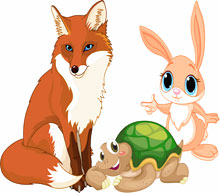
Animals that act like people,
Animals that talk,
People that talk with animals,
Or animals teaching us lessons,
It just might be a fabulous fable!
Task

You will be reading and studying fables.
Some were written long ago and some were written more recently.
You will look for things that are similar in all fables and then you will write your own fable.
Process
Let's look at some fables.
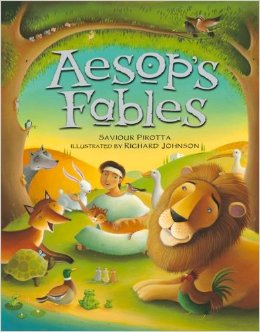 Many years ago, a Greek slave names Aesop wrote and told stories. These stories all taught a lesson, or moral, that helped people figure out good ways to behave and act towards other. Most of his stories were about animals.
The links below will take you to some of his fables. If you do not understand some of the words in these fables, here is a link to an online dictionary. Type in a word you do not know, click GO, and it will give you a definition.
Find the paper titled Fables in your folder. Look over it so you know what information you will be looking for in each story. Read each fable and then fill in the chart on the paper.
Another writer of fables was a frenchman named LaFontaine. He was a poet and, in French, his fables were also poems. One of his fables is below. After reading it, fill in the chart on the paper.
The Wolf, the Nanny Goat, and the Kid

A more recent writer, Arnold Lobel, wrote a book of fables. Read three fables from his book, and then fill in the chart on the paper.
The Hen and the Apple Tree - page 11
The Camel Dances - page 22
The Mouse at the Seashore - page 40
Now that you have read the fables, let's see if you can figure out how they are similar. Find the paper titled Similarities in your folder. For each topic write down what is similar, or mostly the same, in all the fables.

Write your own Fable.
You are now ready to write your own fable. There is a worksheet in your folder so you can write down your ideas.
First, you must choose what moral or lesson you want to teach in your story.
Think of things your parents have told you or rules you have learned at school. Are there special ways we need to behave in a nice restaurant, at the store, or on a long trip? Any of these might give you an idea for what you want to teach.
Second, decide on who your characters will be.
Try to think of at least 2 animals that would probably do things differently (if they were human) so you can illustrate your lesson.
Third, figure out what problem your characters need to solve.
The problem should help the reader understand your moral or lesson.
Finally, decide on an ending for your fable.
What is the solution to the problem? One of the characters must learn the lesson or moral you want to teach.
Put all of your ideas together into a story. In your folder there is notebook paper for your "sloppy copy" and there is some nice paper for your final copy. After you have written your story, read it carefully to make sure it makes sense. Check your work for spelling errors and for punctuation before copying it to your final paper.
Evaluation
You will read your fable to your class.
See if they can figure out the lesson, or moral, of your fable before you read it to them.
Give your story and all of your other papers to your teacher.
Conclusion
Congratulations!!

You have joined the ranks of Aesop, La Fontaine, and Lobel.
You are an author of a fable!