Introduction
Grade level: 6-7
Curriculum: Science
Keyword: Digestive system, food, organs involved, digestive track, and body organs
Let's Discover Our Body!
welcome:
Yum! Food sure tastes good! But how do we digest it?Not all that we eat can be digested, so the waste must be disposed of in an efficient way. It may not be a savory ending for the food or drink we thought was so delicious in the mouth, but it is just as important for our health. In this video, They will teach you about, where the digestive cycle starts, and where does it end. It’s kind of a gory story, but don’t worry - we’ll try not to make you hurl.
Description:
[video:https://www.youtube.com/watch?v=JnzwbipJuAA]
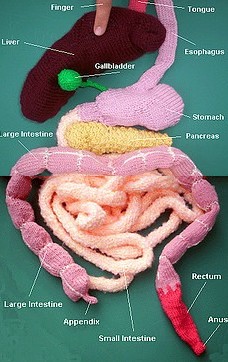
Digestion begins in the mouth with the teeth, which grind the food into small particles; the tongue, a powerful muscle which detects "good" and "bad" flavors in food and manipulates the food between the teeth for chewing, and saliva, a watery fluid which lubricates chewing and swallowing and begins the process of digestion. The digestive system begins in the mouth, continues in the pharynx (throat) and esophagus and into the "gut" region: the stomach, small and large intestines, the rectum and the anus.
- This picture demonstrates the organs involved in the digestive track.

Author’s :
- Diala Bouhadir
- Lama Hseiky
- Salwa Abdulkhalek
- Sara Hamdan
Process
Diala Bouhadir Let us construct a creative model of the digestive system!!!
You are supposed to watch this videao to help you recall about the structure and function of the digestive system.[video:www.youtube.com/watch?v=BgFlT7avdNo]
Steps needed to follow inorder to construct a model of the digestive system:
Step 1:
Learn about the digestive system. You can’t make a model of an organ system if you don’t know what organs are involved, where they are located, or what they do. The major organs in the digestive system are the mouth, salivary glands, esophagus, stomach, small intestine, large intestine, liver, gall bladder, pancreas, rectum and anus. Learn how food moves through the digestive system, what the function of each organ is, and, especially, how the organs are connected to each other.
Read more : http://www.ehow.com/how_7807839_make-model-digestive-system-kids.html
Step 2:
Make a plan on how to design your model and obtain appropriate materials. Use pipes or tubing for the tubular organs such as the esophagus and intestines (cardboard paper towel tubes work great for straight tracts like the esophagus), empty soda or milk bottles for organs like the mouth and stomach, jelly beans for the salivary glands, and molded play dough or modeling clay for solid organs like the gall bladder, liver, and pancreas. As an alternative, use different colored play dough or modeling clay to create all the organs and fit them together.
Read more : http://www.ehow.com/how_7807839_make-model-digestive-system-kids.html
Step 3:
Work on the different organs one by one. Start at the beginning of the digestive tract, the mouth, and by following a diagram of the digestive system, work your way down, forming and attaching each organ as you go. If using clay or play dough, form the organs into their appropriate shapes using a different color for each organ. If using tubing, form the hollow digestive system first, and then form and attach the solid organs. If desired, cut out images or labels for the major organs and attach them to the model.
Read more : http://www.ehow.com/how_7807839_make-model-digestive-system-kids.html
Supplies needed:
• 32 feet lighweight rope
• colored card stock or construction paper
• 1-liter soft drink bottle or 1/2-gallon milk jug
• colored tape or marker
• Stomach and Mouth images
• Information Cards describing organs and organ functions
Instructions:

1. Make holes in the lid and bottom of the container.
2. Make copies of the Information Cards and the Stomach and Mouth images. Laminate each card and image.
3. Attach a 1-foot section of the rope to the container lid by threading the rope through the hold and tying a knot in the rope. Attach lips of mouth to the other end of the 1-foot rope section.
4. Connect remaining rope to the bottle by threading the rope through the hole in the bottom of the container. Tie a knot in the end of the rope to secure it to the bottom.
5. Measure and mark a spot 20 to 25 feet down the rope. Color the last 5 to 6 feet of the rope with tape or a marker pen.
6. Attach stomach to the bottle. Attach organ information cards to the appropriate parts of the model.
7. Copy and laminate cards describing each organ.
Evaluation
Salwa Abdelkhalek
Grade 6
Let us check your Work!

Sample Model:
[video:https://www.youtube.com/watch?v=HCGmmdn7hb4]
|
CATEGORY |
4 |
3 |
2 |
1 |
|
Scientific Knowledge
|
Explanations by all group members indicate a clear and accurate understanding of scientific principles underlying the construction and modifications. |
Explanations by all group members indicate a relatively accurate understanding of scientific principles underlying the construction and modifications. |
Explanations by most group members indicate relatively accurate understanding of scientific principles underlying the construction and modifications. |
Explanations by several members of the group do not illustrate much understanding of scientific principles underlying the construction and modifications. |
|
Design
|
Design is neat with clear measurements and labeling for all components. |
Design is neat with clear measurements and labeling for most components. |
Design provides clear measurements and labeling for most components. |
Design does not show measurements clearly or is otherwise inadequately labeled. |
|
Labels
|
All items of importance on the model are clearly labeled |
Almost all items of importance on the model are clearly labeled. |
Several items of importance on the model are clearly labeled. |
Labels are too small to view OR no important items were labeled. |
|
Construction -Materials
|
Appropriate materials were selected and creatively modified in ways that made them even better. |
Appropriate materials were selected and there was an attempt at creative modification to make them even better. |
Appropriate materials were selected. |
Inappropriate materials were selected and contributed to a product that performed poorly.
|
|
Attractiveness
|
The model is exceptionally attractive in terms of design, layout, and neatness. |
The model is attractive in terms of design, layout and neatness. |
The model is acceptably attractive though it may be a bit messy. |
The model is distractingly messy or very poorly designed. It is not attractive. |
|
Creativity
|
Several of the graphics used on the model reflect a exceptional degree of student creativity in their creation and/or display. |
One or two of the graphics used on the model reflect student creativity in their creation and/or display. |
The graphics are made by the student, but are based on the designs or ideas of others. |
No graphics made by the student are included. |

Check the following websites for more models:

Conclusion
Sara Hamdan
The Journey of Food in Our Bodies

This video shows you the journey of digestion and helps you to make your model
[video:https://www.youtube.com/watch?v=123UsYMdS2o]
Digestion is a complex process involving specialized anatomical and physiological adaptations for the absorption of nutrients.
Its purpose is to prepare food for use by cells and organs throughout the body. Because large food particles cannot reach cells, the process of digestion breaks the food down into nutrients that can be absorbed into the blood stream and carried to any cell in the body.
The methods of digestion are mechanical and chemical.
Each segment of the digestive system has a special design to perform a unique function that is an essential part of the digestive process.
Digestion begins in the mouth and is completed at the anus. As food moves through the digestive tract, it passes through several sections.
Accessory organs that produce digestive enzymes drain their contents into the sections at different points along the way. Each section and accessory organ serves a specific function.
At each stage, the food is transformed into a slightly different form that allows it to be passed along to the next section. As it moves through the digestive tract, nutrients and water are extracted, producing waste. The waste products are eventually eliminated.
The coordination of functions is complicated. Signaling between the nervous and endocrine systems occurs at both the local cellular level as well as throughout the entire body. Through the process of digestion, food is transformed from large complex particles into basic elements that are then easily absorbed into the blood stream.
Once a food is in the mouth, digestion begins.
- So the main thing about digestion is:
Transforming the food to make it usable by all organs of the body: the brain to the muscles of our legs.
Briefly food in the mouth is chewed, it goes down into the stomach through the esophagus. They stay in the stomach, progress to the small intestine where most passes in blood. The rest continues in the large intestine, also called the colon, and is rejected by the anus.