
Introduction
So far this term we have been investigating the key events in ancient Roman history, and the legacy that the ancient roman society has left on the modern world. This week we will be investigating how ancient Romans conducted their everyday lives. Our focus question for this week is:
How comfortable were the everyday lives of ancient Romans?
In order to support our answers to this question, we will be focusing on the sources uncovered in the excavation of Pompeii. On 24 August 79 AD, the ancient Roman city of Pompeii was buried under volcanic ash from the eruption of Mount Vesuvius. The ash from this natural disaster hid the city until excavations began in 1748, providing archaeologists with a time-capsule of everyday life in ancient Rome.
Your role in this WebQuest over the next three lessons is to analyse sources uncovered from Pompeii, conduct further research, and develop a poster, brochure, or presentation that provides an answer to the focus question. You will be given three lessons of class time to complete this task, however you may access this WebQuest from home if you require additional time to complete your task.
Task
The final product of this WebQuest is to develop a poster, brochure, or presentation that provides an answer to the focus question: How comfortable were the everyday lives of ancient Romans? This will be developed in four stages.
Firstly, you will develop an understanding of how and why the ruins of Pompeii are such an important source for archaeologists to understand the lives of ancient Romans.
Secondly, you will analyse a number of sources found in Pompeii to make conclusions on life in ancient Rome.
Thirdly, you will use this information to guide further research into everyday life of ancient Romans.
Finally, you will synthesise this research into the form or either a poster, brochure, or presentation that can be shown to the rest of the class to contribute to our focus question discussion.
Process
Part One - Introduction to Pompeii
To begin, let’s investigate why the ruins of Pompeii are such an important source for archaeologists. The first video shows the city in its current state, while outlining the events that led to Pompeii’s preservation.
[video:https://www.youtube.com/watch?v=DeB5N_bH7E8 autoplay:1]
This second video is an animation that overlooks the city of Pompeii as it is destroyed by the eruption of Mount Vesuvius. It is best viewed in full screen with headphones, so that you can experience the full impact of this process. While viewing this video, consider the meaning of the term ‘city trapped in time’.
[video:https://www.youtube.com/watch?v=dY_3ggKg0Bc autoplay:1]
Part Two – Analysis of Sources
Now that you are aware of the archaeological importance of Pompeii, it’s your turn to investigate some of the artefacts that have been uncovered.
Click on this hyperlink to the Western Australian Museum to view a selection of artefacts uncovered by archaeologists in Pompeii.
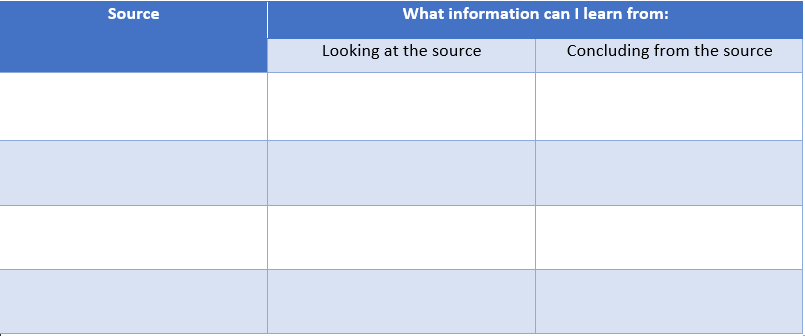
Choose either ancient Roman décor, fashion or everyday objects to investigate, and select four artefacts that may assist you in discovering more about the topic. Create and fill in the table below in a new Microsoft Word or OneNote document.
Part Three – Individual research
Guided by your new understanding of life in ancient Rome from the sources analysed, choose one aspect of everyday life (e.g. food, décor, clothing, housing) and conduct your own research, guided by the focus question: How comfortable were the everyday lives of ancient Romans? Consider whether someone from the twenty-first century would feel at home in these conditions.
Break your topic into sub-headings, and be sure to complete at least a full page of typed research notes, as this will inform your presentation in the next part of the WebQuest.
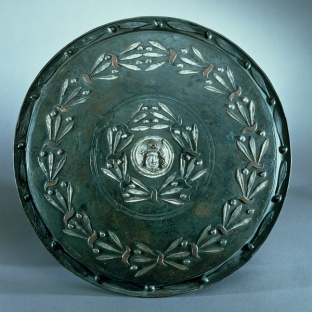
These Western Australian Museum, History Extra, and Odyssey Online websites are a great place to start, however you are encouraged to conduct you own research, provided you follow our guidelines for reliable historical research.
Part Four – Presentation
Now that you have conducted research into your chosen element of ancient Roman daily life, it is time for you to synthesise this information into a presentation of your choice. Create either a poster, brochure, or presentation that persuades someone from the twenty-first century that ancient Rome is or isn’t such a comfortable place to live.
At the end of our last lesson on this WebQuest, we will be sharing our presentations, and discussing the answer to our focus question: How comfortable were the everyday lives of ancient Romans?
Evaluation
Conclusion
To conclude your learning journey into Pompeii and the lives of Ancient Romans, we will pre presenting our posters, brochures, Prezis or PowerPoints to the rest of the class.
As each of your classmates presents their findings, discuss how they contribute to answering our focus question for this lesson:
How comfortable were the everyday lives of ancient Romans?
Congratulations on completing the WebQuest!
Credits
Carlos, M. (n.d.). Daily Life. Retrieved from http://carlos.emory.edu/ODYSSEY/ROME/daily.html
Gkouronis. (2012, Sep 23). The lost city of Pompeii [Video file]. Video posted to https://www.youtube.com/watch?v=DeB5N_bH7E8
Mason, E. (2015). The A to Z of life in Pompeii with Mary Beard. Retrieved from http://www.historyextra.com/feature/z-life-pompeii
Western Australian Museum. (2010). Objects | A day in Pompeii. Retrieved from http://museum.wa.gov.au/pompeii/objects/
Western Australian Museum. (2010). Daily Life | A day in Pompeii. Retrieved from http://museum.wa.gov.au/pompeii/daily-life/lifestyle/
Zero One Animation (2013, December 19). A day in Pompeii – full length animation. [Video file]. Video posted to https://www.youtube.com/watch?v=dY_3ggKg0Bc
Teacher Page
Rationale
This task has been created for the year seven Australian Curriculum history unit titled The Mediterranean World: Ancient Rome. It can fit seamlessly into the Curriculum to Classroom (C2C) unit, between lessons nine and ten. The WebQuest is designed to take place over three, seventy minute history lessons, for the introduction, source analysis, research, synthesis, and class presentation stages.
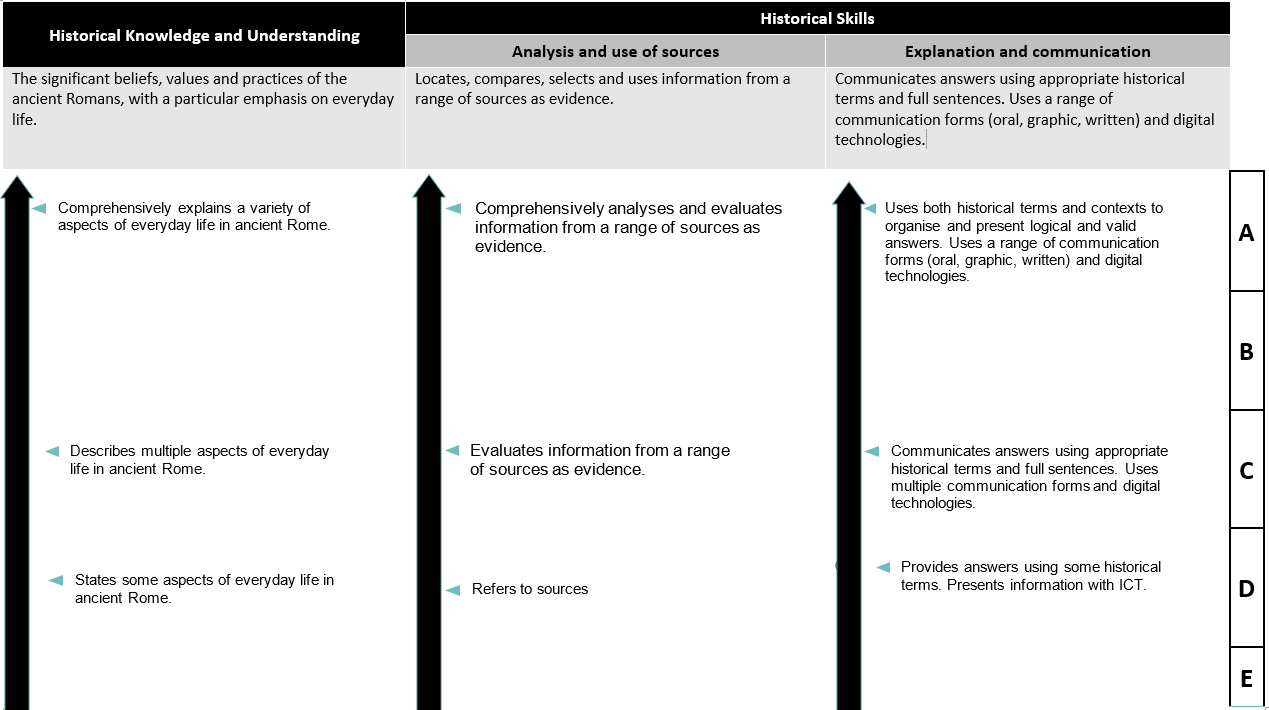
Using the ACARA content descriptions (ACARA, 2016) as a framework, this WebQuest has been designed to teach both historical skills and historical knowledge and understanding. Students completing this WebQuest develop knowledge of the significant beliefs, values and practices of the ancient Romans (ACDSEH039, ACARA, 2016) through their research, and begin to synthesise this information in a format they can use to teach their peers using various ICTs. Students are also encouraged to locate, compare, select and use information from a range of sources as evidence (ACHHS210, ACARA, 2016), as they identify, draw conclusions from and categorise a range of primary sources. Students also demonstrate their ability to explain and communicate their new knowledge in historical forms as they present information using appropriate historical terms and full sentences in a range of communication forms (oral, graphic, written) and digital technologies (ACHHS214, ACARA, 2016). Students are also given the opportunity to practice various skills under the five organising elements of the ICT general capability (ACARA, 2016). This adherence to the Australian Curriculum and standards ensures that the WebQuest not only ensure that students are learning the prescribed content, but that the WebQuest can be used as a collaborative tool shared among teachers throughout the nation.
The academic consensus states the use of ICTs in the classroom greatly contributes to facilitating student engagement (Killen, 2013). By offering a range of presentation formats, students are more likely to guide their own learning in a way that is enjoyable and familiar, yet still structured through the WebQuest framework. By removing the traditional ‘chalk and talk’ format which traditionally controls the pace of a classroom learning experience, students are able to work at their own pace, embedding vital ICT skills as they troubleshoot issues and adjust programs to suit their own learning. This self-paced, web-based style of learning also aids in facilitating differentiation in the classroom, as students with additional learning needs can be subtly provided with a scaffolded or differentiated form of the task while still learning alongside their peers.
Finally, the use of elements of Bloom’s revised taxonomy throughout this WebQuest establishes, scaffolds, and aligns the learning objectives of each step of the process. Students begin by applying lower-order thinking skills such as remembering and understanding the archaeological importance of Pompeii, before utilising higher-order skills such as analysing sources and synthesising research using ICTs to present to their peers. By creating a multi-lesson WebQuest, the different stages of the learning process are more tangible to students, as they can explicitly see how the processes of one part of the WebQuest create the foundation for the next.
Australian Curriculum, Assessment and Reporting Authority. (2016). Information and Communication Technology (ICT) Capability. Retrieved from http://www.australiancurriculum.edu.au/generalcapabilities/information-…
Australian Curriculum, Assessment and Reporting Authority. (2016). 7-10 History. Retrieved from http://www.australiancurriculum.edu.au/humanities-and-social-sciences/history/curriculum/f-10?layout=1
Killen, R. (2013). Effective teaching strategies. South Melbourne, Australia: Cengage Learning