
Introduction
You are travelling back in time to Australia during the 1910s. World War One is in action and is having an impact on Australia economically, politically and socially. Men are being encouraged to help with the war effort and there is even political debate on making enlistment compulsory (conscription).
You are taking on the role as Historians, and you will embark on a quest to find out why men were encouraged to enlist and why there was a debate on conscription. You will need to bring back your findings and share!
Task
Over the next week you will be embarking on a historical journey/quest. In this journey/quest you will be exploring the concepts of enlistment, conscription and the use of propaganda during WWI. You will be required to visit links, do some research and present your findings in a number of different ways. To be successful you must think critically and creatively.
At the end of the quest you will be presenting your findings to the class.
So...
By the end of this quest:
You will be able to explain a range of motivations for men to enlist to fight in WW1.
You will also have an understanding of the Conscription debate in Australia during this period.
You will be able to identify a number of persuasive devices used in the different types of propaganda.
You will have analysed and evaluated a number of Primary and Secondary sources.
You will have applied your knowledge and understanding of the concepts into a number of different formats, in which you will present to the class.
Begin your journey now!

Process
STEP ONE:
Create a OneNote for this task. You will need to make a tab for each activity you complete. This is so you can keep your research and work in one place. You will submit your OneNote at the end of the quest, and you will also be required to present some of your work to the class.
STEP TWO:
Your first tab in your OneNote should be a list of terms in relation to the topic, that you can refer back to as you embark on this journey.
Do your own online research and find definitions for the following words and create a glossary: Enlistment, Conscription, Propaganda, Nationalism, Alliances, ANZAC, Assassination, Militarism and Imperialism.
Add to this glossary.
STEP THREE:
Watch this YouTube clip on Australia and World War One.
https://www.youtube.com/watch?v=SXD4brGzncI
This clip is a recap on what we learnt last lesson about how the war started and Australia's involvement.
Then answer these questions in the form of sentences.
Name the Alliances in WWI.
How did WWI start?
What increased during WWI?
Why was Australia involved in WWI?
Why at the beginning of the war did Australian men enlist to fight?
Why, after the battle in Gallipoli, did enlistments decline in Australia?
Why did we vote NO for Conscription?
Then create a table, outlining the Pro's and Con's of World War One; using the information from the video, and discussion we had from last lesson.
STEP FOUR:
Click on this link http://www.scootle.edu.au/ec/pin/RFEURS?userid=135329
The link will take you to an interactive site to complete the activity.
In this activity, you are to help a teenager to decide whether to enlist for Australian Military service in World War I or not.
To help make the decision, you will look at the summary of the key military and political events, interview people with a range of opinions and examine background materials about recruitment drives, voluntary enlistment and conscription.
You will then create a SWOT analyse (which you will need to copy into your OneNote) and make a decision on whether to enlist or not. You will then explore the effects/consequences of your decision.
I have also provided a list of questions you will need to answer as you interact with this site. The questions will help you with creating your SWOT analyse at the end and will deepen your knowledge of WWI.
Questions:
Why were some young men sent a white feather during WWI?
Name the significant events that happened on these dates and create a mini timeline: August 1914, December 1914, 25 April 1915, March 1916, July 1916, August-November 1917.
When did recruitment for military service in Australia begin?
How many men had enlisted to fight in Sydney by August 1914?
What were the physical requirements to join the military service?
What years did Australia try to introduce conscription?
Summarise each interviewee’s argument in your own words. This will help you complete your SWOT analyse and will help you make your decision on whether you should enlist the teenager in the war or not.
In one/two sentences tell us what your decision was and why? Outline the effects/consequences of your decision.
STEP FIVE:
Create a mind map in your OneNote’s outlining reasons why men enlisted to fight during WWI.
Watch these videos and add to your mind map:
https://www.youtube.com/watch?v=C-MoYsr0rM8 - This first video has been created by the Australian War Memorial and is the voices of five Australian Veterans whom are recalling their memories of enlistment and the recruitment processes during WWI.
https://www.youtube.com/watch?v=FMsuEUC94O0 – This second video is from an unknown source; however, it gives further reasons as to why Australian’s enlisted in WWI.
Food for thought: (Answer in your OneNote)
Would you have enlisted to fight if given the opportunity? Why?
STEP SIX:
Propaganda in Australia during World War One was used to encourage men to enlist. Propaganda used a variety of persuasive devices to do so. Australian propaganda posters utilised six different aspects to appeal to men to enlist. These included:
- Appealing to their patriotism by summoning people to 'rally around the flag' and reminding them of their duty to the Empire and the British
- Utilising a gender approach which made men feel they needed to enlist to prove their sporting aptitude, courage and masculinity.
- Inviting peers and family to place pressure and shame on men for not applying in order to make them feel ashamed and cowardly.
- Encouraging a spirit of adventure and a desire to see the world by using a recruitment poster which places emphasis on a physical, sport-like side of war.
- Self-interest, including a chance to have a secure job which was relatively well paid.
- Exaggerating the hatred and fear of the Germans by allowing people to think that they might attack their friends and families.
Visit this website: http://www.ww1propaganda.com/world-war-1-posters/australian-ww1-propaganda-posters
This website contains a variety of propaganda posters used during World War One to encourage men to enlist. Choose four of these posters identify the persuasive devices, analyse and evaluate them using the format below:
Motive:
Target Audience:
Message:
Text:’
Visuals:
Appeals to emotion:
What reasons for enlistment does this poster focus on?
Techniques:
STEP SEVEN:
Create your own propaganda! Go to this website: https://www.canva.com/create/posters/ and create your own piece of propaganda that will encourage young men to join the war effort. Use your knowledge of reasons as to why men enlisted and the persuasive devices used in propaganda.
You will need to write a summary of why you used the techniques you used and explain your propaganda poster to the class.
STEP EIGHT:
The Conscription Debate:
Visit this website: http://billyhughes.moadoph.gov.au/conscription_debate
Read the information on the conscription debate and listen to the different tracks and cast your vote.
Create a table for both sides of the debate and fill it in as you go through the website and listen to the tracks.
Cast your vote. Did you vote yes or no for conscription? Why?
STEP NINE:
In groups of four, you will recreate the Conscription Debate for the class. Two people will be affirmative, two will be negative. You are to work collaboratively to create your debate and will use the information you collected from the Billy Hughes Conscription website. You will present your debate to the class. The class will be required to vote for or against conscription afterwards.
Then write individual reflections on the debate.
STEP TEN:
You are to take on the role as Prime Minister before World War One. With your research, you are to make a speech. In your speech you must either encourage or discourage enlistment and give reasons why you are encouraging or discouraging.
STEP ELEVEN:
You must submit your OneNote including the propaganda and the speech you made for evaluation.
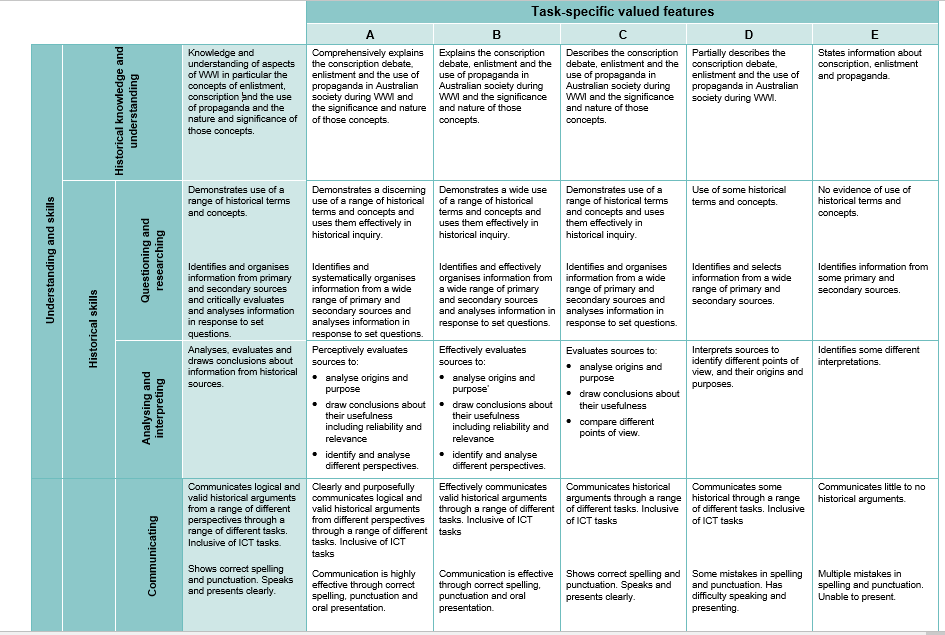
Evaluation
Conclusion
Well done you have completed your historical quest!
You have taken on many roles in your quest! You have been a teenage boy confused about enlisting, a propaganda creator, a debator, Prime Minister and most importantly a historian.
If you can say 'Yes I can do that or yes I understand that or yes I did that' in response to the listed goals below you have been successful!
- You can explain a range of motivations for men to enlist to fight in WW1.
- You have an understanding of the Conscription debate in Australia during this period.
- You can identify a number of persuasive devices used in the different types of propaganda.
- You have analysed and evaluated a number of Primary and Secondary sources.
- You haveapplied your knowledge and understanding of the concepts into a number of different formats, and presented to the class.
Teacher Page
This web quest has been created for Year 9 History students who are learning about World War One. Students will be given this task half way through their unit on World War One. Thus, students should already have knowledge on some of the concepts surrounding WWI. The focus of this web quest is enlistment, the conscription debate and the use of propaganda during WWI. The web quest should take students one week or five lessons to complete.
In accordance to the Australian curriculum, students are required to have an overview of the causes of World War One and understand the reasons surrounding why Australian men enlisted to fight in the war. This web quest not only covers both of those areas, but the conscription debate in Australia as well. The web quest allows the students to develop a knowledge and understanding of enlistment, conscription the use of propaganda during the First World War. Students are also engaging in historical inquiry and skills through processing and synthesising information from a range of sources for use as evidence in historical argument. Students are also identifying and analysing perspectives of people from the past. Students will be required to communicate and demonstrate their historical knowledge, understanding and skills through a range of communication forms (written, graphic and oral) and digital technologies.
Bloom’s Taxonomy theory has been effectively applied to this web quest. The activities students have to do range from the lower order thinking skills to higher thinking skills. Students will be working individually but also collaboratively during this web quest. They will also be required to think critically and critically.
References & Citations:
Australian Curriculum and Reporting Authority. (2012). The Shape of the Australian Curriculum: Technologies. Retrieved from: http://www.acara.edu.au/_resources/Shape_of_the_Australian_Curriculum_-…
Australian Curriculum and Reporting Authority. (2016). Information and Communication Technologies Learning Continuum. Retrieved from: http://www.australiancurriculum.edu.au/generalcapabilities/information-…
Australian Curriculum. (2016). 7-10 History. Retrieved from: http://www.australiancurriculum.edu.au/humanities-and-social-sciences/h…
Krathwohl, D. (2002). A Revision of Bloom's Taxonomy: An Overview. Theory Into Practice, 41(4), pp.212-218.