
Introduction

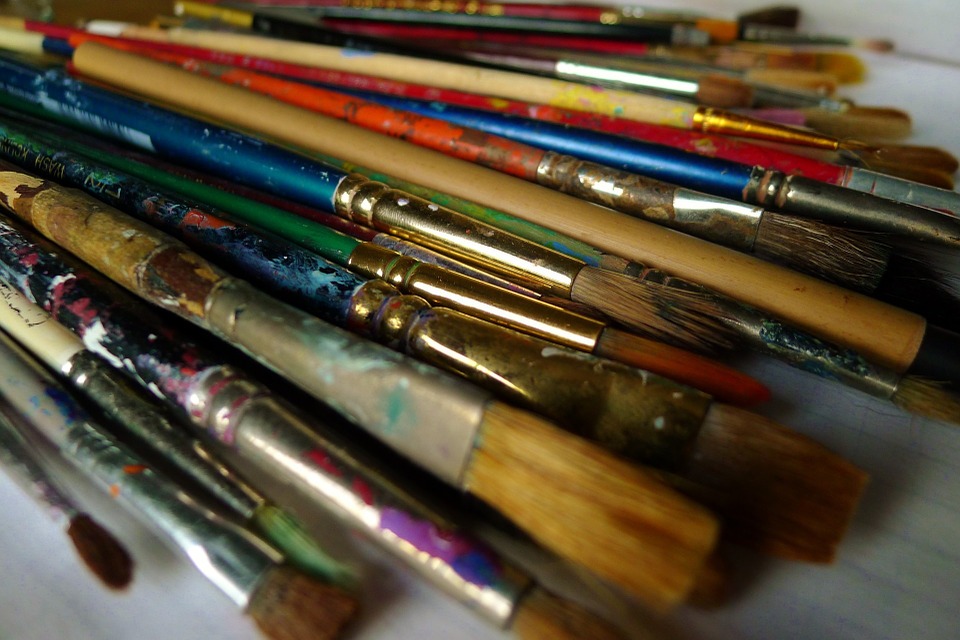
Artists have many tools that they use to create artwork. When we think about tools, we often think about the physical objects we use for art making like paintbruhes, carving tools and palettes. While these are very important items to have when we want to make artwork, we also need visual tools or concepts that we draw, paint or carve onto our artwork to create complex images. These tools are called the elements of art.
Even if you haven't heard the term, elements of art, before, you have probably seen them in every image that you've viewed or made! These elements are: line, form, shape, space, texture, value and color. When these items work together, we can create abstract and representational images that convey different moods, stories and ideas.
Watch this short video for an overview of each of the elements of art and their uses:
[video:https://youtu.be/NJJbn2LqzZU width:420 height:315 align:center]
This webquest will offer an opportunity for you to grow in your understanding of the elements of art. As you move through the tasks, you will have the chance to create and organize artwork. Think about how the elements of art work together to create meaning. How can the same element be used in different ways to highlight an artist's point of view?
If you feel ready to explore this webquest, please move on to the task section. Could you use a little more review first? Check out this great video series on the elements of art created by KQED Art School.
Remember: You can always view the videos again if you need a refresher as you work!
Task

Your mission today is to become an art curator and build your own art gallery inspired by the elements of art. A curator is a professional who works in a museum or art gallery. The curator is responsible for choosing the work featured in an exhibition or show, and for writing the interpretive information that accompanies the show. Interpretive information includes labels and wall text that explain how and why a curator chose specific works.
Because many of the best curators are also artists, you will have to practice making art as well as explaining art. Get ready to create, design and discuss your favorite art works in brand new ways.
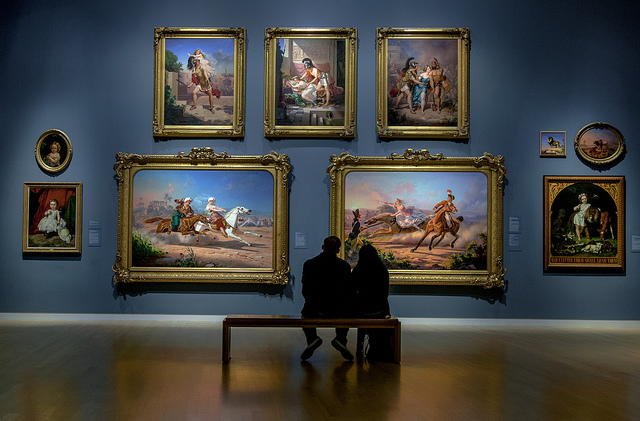
Through this webquest you will complete the following tasks in your mission to build your very own art gallery!
1) Develop a working definition of each of the elements of art based on your own research.
2) Create your own artwork using the elements of art while experimenting with composition.
3) Apply your knowledge of the elements of art to choosing world famous art works for your gallery that embody the importance and uses of the elements of art.
4) Organize your chosen art works into a meaningful gallery using Google Cultural Institute that tells a unified story.
5) Develop interpretive text that explains your curatorial choices to your viewers using appropriate vocabulary and information about the elements of art.
Before you get started: Need a little more help understanding what a curator is? Check out the videos below for a little extra information to get you started!
[video:https://youtu.be/Hix5aMZvMQ8 width:420 height:315 align:center]
[video:https://youtu.be/4qCDSPe2-uc width:420 height:315 align:center]
Ready to get started? Click the Process button to begin.
Process

Your journey as a curator will require that you work through several steps. These steps are very similar to the way real world curators interact with information and artwork to create exhibitions. Remember that each step is important to the process. Try to follow them closely and confidently so that you can be just like a world-renowned curator!
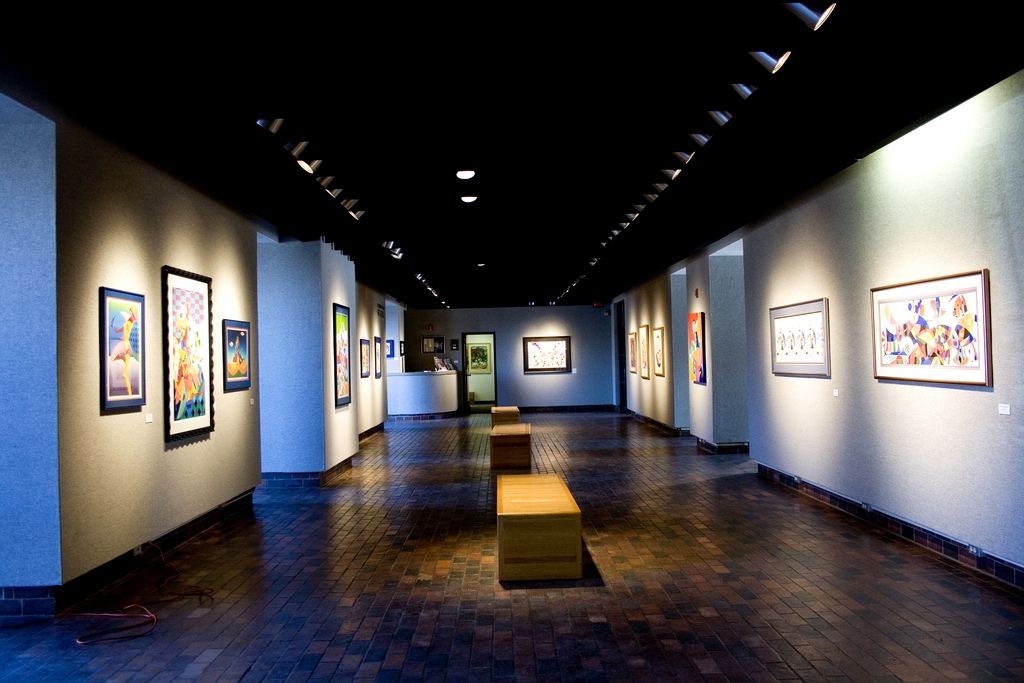

As you begin your curatorial journey, you must first develop your own definitions of the elements of art. These definitions will help you to better understand each concept. Sometimes being able to put into words what you know already in your head can help you establish your artistic sense. Curators must always begin their exhibition design process through research so that they will have scholarly authority or special knowledge about the artwork they are discussing.
A) Select at least three (3) online sources to develop your definitions. You should choose sources that you think best illustrate the elements.
Ask yourself: Does this source tell you something you didn’t already know? Does it use words or ideas that you think make the concept clearer to people who are unfamiliar with them?
While you are encouraged to find your own sources some helpful places to start are:
B) Create a Mind Map of the terms and ideas that you think are most important to each element of art based on your research using Mindmup.
When designing your Mind Map decide how you think the information can be best organized by exploring the different types of maps and the different ways you can combine the concepts.
C) Using your Mind Map, create a 1-3 sentence definition for each element of art in the word processing application of your choice. Keep these definitions close as you work through the rest of the webquest. They will guide you through your role as curator.
 Do you feel like an expert in the elements of art now? You’re off to a great start! Now that you know the definitions of each element, it’s time to use them to create artwork! Artist and curators share a very close relationship. Artists have to think about how a curator will display their work and curators need to understand the formal qualities of the artwork in order to interpret it. Curators who have artistic training have an advantage in planning exhibitions, and you want to have that same advantage!
A) On an iPad tablet, download and access the Museum of Modern Art (MoMA) ArtLab application available for free download from the iTunes App Store. This application allows you to easily create art compositions that use the elements of art. *
B) Once you have accessed the application, create an abstract artwork. Abstract art is art that does not look like a scene or setting from real life. Instead, it will look like a collection of the elements of art. Feel free to create more than one abstract artwork, but be sure to save your favorite for later!
While you’re working, experiment with individual elements of art and combining them. Make observations and consider which you like better. Is there a reason you prefer one work to another?
C) Next, begin a new artwork in the application. This time create a representational artwork. Representational artwork is work that shows objects that exist in real life including people, places and things. Create as many works as you like, but save your favorite again.
Remember: The elements of art are the building blocks of art. This means that even representational works are created by combining the elements of art
*If you don’t have access to an iPad, check with your local library, art museum or arts center to see if they have the MoMa ArtLab application available for rent. If you are unable to access the application, the Artist’s Toolkit also has a creation tool that can be used for this step, though it will not allow you to use multiple elements of art at once.
As we move away from the creative process of artmaking into our new role as curators, please take some time to watch the following video. This video features a conversation with Fred Wilson. Wilson is a conceptual artist who takes items from museum collections and places them together to create an installation. Listen to Wilson describe his process of choosing objects as inspiration as you move into the next section of the webquest.
[video:https://youtu.be/YLG6c_NSvCE width:420 height:315 align:center]
 As a curator, it’s important that you visit other museums and art galleries to see what other curators are doing. Good curators will notice trends or popular ways that other curators are displaying work.
A) Visit Google Cultural Institute’s Art Project online using the browser of your choice. For the best view of the website, use a desktop or laptop computer
B)Explore artworks and exhibitions in Art Project either by using the search bar at the top of the page or using the Collections, Artist or Artworks links.
Not sure where to start? Search for the following institutions as a starting point: Museum of Modern Art, The Metropolitan Museum of Art, The National Gallery (London), Tate Britain.
C) As you look through the exhibitions and items in the galleries, take note of what you see. Can you recognize the elements of art in some of these artworks? How does the text in the exhibits help to make the work easier to understand? How does the Museum View differ from the online exhibits view? How are they similar? If it helps you to process information, create a chart or graph of your findings.
 You now have a great foundation for developing your own art gallery that embodies the elements of art. Remember to keep all of the things you’ve explored, discovered and learned in the previous steps. Do you have your definitions and Mind Map available? How about your observations about the galleries you saw? Don’t be afraid to go back to review videos and ideas from earlier sections of the webquest if you need a few reminders.
A) For this step, you will need a Google Account. You can use an existing account or sign up for free. Be sure to get a parent’s or guardian’s permission before creating an account. You can use a parent’s or guardian’s account if one is available.
B) Once you have logged in to your Google Account, return to Google Cultural Institute’s Art Project.
C) Click on My Galleries on the upper right hand of the page. This will take you to your user created galleries. You will create a gallery that embodies the elements of art.
D) Choose “New Blank Gallery” to create your gallery. Add a title and short description. You can always edit your title and description as you develop your gallery so don’t be afraid to use a placeholder.
E) Using the search functions you explored in the previous section, find five (5) art works that embody the elements of art. You may choose 5 works that show specific elements of art or you may choose 5 artworks that each combine the elements of art in different ways. To save an artwork that you want to use, click on the small plus sign in the lower left corner of the image you are selecting.
Remember: Use your definitions and previous observations to help you narrow down your choices. What did you single out as being MOST important to each element? Do you SEE that in the work you’re choosing?
F) Return to the gallery you created. You will now see your saved images along the bottom of the screen. Drag them into the gallery to build it up.
Be sure you’re thinking about why you are putting them in the order that you are putting them in. How will your viewer learn from the order you are placing them in?

You’ve come so far on your journey as a curator. You have done your research and developed your art gallery based on that research. You are almost done! The last thing you must do to complete your elements of art exhibition is to create interpretive text. Interpretive text refers to the text that accompanies an image in an art gallery that helps viewers understand the images and your choices as curator.
A) Revisit Mindmup. You will now create a small Mind Map for each of your artworks. In your Mind Maps, be sure to identify the elements of art that the artwork represents.
B) Next, add additional descriptive words to your Mind Map that you think best explain the work. For help finding the perfect word visit Words for Art.
Some of these words may be new to you. Use an online dictionary such as Oxford Dictionaries or Merriam Webster: Dictionary and Thesaurus to define any unfamiliar words.
C) Using your Mind Maps, write a 200-word description of each artwork in your art gallery.
D) Add your descriptions to each artwork in your gallery by returning to your Google Cultural Institute Art Project Gallery. Choose the image and click edit. You will see the option to add text in the upper left of the page. Add your text to the box and save. Repeat the process for each image.
Are you stuck or need a little extra help? Visit the Teacher's Page for more resources!
Evaluation

Congratulations! You did it! As you’ve completed the difficult task of becoming an art curator, you have worked hard to develop your artistic and curatorial vision for your own art gallery. You will be able to revisit your art gallery time and again to remind yourself of how hard you’ve worked and how much you’ve learned.
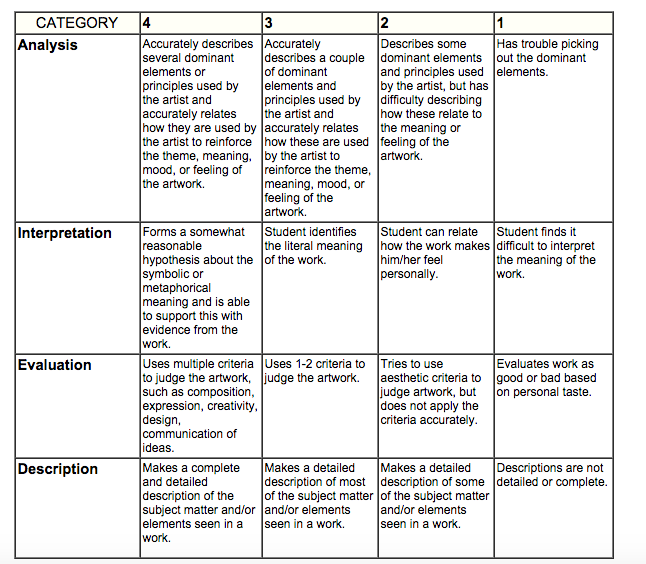
While our goal was first and foremost to have fun while learning about art, it can be helpful to add a score to our work on this webquest so that we have a better sense of all we’ve accomplished.
How do you think you would score yourself based on the guidelines below?
 Kids: Tell us what you think! Complete a short survey and show us what you created.Parents and Educators: We want to hear from you too. Complete a short survey to tell us about your experiences with this WebQuest.
Conclusion

The elements of art are important building blocks that artists use to create artworks. As art viewers, enthusiasts and critics, we use the elements of art to deepen our understanding of the formal elements of art. This lets us describe the work in great detail helping us to recognize what an artist may have been thinking while they were working. Additionally, as artists, we can use the elements of art in meaningful ways to create a sense of mood, balance, and tone.
Art curators, or professionals who create art exhibitions, can use the elements of art as well as other tools to create exhibitions that tell stories and teach viewers about art.
.jpg)
Credits
 lets see if white text wiill disappear and let me start where I want lets see if white text wiill disappear and let me start where I wantlets see if white text wiill disappear and let me start where I
A Day at the Museum [Online Image]. (2014, February 28). Retrieved from:https://farm3.staticflickr.com/2848/12859956864_575f1de951_k_d.jpg.

ArtsConnectEd (n.d.). The Artist’s Toolkit: Visual Elements and Principles. Retrieved from: http://www.artsconnected.org/toolkit/index.html.
Choo, A. [ashreecar]. (2013, March 28). The Elements of Art [Video File]. Retrieved from: https://youtu.be/NJJbn2LqzZU.
ConnectEd. (2011, November 1). Day in the Life: Art Curator [Video File]. Retrieved from: https://youtu.be/Hix5aMZvMQ8.
Denver Art Museum. (2013, March 5). A Day in the Life: Museum [Video File]. Retrieved from: https://youtu.be/4qCDSPe2-uc.
Evans, K. (2005, August 25). Sorting and cataloguing – australian volunteer Louise Barber with Chack Tuoch [Online Image]. National Library Cambodia. Retrieved from: https://upload.wikimedia.org/wikipedia/commons/thumb/1/13/Sorting_and_c….
Fletcherspears. (2010, October 7). Gardiner Art Gallery [Online Image]. Retrieved from: https://commons.wikimedia.org/wiki/File:Gardiner_Art_Gallery.JPG.

Google Cultural Institute. (2016). Art Project. Retrieved from: https://www.google.com/culturalinstitute/home.
J. Paul Getty Trust. (n.d.). Elements of Art. J. Paul Getty Museum. Retrieved from: http://www.getty.edu/education/teachers/building_lessons/formal_analysi….
KQED Art School. (2015, February 2). The Elements of Art . Retrieved from: https://www.youtube.com/playlist?list=PLiOil1qP-cMURN_8baOr3QWfySmIjqKIj.
Merriam-Webster Incorporated. (2016). Merrian-Webster Dictionary and Thesaurus. Encyclopedia Britannica. Retrieved from: http://www.merriam-webster.com/.
MindMup. (n.d.) Retrieved from: https://www.mindmup.com.
Museum of Modern Art. (2016). Art Lab iPad App. Retrieved from: http://www.moma.org/explore/mobile/artlabapp.
National Gallery of Art. (n.d.) The Elements of Art. Retrieved from: http://www.nga.gov/content/ngaweb/education/teachers/lessons-activities….
Oxford University Press. (2016). Oxford Dictionaries. Retrieved from: http://www.oxforddictionaries.com/us.
Seton Hall University. (2010, June 7). A Conversation with Fred Wilson. Retrieved from: https://youtu.be/YLG6c_NSvCE.
[Untitled Image of Paintbrushes]. (2014, April 5). Retrieved from: https://pixabay.com/static/uploads/photo/2014/04/05/11/08/art-314698__1….

Words to Use. (2016). Words for Art. Retrieved from: http://www.words-to-use.com/words/art/.
Teacher Page
[img_assist|nid=35350|title=Resources|desc=|link=none|align=left|width=498|height=66]
As you worked through the Process section of this webquest, you should have noticed several resources to help you along the way. On this page, you will find those resources as well as a few others that will help you if you need some extra help in completing your webquest journey.
[img_assist|nid=35351|title=Vocab and Writing Help|desc=|link=none|align=middle|width=498|height=66]
The Artist's Toolkit | artsconnected
Explore the elements of art and understand their definitions.
-----------
Descriptive Writing | Amazing Kids Magazine
A short article that offers great tips for writing descriptively. A great helper for your interpretative text.
-----------
The Elements of Art | Ashley Choo
A quick overview of the elements of art to help you understand the basics.
-----------
The Elements of Art | KQED Arts
A video series looking at each of the elements in depth.
-----------
The Elements of Art | National Gallery of Art
Explore the National Gallery's activities using the elements of art to better understand them.
-----------
Formal Analysis: Elements of Art | J. Paul Getty Museum
In-depth written explanations of the elements of art to help as you plan your definitions.
-----------
Merriam Webster: Dictionary and Thesaurus
Look up words you don't know or find synonyms for more descriptive writing.
-----------
Mind Maps for Kids | Udemy Blog
Review this blog post about how and why we use mind maps to help you creating you own mind maps. Scroll to the bottom for important tips to remember!
-----------
If you come across words you don't know, be sure to look them up in a dictionary!
-----------
Find words to help your describe your artworks and your curatorial choices.
[img_assist|nid=35352|title=Curator|desc=|link=none|align=middle|width=498|height=66]
Ask the Kids: What is a Museum?
Explore what some kids think about museums. Based on what you know, do you agree or disagree? How can you use this information in your gallery?
-----------
A Conversation with Fred Wilson | The Institute of Museum Ethics
Fred Wilson is a notable artist-curator. Use his advice as you build your gallery.
-----------
Day in the Life: Art Curator | ConnectEd
Spend a day with an art curator and learn about what the ins and outs of the job are.
-----------
A Day in the Life: Museum Curator | Denver Art Museum
Another great look at a day in the life of a curator in case you need more help understanding what they do.
-----------
This informative video will help you understand the rules of most museums!
-----------
A great overview of what a curator is and what they do.
[img_assist|nid=35353|title=Apps|desc=|link=none|align=middle|width=498|height=66]
Google Cultural Institute: Art Project
Develop your own art galleries and explore notable work from around the world.
-----------
Create free Mind Maps to organize ideas and create connections.
-----------
Use ArtLab to create your own artworks during the Process section.