
Introduction
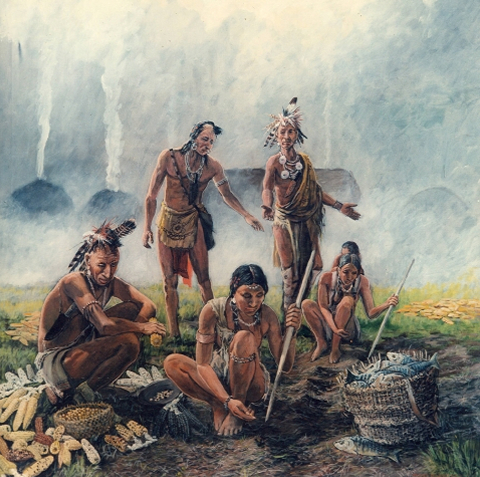
The Eastern Woodlands cultural region stretched east of the Mississippi River. The region's name came from the thick forests that once covered this land.The Eastern Woodlands people built their villages along the banks of the many rivers and streams flowing through the forests. The Native Americans of the Eastern Woodlands cultural region included two main language groups, Algonquian and the Iroquoian. Today, we will be looking closer at these two groups. We will see the homes they lived in, the food they ate, their religion, and much more. We will be able to compare and contrast the Iroquoian and Algonquian.
 Overview:
Step 1: Read about the Iroquois Homes
Step 2:Task
Step 3:Read about the Iroquois way of life
Step 4: Read about the Iroquois League
Step 5: Task
Step 6: Read about the Algonquian
Step 7: Task
Step 8: Task
The End
BIG QUESTION: Compare and contrast the Iroquois and Algonquian.
CORE CONTENT: 6.EDM.5/ 6.GR.9/ 6.GR.11/
2.20 Students understand, analyze, and interpret historical events, conditions, trends, and issues to develop historical perspective.
2.19 Students recognize and understand the relationship between people and geography and apply their knowledge in real-life situations.
Task
At the end of the Web Quest you should be able to compare and contrast the Iroquois and Algonquian by using a graphic organizer.
Process
STEP 1: Read about the Iroquois homes.
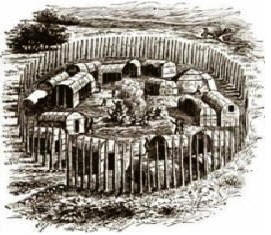
The Native Americans of the Eastern Woodlands cultural region included two main language groups, the Algonquian and the Iroquoian. The Iroquois spoke the Iroquoian language. Among the Iroquoian groups were the Mohawk, the Oneida, the Onondaga, the Cayuga, and the Seneca. Together these groups are known as the Iroquois, or the Five Nations. Like other Eastern Woodlands groups, the Iroquois farmed and lived in villages on top of steep hills. To protect against enemies, many Iroquios built palisades, or walls of wooden poles, around their villages.

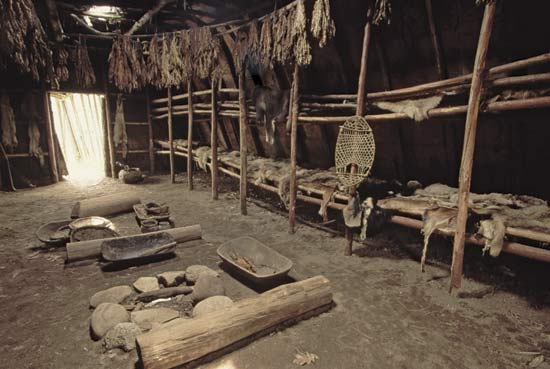
The Iroquois lived in shelters called longhouses. These wooden buildings could hold up to 50 people. Their frames were made by cutting poles from small trees, bending the poles, and then covering them with bark.They had a large door at each end. Each longhouse was divided into sections, and each section was home to one or two families.
Step 2: Task
- Turn to Page 6 in Notebook.
- Look at the outside of the longhouse.
- Use the websites to get a better look at the exterior and interior of the longhouses.
http://www.warpaths2peacepipes.com/native-american-houses/longhouse.htm
http://www.britannica.com/topic/Huron-people/images-videos/Reconstructe…
https://iroquoisbypreston.wikispaces.com/?responseToken=d4ef5c0ba3c223e…
- Turn to Page 7 in Notebook.
- Draw the inside of an Iroquois Longhouse using the websites above.
Step 3: Read about the Iroquois way of life.
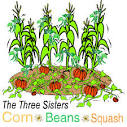
The Iroquois relied on both animals and crops for food. They used animals for food, but they also used the animal skin for clothing. Near their villages, the Iroquois grew three main crops-corn, beans, and squash. The Iruoquois called these the Three Sisters because all three were planted in the same field. After a field was farmed for a few years, the soil became less fertile. The Iroquois would then clear a field in a nother location and begin farming there. The Iroquois also depended on the wood that surrounded them. It was a major resource for them.
Step 4: Read about the Iroquois League and the 5 Nations.

For many years the Iroquois fought with each other and with the neighboring Algonquians. The fighting often began over land. Over the years farmers had cleared more and more forest land to raise their crops to feed their people. This meant that hunters had to go farther away to find animals, often entering other tribes' lands. But the fighting that began over land continued out with revenge attacks. This kept the Iroquois in constant warfare.
Like many native peoples, the Iroquois often used legends, or stories handed down over time, to explain the past. One legend says a Holy man named Dekanawida was one of the first to speak out against all the fighting. He said that the Iroquois must come together "by taking hold of each other's hands firmly and forming a circle so strong that if a tree should fall upon it, it could not shake nor break it, so that our people and grandchildren shall remain in the circle in security, peace, and hapiness."
An Onondaga chief named Hiawatha shared Dekanawida's hopes for peace. Hiawatha visted the Iroquois tribes, asking for an end to the fighting. Tired of war, they finally agreed to work together in what became known as the Iroquois League. The Iroquois was governed within the Iroquois League to settle disptues.
In 1570 the members of the Iroquois League agreed to form a confederation, or loose group of governments. Each tribe governed itself. But matters that were important to all of the groups, such as war and trade, were decided by the Great Councl. A council is a group that makes laws.
Men from the Iroquois groups, Mohawk, Oneida, Onondaga, Cayuga,and Seneca, were called the Five Nations. Together men from each tribe served on the Great Council. The eldest women of each tribe chose the members of the council. Each member had one vote. All had to agree before anything was done in the group.
Step 5: Task
- Turn to Page 8 in Notebook.
- Use the Step 4 reading to complete the circle chart by naming the five nations of the Iroquois people.
- Use the Step 4 reading to complete the two squares by answering the questions in the boxes.
Step 6: Read about the Algonquian.
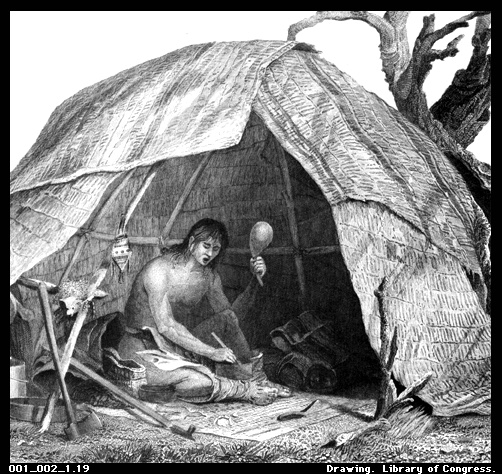
Among the Algonquian groups were the Delware, the Wampanoag, the Powhatan, the Miami, the Ottawa, and the Chippewa tribes. Most Algonquian groups had anywhere from 1 to 20 villages. Some groups built longhouses similar to those of the Iroquois. Others built round, bark covered shelters called wigwams. Apart from their shape, wigwams wre made in much the same way as longhouses. The trunks of small trees were bent, tied together into a dome shape, and then covered with bark.
The Algonquian who lived near the coast did not rely on their crops for food as much as their Iroquois neighbors. Fish was an important food source. The Algonquian built canoes to fish in the rivers and along the coast. They used animal bones and wood to make hooks and fishing traps. The Algonquian made clothing mostly from deerskin, which kept them warm during the cold winters. Men wore shirts, leggings, and moccasins. Women usually wore dresses.
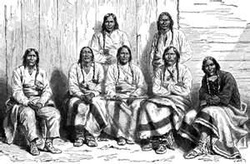
Many Algonquian groups had leaders who governed more than one village. Some groups had two cheifs, one to rule on matters of peace and one to rule on matters of war. Among Algonquian groups, marriage ceremonies were very much alike. If a man wanted to marry a woman, he had to show her he was a good hunter. If the woman wanted to marry him, she would show him that she was a good homemaker. When the couple got married, they usually exchanged gifts and invited their families to a feast.
Step 7: Task
- Turn to page 9 in Notebook.
- Use Step 6 reading to complete the circle chart at the top by naming the 5 tribes of the Algonquian people.
- Use Step 6 reading to complete the Circle graph at the bottom by naming what the two chiefs ruled over.
- Turn to page 10 in Notebook
- Use Step 6 reading to complete the diamond chart by finishing the sentences.
Step 8: Task
- Turn to page 11 in Notebook.
- Use the readings from step 1, step 3, step 4, and step 6 to compare and contrast the Iroquois and Algonquian people of Eastern Woodlands.
- You can also use these websites to help compare and contrast the Iroquois and Algonquian.
http://www.ducksters.com/history/native_american_iroquois.php
http://algonquian.weebly.com/way-of-life.html
THE END
Evaluation
RUBRIC
|
Criteria |
5 |
4 |
3 |
2 |
1 |
|
Overall Ideas and Content
|
* Student has complete accuracy with content knowledge and ideas are exceptionally clear.
|
* Student has almost complete accuracy with content knowledge and ideas are very clear.
|
*Student has somewhat complete accuracy with content knowledge and ideas are clear.
|
* Student has a low accuracy with content knowledge and ideas are cloudy.
|
* Student has little to no accuracy with content knowledge and ideas are unclear.
|
|
Comparing
|
*Student does an exceptional job at comparing Iroquois and Algonquian. |
*Student does a good job at comparing Iroquois and Algonquian. |
*Student sufficiently at comparing Iroquois and Algonquian. |
* Student does a poor job at comparing the Iroquois and Algonquian |
*Student does no compare the Iroquois and Algonquian. |
|
Contrasting |
*Student does an exceptional job at contrasting Iroquois and Algonquian. |
*Student does a good job at contrasting Iroquois and Algonquian |
*Student sufficiently at contrasting Iroquois and Algonquian. |
*Student does a poor job at contrasting the Iroquois and Algonquian. |
*Student does no contrasting of the Iroquois and Algonquian. |
|
Algonquian tribes, Government, and Marriage Customs |
* Student has complete accuracy with Algonquian tribes, Government, and Marriage Customs |
* Student has almost complete accuracy with Algonquian tribes, Government, and Marriage Customs |
*Student has somewhat complete accuracy with Algonquian tribes, Government, and Marriage Customs |
*Student has a low accuracy with Algonquian tribes, Government, and Marriage Customs. |
*Student has little to no accuracy with Algonquian tribes, Government, and Marriage Customs |
|
Longhouse and Iroquois League |
*Student has complete accuracy with Longhouse and Iroquois League. |
*Student has almost complete accuracy with Longhouse and Iroquois League. |
*Student has somewhat complete accuracy with Longhouse and Iroquois League. |
*Student has a low accuracy with Longhouse and Iroquois League. |
*Student has little to no accuracy with Longhouse and Iroquois League. |
Weighing
Ideas and Content 35%
Comparing 15%
Contrasting 15%
Algonquian tribes, Government, and Marriage Customs 25%
Longhouse and Iroquois League 10%
Total 100%
|
Criteria |
Rating |
Weight |
Points Earned/ Possible points earned |
|
Ideas and Content |
5 4 3 2 1 |
x 7 |
/35 |
|
Comparing |
5 4 3 2 1 |
x 3 |
/15 |
|
Contrasting |
5 4 3 2 1 |
x 3 |
/15 |
|
Algonquian tribes, Government, and Marriage Customs |
5 4 3 2 1 |
x 5 |
/25 |
|
Longhouse and Iroquois League |
5 4 3 2 1 |
x 2 |
/10 |
|
Points |
Letter Grade |
Percent |
Grade Earned |
|
90-100 |
A |
92-100 |
|
|
70-89 |
B |
85-91 |
|
|
50-69 |
C |
78-84 |
|
|
49-30 |
D |
70-76 |
|
|
29-0 |
F |
69-0 |
|
Conclusion
In conclusion, this web quest should have helped you:
- visualize an Iroquois longhouse
- understand the Iroquois Leage and Grand Council
- understand the Algonquian Government
- comprehend the marriage customs of Algonquian people
- compare and contrast the Iroquois and Algonquian.
- have a better understanding of the Eastern Woodland people.
Additional Links for Extending You're Thinking:
http://www.dhr.virginia.gov/arch_NET/timeline/contact_indian.htm
Credits
Thank You to these following resources for making this web quest possible:
http://algonquian.weebly.com/way-of-life.html
http://www.dhr.virginia.gov/arch_NET/timeline/contact_indian.htm
http://www.warpaths2peacepipes.com/native-american-houses/longhouse.htm
https://www.sites.google.com/site/205206aimuseum/exhibits/eastern-woodl…
https://iroquoisbypreston.wikispaces.com/?responseToken=d4ef5c0ba3c223e…
https://www.createwebquest.com/node/33837/edit
Berson, M. (2012). Early People. In Harcourt social studies [sample set] (Vol. 1, pp. 52-87). Orlando, Fla.: Houghton Mifflin Harcourt Publishing.
Boehm, R. (2000). Indians of North America. In Harcourt Brace social studies (Teacher's ed., Vol. 1, pp. 71-90). Orlando: Harcourt Brace & Company.
Heistler. Shelly. The Teaching Bank. The Eastern Woodland Region Interactive Notebook. Grenta, NE 2015