Introduction
"Some men are born great, some achieve greatness, and others lived during the Reconstruction period." -Paul Laurence Dunbar, 1903
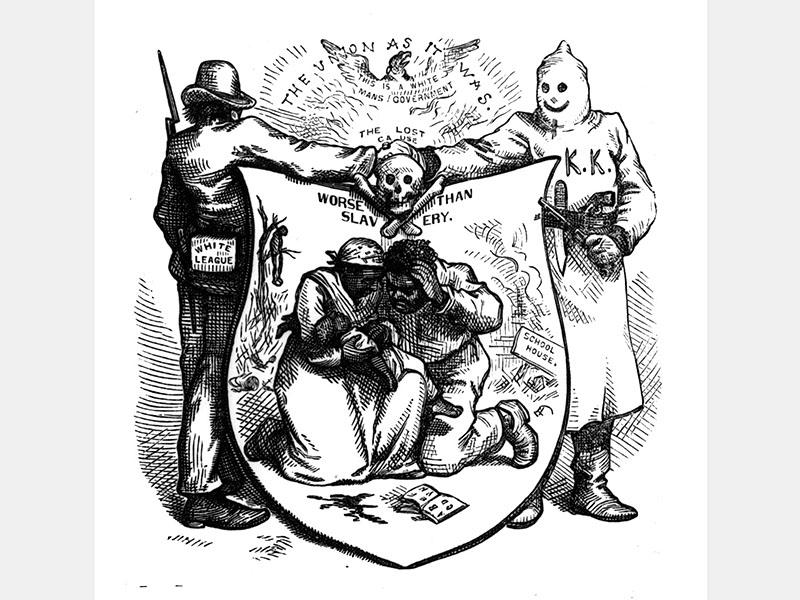
It is 1865. The Civil War is finally over, after four long years of battle and hundreds of thousands of deaths. Four million slaves have been set free by the Thirteenth Amendment. The country and its people face many challenges if the nation is to be “reconstructed." Most important to the freedmen is the question of freedom: What is it? What does it look like? How should it be protected?
[video:https://www.youtube.com/watch?v=OFGgbT_VasI width:5" height:5" align:center]
Task

Today we will examine the plight of the so-called freedmen, or former slaves, that continued long after the cessation of the American Civil War (1861-1865). In the years immediately following the war, during the era known as Reconstruction (1865-1877), the United States Government enacted policies to reunify the nation, repair the devastated South, and readmit southern states into the Union. Perhaps the utmost goal of Reconstruction, however, was to advance the political, economic, and social position of the freedmen. Congressional passage of the 13th, 14th, and 15th Amendments outlawed slavery, established the rights of blacks, and defined the framework by which Southern states could rejoin the Union. Passage of these amendments, profits made by carpetbaggers and scalawags, and the increased economic and political power held by some Southern blacks all caused some members of traditional Southern society to feel long-lasting anger and resentment.
A combination of enduring racism, a severe economic depression, Northern exhaustion with Reconstruction, a desire for national unity, and a campaign of organized violence against African Americans and their white allies overturned much pieces of Reconstruction legislation. The Compromise of 1877 removed the last federal troops from southern statehouses and formally ended Reconstruction. African Americans would continue to exercise some voting rights in the South until the 1890s, but they were progressively stripped of political, social, and economic power.
Yesterday we discussed the definition of the word "freedom," concluding that, even today, some people experience greater degrees of freedom than do others. We also talked about the fact that the concept of freedom is fluid, meaning that it is ever-changing, evolving alongside societal norms of morality and ethics. Thus, it is understood that freedom-- the qualities that render someone "free" or "unfree-- is contextual. Although disparities in freedom still exist today, they were far more pronounced in the years following Reconstruction, despite the newfound promises of equality that were supposedly secured by the passage of the 13th, 14th, and 15th Amendments... So, even though freedmen were granted more "priviledges" than ever before as a direct and immediate result of Reconstruction and the Constitutional revisions therein, the freedoms that they did receive were immeasurably inferior to those experienced by whites.
Using the four sources introduced in the "Evaluation" section, your background knowledge, and your own personal experiences, your task is to determine just how free freedpeople were at the end of Reconstruction. In addition, you are to pinpoint exactly what freedoms, or lacktherof, are represented in each of the sources provided, ultimately determining whether or not freedmen reached their goal of freedom by the year 1877.
Process
The Big Question: How free were freedmen at the end of Reconstruction?
Step #1: Explore and ponder, keeping the "Big Question" in the front of your mind!
Below are 4 sources that tell us something about whether freedmen had achieved their goal of freedom at the end of Reconstruction. Your job is to carefully examine the 4 sources provided, reading the corresponding description of each in entirety to insure that you understand exactly what it is you're looking at.
When viewing these sources, consider the following elements:
- The modern, standardized definition of the word "freedom"
- Your understanding of what it means to be free
- The political, economic, and social categories of freedom we discussed yesterday
- Your background knowledge on the African American struggle for civil rights and equality
Step #2: Rate the success of Reconstruction, on the scale of 1-10!
Once you've viewed each of the 4 sources, conclude just how free freedpeople were at the end of the Reconstruction, with "1" being totally unfree and "10" meaning completely liberated. What made you come to this conclusion?
*No writing is required for this assignment, however, you are strongly encouraged to record your answers to these questions! This will help you with the T-Chart in the "Conclusion" portion and prepare you for the upcoming Fishbowl/writing assessment, both of which will be completed in class tomorrow!
Step #3: Prep for your assessment!
Once you've completed Steps #1 & 2, take a look at the next tab in preparation for tomorrow.
In our next class session, you'll be graded on two things:
A). Your participation in the completion of a class T-Chart (pictured in the next tab)
B). Your involvment in either a Fishbowl OR your written response to an identical prompt, which must be completed independently during the class period
*Both tasks are described in greater detail in the proceding "Evaluation" section. Thus, is it strongly recommended that you use the remainder of class time wisely.
_______________________________________________________________________________
Example of Steps #1 & 2
Step #1: The picture below, which captures railway signs meant to direct black and white passengers to their respective cars, captures the realities of segregation. Taken in 1890, 13 years after Reconstruction's demise, this image tells us that blacks continued to be treated as second-class citizens.
Step #2: 2/10
.jpg)
Evaluation
Reminder: You are examining these sources to determine how free freedmen were at the end of the Reconstruction, rating their degree of autonomy on the scale of 1-10!
EVALUATION OF SOURCES-
Source #1: Maps illustrating the effects of emancipation on plantation life in the South
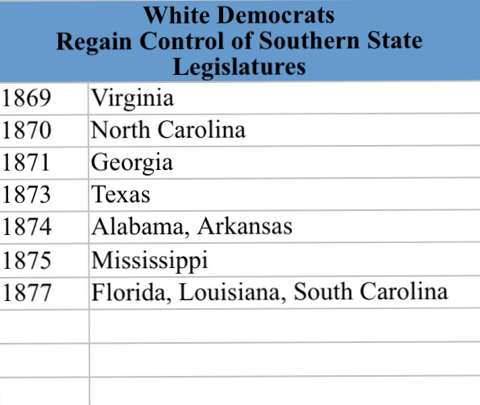
Source #2: See chart below
“Under the Reconstruction Acts of 1867, Republican governments came to power throughout the South. These governments offered blacks, for the first time in American history, the right to vote and be elected to political office. These governments established the region's first public school systems, passed civil rights laws, and promoted economic development.
But white southerners (using violence, the KKK, and other tactics designed to keep freedmen from voting) regained control of the Southern state legislatures. Once back in control, they were able to pass new laws restricting the freedoms of the South’s AfricaAmerican population."
Source #3: Building the Black Community: The School
Source #4: Convict Leasing (watch video clip!)
"While most believe that the 13th Amendment abolished slavery and involuntary servitude, a loophole was opened that resulted in the widespread continuation of slavery in the Southern states of America--slavery as punishment for a crime. According to the 13th Amendment, 'Neither slavery nor involuntary servitude, except as punishment for crime whereof the party shall have been duly convicted, shall exist within the United States, nor any place subject to their jurisdiction.'"
Convict leasing began in Alabama in 1846 and lasted until July 1, 1928, when Herbert Hoover was vying for the White House. In 1883, about 10 percent of Alabama's total revenue was derived from convict leasing. In 1898, nearly 73 percent of total revenue came from this same source. Death rates among leased convicts were approximately 10 times higher than the death rates of prisoners in non-lease states."
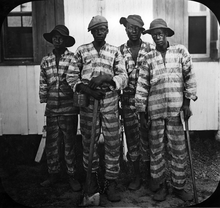
Convicts leased to harvest timber in Florida, 1915
Conclusion
So, how free were the freedmen after Reconstruction? After perusing the sources and images provided, you should be able to answer this question, supporting your claims with at least 4 examples.
A). The T-Chart pictured below will be filled out as a class tomorrow, just prior to the Fishbowl. Please think about your contributions to the discussion in advance to ensure that you receive the maximum amount of participation points.
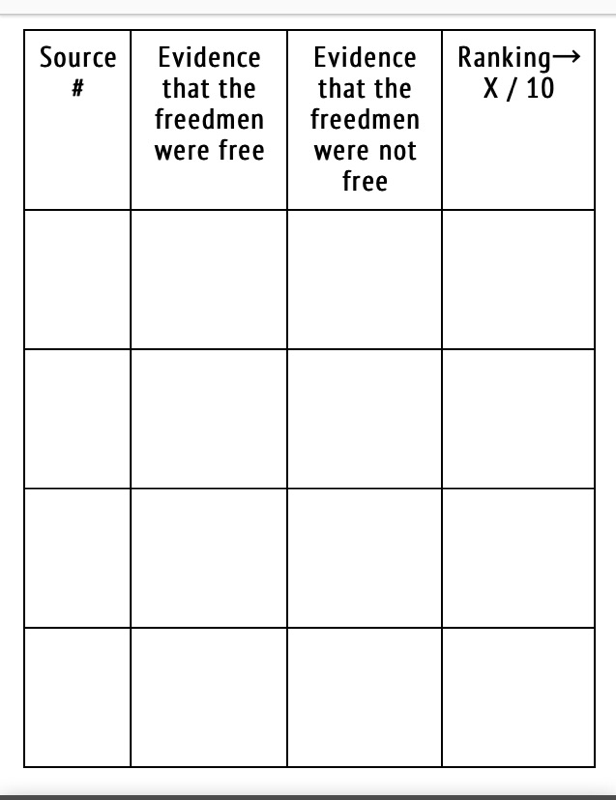
B). The Fishbow will center on the "Big Question" (How free were freedmen at the end of Reconstruction?), and you must use evidence from the documents to corroborate your stance in order to receive a "good" grade. You will be graded in accordance with the rubric.