
Introduction
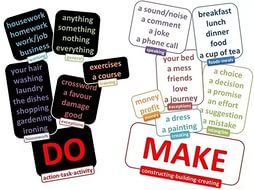 There are some words in English which are considered as "confusable". They may have the same meaning but should be used with different words. Make and do is one of the most commonly confusable word pairs.
Does "do" and "make"mean the same?
What is the difference between them?
Task
In this web-quest your task is
- to do on-line research on the use of words with "do" and "make";
- to practise the use of "do" and "make" by doing exercises;
- to summarize the received information and create clusters or mind-maps that can help you learn the word combinations with "do" and "make"
Process
STEP 1
go through all the links below and study the information about the verbs "do" and "make": Rules Rules Rules Rules If you have found some useful links yourselves, don't forget to share them with your classmates.STEP 2
go through all the links below and do the exercises: Exercises Exercises ExercisesSTEP 3
make a conclusion how to use "do" and "make", discuss the results with your classmates
STEP 4
make a cluster or a mindmap on how to use "do" and "make", make a report to your classmates.
Evaluation
|
|
|||||||||||||
|
| Cooperation | Rarely takes part in group discussions, shares very few ideas and does not respect others' opinions | Occasionally takes part in group discussions, shares some ideas and respects others' opinions to a limited degree | Takes an active part in group discussions, shares ideas most of the time, and respects others' opinions | Takes the initiative in group discussions, shares ideas and encourages others to do the same, respects others' opinion | 5 |
| Time management and focus on task | Wastes his or her time and focuses very little on the task | Does not make good use of time and is often distracted from the task | Manages time well and generally focuses on the task | Manages time very efficiently and focuses on the task | 5 |
| Organization of thought: | No structure, the information is disconnected | The information is organized, but there are no logical links between the parts | The information is organized logically but misses headings | The information is organized logically and has headings | 5 |
|
|
|||||
| Esthetic value: | There is difficulty in reading the information on the cluster or a mindmap | The given information prevents comprehension | There is no unity in organizing the cluster/mindmap | The cluster/mindmap is done esthetically and creatively | 5 |
Total score: 20
Conclusion
Your work is over.
I hope that you have learnt a lot of useful information about the verbs "do" and "make"
and will never feel confused while using them in your speech.
.jpg)
Teacher Page
This web is designed
- to stimulate students' self-supporting work, cognitive activity
- to develop students' grammar skills
- to broaden their outlook,
- to stimulate and develop their competences, grammar and speaking skills.
[img_assist|nid=32482|title=aim|desc=|link=none|align=left|width=172|height=190]