
Introduction
Freedom of Speech & Freedom of Opinion, both set the foundation for freedom of the press. They are one of many cornerstones of democracy. We can look at each pars pro toto and take their respective condition as an indicator of the well-beeing of democracy or its vulnerability.
You are entering the main WebQuest project on the topic which is heading another six SubQuests.
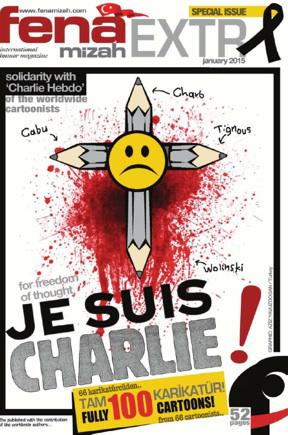
Before French satirical weekly Charlie Hebdo was attacked by Islamist gunmen early January 2015, its Paris offices had been fire bombed the previous November after it published a mocking caricature of Mohammad. In 2005, Danish cartoons of the Prophet sparked a wave of violent protests across the Muslim world that killed at least 50 people. This incident became known as the Jyllands-Posten Muhammad cartoons controversy (or Muhammad cartoons crisis).
In the wake of Islamic threat the French government had warned Charlie Hebdo's editor to stop presenting critical pictures, which Muslims might find blasphemous.
A middle-east expert said that it’s not enough to argue that Western principles of free speech apply. “Of course you have the right to publish this in a free society, although, France has a much more restricted free speech mandate than the United States of America,” he explained. “But, on the other hand, the question is do you take advantage of that freedom if the purpose is purely to incite and purely to provoke and, therefore, one would say that discretion is the better part of valor in this instance."
While the subWebQuests pave your way through the many aspects of media, here you focus on editorial -aka political- cartoons, and take part in the current debate about whether or not to publish cartoons that might be offensive to others. How much tolerance does a peaceful, democratic discourse require of all participants?
|
A cartoon is an illustration containing a commentary that usually relates to current events or personalities. They typically combine artistic skill, hyperbole and satire in order to question authority and draw attention to corruption and other social ills. Concise Encyclopedia |
Should media exercise preemptive censorship to avoid any authority feel offended? Which amount of criticism must be tolerated in cartoons?
Must cartoonists refrain from satirizing religious creeds?
You might not find a satisfying answer but you will most certainly start asking the right questions which help establish a frutiful negotiation process.
Task
|
|
It is your TASK to take a profound stand on a range of critical cartoons in an editorial meeting of a news magazine publishing in English. You may choose the magazine (or newspaper) but you have to adhere to the publisher's mission. |
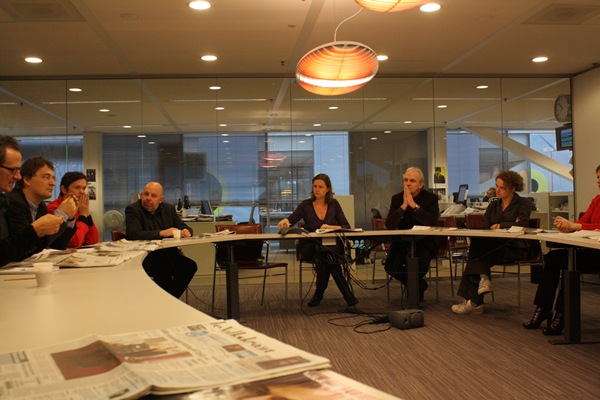
There are a few ways of approaching the task:
-
prepare yourself for your “role” during the editorial meeting. Further down you find job descriptions. Make sure you have at least two more role players with a different profile inyour performing team.
- use adequate language to describe, analyze and evaluate cartoons and as a Learner of English most input given here serves as a scaffold of your learning process.
-
work through a number of activities and and sub-tasks (Sub-WebQuests) which provide insight into this sensitive issue. You can either pair up for the preparation or work through the sub-tasks on your own. The assignments follow test standards laid down be the Federal Ministry of Education of NRW (Germany) for upper secondary level learners of English. You start this work when you proceed to “Process”.
See how the task works and make yourself familiar with your role using the information below this line.
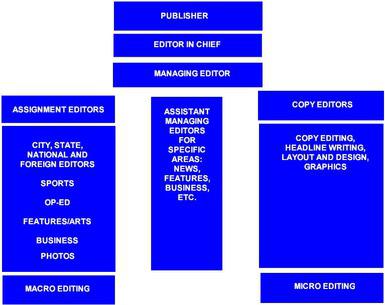
Most newspapers have a hierarchy of editors responsible for various aspects of the operation. The graphic shows a typical hierarchy, starting at the top with the Publisher:
…
The Publisher
… he or she often has little involvement in the day-to-day operationof the newsroom.
The Editor in Chief /Senior EditorThe editor in chief is responsible for all aspects of the news operation, including the content of the paper, hiring, budgets, etc. The editor's involvement with the day-to-day running of the newsroom varies with the size of the paper. On small papers, the editor is very involved; on big papers, maybe less so. You are responsible for
|
Managing Editor
The managing editor is the one who directly oversees day-today operations of the newsroom. More than anyone else, perhaps, he or she is the one responsible for getting the paper out everyday, and for ensuring that it's the best that it can be. Again, depending on the size of the paper, the managing editor may have a number of assistant managing editors responsible for specific sections of the paper, such as city news, sports, etc. |
|
Copy EditorsCopy editors typically gets reporters' stories after they have been given an initial edit by assignment editors. They edit stories and often also write headlines and do layout. |
Assignment EditorsAssignment editors are those directly responsible for specific section of the paper, such as city news, business, sports, features, etc. They are the editors who deal directly with reporters, photographers and cartoonists; they assign stories, work with their crew on their coverage, suggest angles and ledges, and do the initial editing of reporters' articles. You are the link between magazine staff and freelance writers and cartoonists.
|
|
|
Cartoonist A cartoonist draws cartoons for publications to amuse readers and interpret or illustrate news highlights, advertising, stories or articles; develops personal ideas or reads written material to develop ideas from context; discusses ideas with editor or publisher's representative or sketches cartoon drawing and submits drawing for approval; makes changes and corrections as necessary and finishes drawing; and may develop and draw comic strips.
|
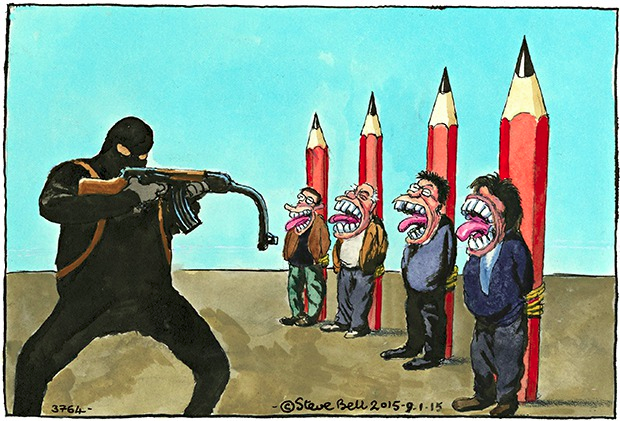
Watch Steve Bell drawing the following cartoon and discussing his depiction of the Charlie Hebdo terrorists: |
Process
To prepare yourself for the main task you can choose SubQuest stations, that provide you with different aspects you need to know. You find these here
|
SubQuest 1 Genres of pictorial critical comment |
SubQuest 2 (Print) Media – His master's voice: who pays and who profits from media? |
The Freedom of the Press |
SubQuest 4 Tout le monde est Charlie? Reactions to the attacks |
SubQuest 5 Controversy over Charlie Hebdo's Cartoons |
SubQuest 6 Listening to a radio interview on eyewitness media posted to Twitter, Facebook and Instagram |
Before task performance:
Plan the presentation of your position on the issue at hand:
- Think about your likely gains that you can negotiate
- Stipulate your bargaining range/settlement range
- Know your BATNA
- Decide on your resources
During task performance:
Negotiate your points strategically and effectively in whatever way you want, using a wide range of techniques.
- Build your central line of reasoning either on a cause-effect perspective
- similarly on a linear (antecedent and consequence) perspective
- (rather persuasively)using contraries and/or contradictions.
- Be conscientious of report talk / rapport talk
- Adhere to regulative rules
- Reject negative attacks by but rather use face-saving tactics
Abridged and adapted from the following sources:
"Silva Rhetoricae" (rhetoric.byu.edu) http://rhetoric.byu.edu/Figures/Figures-Overview.htm
http://de.scribd.com/doc/527869/Debate-Rules
http://www.cios.org/encyclopedia/conflict/glossary.htm Suzanne McCorkle, Ph.D. with funding from the Communication Institute for Online Scholarship
http://english.iifac.org (International Institute for Facilitation and Change An educational business run by Beatrice Briggs, based at Mexico)
Evaluation
| Elements of the task | Perfect accomplishment | Average accomplishment | Basic accomplishment |
| You can ... | You can ... | You can.. | |
| Talking about cartoons |
describe and understand critical cartoons and can see their ideological charge their use in context; |
use topical vocabulary and point out some of the satirical message |
use topical vocabulary describing cartoons |
| Print media | argue on the basis of thorough familiarity with "your" paper's mission | take part in the discussion describing the features of your paper and explaining some reqirements |
make references to typical features of "your" paper
|
| Questions of Censorhsip |
explain your decision making on the background of a comprehensive concept about ”freedom of the press" |
identify censorship stategies in line with the Freedom of Press Index |
relate methods of censorship according to the RWB |
| Sub-cultural attitudes and believes |
You can mediate opposing reactions to the Paris attack by acknowledging their respective context and transfer this to the decision making process concerning the cartoons |
explain the reactions of different groups to the Paris attacks & identify similar stereotypes in the context of the cartoons |
talk about two main reactions to the Paris attacks and describe their antagonistic character. |
|
balance various moral stands on the cartoons and identify their symbolic representations and ideological charge. |
explain your attitude towards political and /or religious criticism as depicted in the cartoons; |
outline your attitude towards political and /or religious criticism |
| Elements of the task | Perfect accomplishment | Average accomplishment | Basic accomplishment |
| You can ... | You can ... | You can.. | |
| Role identiy | act and argue authentically representing your role charcter's mission | argue from the point of view of your role character | act in your role most of the time |
|
Negotiating- central line of reasoning using:
|
use at least three different lines of reasoning and come up with a range of similarly constructed arguments |
use at least two different lines of reasoning once or twice |
use at least one line of reasoning |
|
Cooperation
|
show cooperation such as pointed out on at least three occasions | show cooperation such as pointed out on at least two occasions | show cooperation such as pointed out on at least one occasion |
Conclusion
In the exchange of views for the purpose of deciding which cartoons go into the paper, and which don't, you will make a big step towards negotiations as tool of participation in a democratic society. You will have experienced the strength of sound reasoning or if your cause falls short of good reasoning, rethink and restructure your ideas.
|
Genres of pictorial critical comment ; |
… words you need to describe the cartoon and the intended message; |
|
Print Media – His master's voice: who pays and who profits from media? |
… know-how of the English Press as an example of international proceedings in the media; |
|
The Freedom of Press Index |
… context knowledge about all types of censorship |
|
Tout le monde est Charlie? |
…. how to mediate between different cultural or sub-cultural concepts, personal attitudes and believes |
|
Work Station 5 Controversy over Charlie Hebdo's Cartoons |
WiP!!! … the general discourse about the term “Freedom of Speech - Freedom of Press” discuss the intricate link between political issues and day to day editorial decision making |
|
Work Station 6 A podcast looks at how the recent terror attack in France was reported by news outlets using eyewitness media posted to Twitter, Facebook and Instagram |
get a model conversation and pick up authentic language from a broadcast on the impact of eye witness accounts via smart phones in the wake of Charlie Hebdo |
Credits
Credits & Reference
(still work in progress Mar 21, 2015)
This research project has been created by In-Service-Teacher-Trainees of the course Fachseminar Englisch /Mai 14-15
Lecturer: M.Teichmann / Zentrum für schulpraktische Lehrerausbildung Solingen Gy/Ge.
Feedback,encouragement and criticism send to Teichmannmonika@arcor.de
It is based on the following material:
| Introduction |
Solidarity Cover |
Fenamizah – e-dergi. International Humour Magazine http://cartooncolors.blogspot.com.tr/2015/01/for-solidarity-with-charli… |
|
Paul Scicchitano and John Bachma: Zogby: French Magazine Should Be ‘Condemned’ for Stoking Islamist Rage. 19 Sep 2012 Latest Breaking News from Newsmax.com |
http://www.Newsmax.com/Newsfront/zogby-french-cartoon-mohammed/2012/09/19/id/456839/#ixzz3RegvJZsj |
|
| Task |
Journalist |
en.wikipedia.org |
|
Cartoonist: Job Description and Career Information |
http://education-portal.com/articles/Cartoonist_Job_Description_and_Car… |
|
|
Graphic by Tony Rogers taken from |
http://journalism.about.com/od/careersinjournalism/ss/editstructure.htm |
|
|
Steve Bell's cartoon |
http://www.theguardian.com/commentisfree/cartoon/2015/jan/08/charlie-he… |
|
| Task | ||
| Process | ||
| Evaluation | ||
| Conclusion | ||
Teacher Page
WIP
If you do not want to use any of the material because you feel the cartoons should not be shown to your class (which would constitute a perfect example of preemptive censorship), we can offer an alternative. (see below)
Use any of the original questions (cf. INTRODUCTION) for a Panel Discussion or a Parliamentary Debate.
- Should media exercise preemptive censorship to avoid any authority feel offended?
- Which amount of criticism must be tolerated in cartoons?
- Must cartoonists refrain from satirizing religious creeds?
Formal/Parliamentary DEBATE
see: http://www.youtube.com/watch?v=ALbuIrVq_u8&list=PLD25DF40AB1E35386
General Principles of a Debate
talk or argue something, think about something; talk about something at length and in detail, especially as part of formal exchange of opinion.
"Game of the intellectuals"
The question at hand to be debated is called the “resolution”/ “motion”.
In parliamentary debates, the house is divided into Government (AKA proposer) and Opposition. The leader of the government is called the Prime Minister; the second speaker is called the deputy prime minister.
On the other side the first speaker is called “leader of the opposition”. The second speaker is called the deputy leader of the opposition.
The third speaker of both sides are called rebuttal or whip speakers.
It is the duty of the government to give a reasonably debatable definition to the given motion at a level understandable to the AVERAGE REASONABLE PERSON. It is the government’s duty to define the motion in such a way that the opposition is given an ample space to promote a reasonable clash. Finally, it is the duty of the government to forward a case that will be faithful to spirit of the motion, and to rebut the case presented to the House by the opposition.
The primary duties of the opposition are to clash with the case forwarded by the government and to present a case that will discredit the government’s arguments.
Procedure (min. 45 minutes)
First speaker/ Prime Minister speaks for 7 (x) minutes
(One bell = one minute left; two bells = time is up)
defines any terms which require interpretation
presents supporting arguments
quotes supporting arguments
Leader of the opposition speaks for 7 (x) minutes
refutes government points
introduces counter-arguments with evidence
Steps 1 and 2 are repeated for the second (5') and third speakers (3') of each side
Leader of the opposition speaks for 2 minutes
summarises the case of the opposition
no new arguments or information are allowed
Finally the Prime Minister speaks for 2 minutes
summarises the case of the opposition
no new arguments or information are allowed
post-activities:
Adjudicator will leave to consider the verdict.
Remaining group have a popular vote (“Who did the best job?”)
Opening to the “floor”: Audience shares comments and observations on subject (content) or the debate (form/performance)
Adjudicator speaks for 7 minutes
assigns each team a score to determine the winner