
Introduction

(Desalination topic words picture, 2014).
Gold Coast Desalination Plant
by Kristy Smith
Desalination plants operate in over 120 countries across the globe, using the Reverse Osmosis (RO) process to desalinate water. The desalination process has been formulated to supply water by tapping into the largest water reservoir, the ocean (Poseidon Water, 2010).
Desalination was first recorded with people using the desalinating process, has been identified within the bible. The text reads of how Moses and the people of Israel came across the water of Marah, which were bitter to taste, and the quote within the bible reads "And he cried unto the Lord; and the Lord showed him a tree, which he then cast unto the waters, the waters were made sweet." After reading these words from the bible, it creates an unfound wonder of whether this was infact desalinating the waters (The history of desalination, n.d.).
Apart from the words of the bible, the official desalination process was founded in 1791 in the United States, presented by Thomas Jeffersen, the Secretary of State. The process was initally used as a source of fresh water in case of emergency, where the information was printed on the back of all papers on board ships (The history of desalination, n.d.).
However, for this geographical inquiry, it will be focusing on the desalination process on the Gold Coast.
As you go through the different parts of this webquest, you will see the report from 7 News about how the desalination process will be affecting some of the community within the Gold Coast.
There is also a YouTube video, which goes through the desalination process in which is being used at the Gold Coast Desalination Plant, (RO).
There is also a graph which explains from a survey just what the community thinks of the desalination process being used within Australia for certain times, such as extreme droughts within Australia.
There is also a Teacher's Page, which gives teacher's an idea for how to implement the desalination concept in a lesson. This lesson would be great for a Science lesson as it shows how to do the desalination process on a smaller scale within a classroom setting.
Task
[video:https://youtu.be/jQW1w8xF75c]
(Seven News, 2015)
Where are the issues or patterns being studied in relation to desalination?
The desalination plant which was built in 2009 in Tugun, was commissioned during extreme drought but has not been used in that time, however has been maintained at a cost of $15 million a year (Seven News, 2015).
The plant will be in full operation for a period of six weeks while the Mudgeeraba treatment plant undergoes much needed upgrading. The plant will be supplying water to around 170 000 homes across eight surrounding suburbs, including Mudgeeraba, Robina, Reedy Creek, Burleigh, Tallebudgera, Elanora, Currumbin Waters and Coolangatta. The water which will be providing the community will be sourced from the ocean off Tugun (Seven News, 2015).
Process

(Tugun desalination plant picture, 2014).
What are the potential issues relating to the desalination plant in Tugun?
Some of the potential issues caused by the Desalination Plant in Tugun, can include but is not limited to:
- noise pollution
- visual pollution
- reduction to recreational fishing and swimming areas
- can become expensive to run constantly
- emission of materials into atmosphere
- brine discharge and disposal methods are main cause for pollution of the ocean
- RO membranes susceptible to fouling and scaling requiring regular cleaning with chemicals which could be toxic to receiving waters
- input and output of water in desalination plants require pre and post treating respectively
- Requires treating for pH, coagulants, Cl, Cu, organics, CO2, H2S and hypoxia (Tularam & Ilahee, 2007).
Evaluation
[video:https://youtu.be/aysj7696b0A]
(Suez, 2012).
What is the process the Gold Coast Desalination Plant has used to provide the community with high quality drinking water?
The Desalination process in which the Gold Coast has gone with is the Reverse Osmosis (RO) process which involves forcing sea water through layers of specially engineered membranes at a high pressure (roughly 60 times atmospheric pressure) to remove dissolved salt and other microscopic particles (Hall, n.d.).
This process is used to provide the community with high quality drinking water, especially during times of severe drought. The process can also provide as an alternate source of water which will help with the overall water supply diversity and be less vulnerable to interruption (Tularam & Ilahee, 2007).
How has the process of the desalination process been communicated to the community?
There has been surveys completed by a variety of people from the community and based on the results of 3077 responses (King et al., 2012), below is a table which indicates what the community think about the prospect of desalinated water being used for water shortages in Australia.
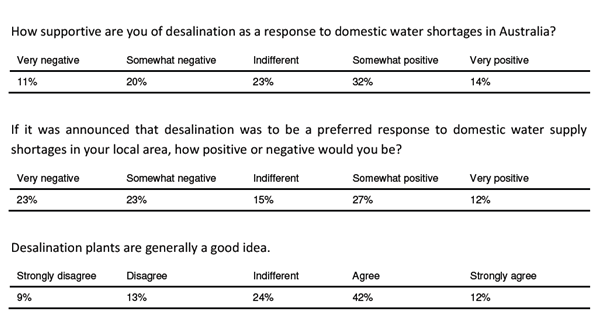
(Desalination survey picture, 2012).
Who has responded to the survey in regards to the desalination plant on the Gold Coast?
The survey included responses from 51% respondents female, mean age of respondent 55, 72% born in Australia, 78% home owners/buyers, also varying education levels with 18% completed yr 10, 17% completed yr 12, 14% with Bachelors degree, varying working with 36% working full time, 31% retired (King et al., 2012).
Conclusion

(Layout of desalination plant picture, 2009).
This is where the information you have read will now be used to answer these questions relating to the Gold Coast Desalination Plant!
A geographical inquiry involves students in active investigation, the purpose of this is to engage students in the learning process through formulating questions, investigating widely and building new understandings, meanings and knowledge.
To successfully complete this geographical inquiry, you will need to answer these questions using the information provided throughout this webquest.
Q1: What and where is the desalination process being studied?
Q2: Which process of desalination is the plant using to successfully create high quality drinking water?
Q3: What are the impacts of the desalination plant on the environment?
Q4: What is being done or what could be done to sustainably manage these impacts?
Q5: How much does it cost to maintain the desalination plant on a yearly basis?
Credits
References - APA Style
Australian Curriculum. (n.d.). Science. Retrieved from http://www.australiancurriculum.edu.au/science/curriculum/f-10?layout=3…
Desalination survey picture [Image] (2012). Retrieved from https://www.deakin.edu.au/research-services/forms/v/.../wps-39w.pdf
Desalination topic words picture [Image] (2014). Retrieved from http://www.researchperspectives.org/grant/EP/J004871/1_Bio-desalination…
Hall, R. (n.d.). From catchment to tap. Retrieved from http://www.goldcoast.qld.gov.au/documents/bf/from-catchment-to-tap.pdf
King, T. J., Ooi, D., Cary, J., Fisher, A., Schibeci, R., Murphy, K., ... Donaldson, J. A. (2012). Public perceptions of, and responses to, desalination in Australia: A report on findings. Australia: Alfred Deakin Research Institute, Deakin University.
Layout of desalination plant picture [Image] (2009). Retrieved from http://archive.siliconchip.com.au/cms/A_111473/article.html
Poseidon Water. (2010). Desalination worldwide. Retrieved from http://hbfreshwater.com/desalination-101/desalination-worldwide
Seven News. (2015, August 12). Sea water to be pumped to Gold Coast homes. Retrieved from https://youtu.be/jQW1w8xF75c
Suez. (2012, November 27). "Drinking from the sea", explore how and why sea water is desalinated. Retrieved from https://youtu.be/aysj7696b0A
The history of desalination. (n.d.) Retrieved from http://www.rpi.edu/dept/chem-eng/Biotech-Environ/Environmental/desal/hi…
Tularam, G.A., & Ilahee, M. (2007). Environmental concerns of desalinating seawater using reverse osmosis. Retrieved from http://www.divingthegoldcoast.com.au/docs/critreview.pdf
Tugun desalination plant picture [Image] (2014). Retrieved from http://www.australiaunlimited.com/environment/securing-australias-water…
Teacher Page
Teacher background information
The process of desalination by distillation removes the salt from water. When enough of the salt is removed, ensuring not too much is removed, the water can then be used for drinking. Due to high energy costs to achieve the right purities for human consumption, distillation is a less common method to use than reverse osmosis (RO), which is the method that is being used at the Gold Coast Desalination Plant. The process of RO costs less to operate than distillation, however does have huge energy requirements. RO uses about 60 times atmospheric pressure to push the water through a semi permeable membrane. This process makes it easy for water molecules to pass through, but is too small of a gap for other dissolved solids, eg. salt (Hall, n.d.).
Equipment
■ beakers, jars, containers
■ salt water
■ cling wrap
Lesson steps
- Given the materials listed, ask the groups to design a water desalination plant that will convert salt water into freshwater.
- If necessary draw attention to the investigations while exploring the water cycle, evaporation and condensation.
- Students are to draw and label the design in their science books.
- Students are to then describe how the desalination plant converts salt water into freshwater.
- Working in groups, students are to devise a method of determining if the salt water has been converted into fresh water by the desalination plant (Hall, n.d.).
This task will be ongoing and will allow teachers to ensure students understand the desalination process and they are able to give reasonable feedback to their responses. This task will also enable students to gain a more detailed understanding of desalination concepts (Hall, n.d.).
By completing this task, students would be completing the following curricular intentions as found on the Australian Curriculum:
The properties of the different states of matter can be explained in terms of the motion and arrangement of particles (ACSSU151)
- explaining why a model for the structure of matter is needed
- modelling the arrangement of particles in solids, liquids and gases
- using the particle model to explain observed phenomena linking the energy of particles to temperature changes
Chemical change involves substances reacting to form new substances (ACSSU225)
- identifying the differences between chemical and physical changes
- identifying evidence that a chemical change has taken place investigating simple reactions such as combining elements to make a compound
- recognising that the chemical properties of a substance, for example its flammability and ability to corrode, will affect its use