
Introduction
Could you emancipate?
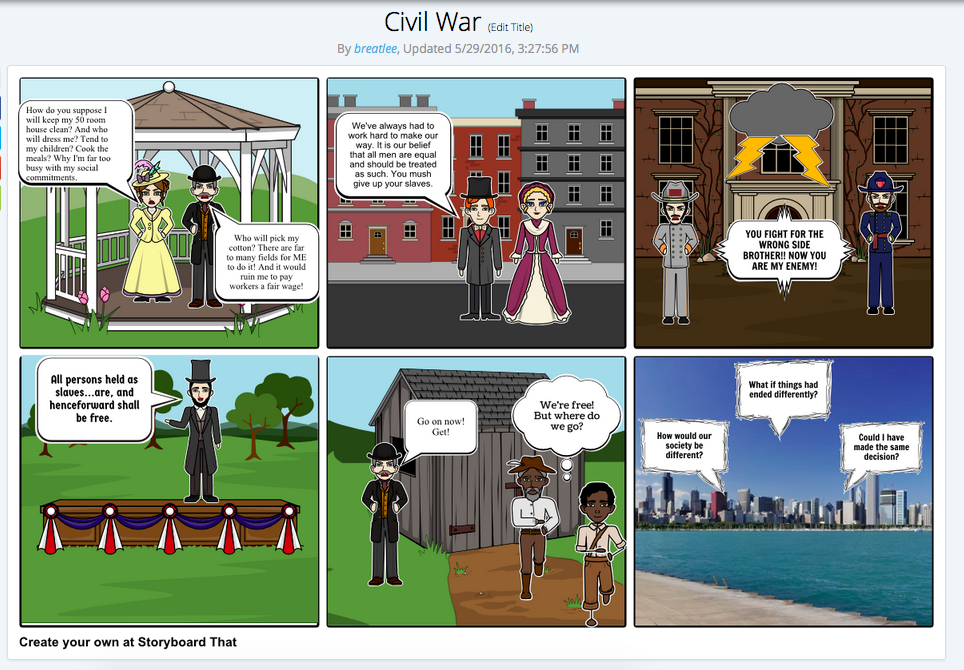
This is a fourth grade quest to determine if faced with the same decision as Lincoln, could you make the same choice that he did. Could you fight to keep the country whole? Free the slaves? Would you do anything differently?
Task
Let's travel back in time for a bit.
The time is April 1861. You are the current president of the United Sates of America. Your beloved nation is on the verge war, of splitting in two. Could you look at both sides points of view and make the same tough choice that Abraham Lincoln did? Can you prevent the country from falling apart? Could you make the choice to free the slaves from the south?
Process
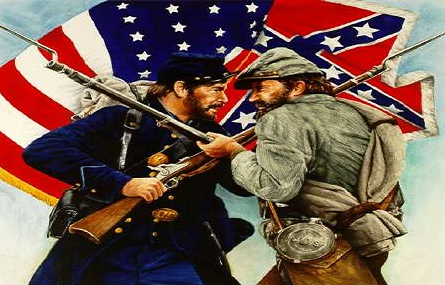
To make an informed decission you will need to read through the information on the websites provided below. In your notebooks you will want to take notes on the views of both sides. You may want to organize your notes in either a T-cart or Venn Diagram.
Use your classmates and your notes to come to a conclusion about what you would do. Construct an argument for your position. Use information that you find while researching to support your reasoning. Your argument can be drafted in your notebook until edited. All final drafts should be submitted to your teacher via Google Docs. You have one week to complete this execise.
http://www.ducksters.com/history/civil_war.php
http://www.socialstudiesforkids.com/subjects/civilwar.htm
http://quatr.us/northamerica/after1500/history/civilwar.htm
Evaluation
At the end of the week you will be assessed on the argument you submit to your teacher either for or against fighting to keep our country whole and to free the southern slaves. Your score will be determined based on the rubric below. You will find a copy in your Google Drive for completion when you have finished the project.
|
|
Minimal 1pt |
Adequate 2pts |
Excellent 3pts |
|
Quality of Argument |
Makes an attempt at an argument. Thoughts are not clear. Supports lacking. |
Makes an argument. Thoughts are clear. Adequate supports present. |
Argument is clearly stated and easily understood. Supports are present and clearly support argument. |
|
Quality of Research |
Unclear if research was completed. Data and support information missing or inaccurate. |
Research appears to be sufficient. Most information is accurate and enough to demonstrate understanding. |
Understanding is clear. All information is accurate and sufficient to support understanding. |
|
Quality of Writing |
Many errors in spelling and conventions. Sentences hard to read. Understanding lost due to errors. |
Argument well written with only minimal errors. Errors do not limit readers understanding. |
Very few to no errors present. Reading is easy and understanding is clear. |
Total points available: 9
Conclusion
Reflect upon your work during this assignment. What level of effort did you put toward the final assignment? Could you have done better?
What about the decission you made? Was it based on the information you gathered? Could you have done, changed, or decided on something different?
Complete the selfassessment rubric in your Google Drive and submit it to your teacher.
Credits
The site links below are to the home pages used in this WebQuest. Links to the specic Civil War pages are located on the Process page.
Website credits:
Teacher Page
Could you Emancipate?

Fourth grade WebQuest on the causes of the American Civil War.
Created by: Ms. Atlee
Date: June 2016
Introduction
We have all heard the phrase “freedom doesn’t come free”. For a great number of people in our country’s history they had no freedom at all. Those people were slaves and the time was the 1860’s. There were many who felt that that was wrong, that everyone should be free and equal. Because both views were held so dear or country was nearly torn into two pieces had it not been for a president with a vision and his decision to fight for his vision. That president was Abraham Lincoln and his vision was that our country be held whole as one great nation, not torn apart by different opinions.
Aim
In this quest students will be gathering information as to the causes of and issues surrounding the American Civil War. They will use the information that they find to determine if faced with the same decision as Lincoln, could they have made the same choice that he did. They will also use the information they find to support an argument stating and supporting their opinion and views.
Rationale
Through the gathering of information and processing of viewpoints from both sides of the Civil War students will gain a better understanding of the causes and major issues that led to Lincoln’s decisions to fight for his vision and to ultimately abolish slavery. They will also gain an insight as to the impact that these decisions have made even today. In gaining a better understanding, students will be able to make a more informed decision about whether or not Lincoln’s decisions were in the best interest of our country and its people.
General Goals
For this activity the overall goal is for students to gain a better understanding of the causes of the American Civil War. Students will analyze information from both sides and craft an argument for or against Lincoln’s decisions to fight for a united nation and emancipate the slaves. Students will also evaluate how the events and outcomes of the Civil War have shaped our country. Teachers will evaluate student understanding by reviewing students written argument submitted on day 5 and score it based on the Argument Rubric provided below. Understanding can also be assessed based on informal observations and discussions of students during the research process and optional discussion on day 6.
Learner Description
This activity is geared toward fourth, possibly fifth, grade students. Depending on the make-up of your specific classroom, accommodations may be made to the writing task, as well as, the research portion. Students can also complete this task in pairs or small groups depending on devices and learner needs.
Prerequisites
To better understand the content students should have a basic understanding of the geography of the United States in the Northeast, Southeast and Midwest regions. They will also need to know how to log into and navigate through their Google Drive documents to access some of the linked documentation. (Unless Google is not available in your school, then documents will need to be printed by the teacher.) You may also want to review the list of Glossary Terms at the end of this document to ensure that students have the vocabulary necessary to complete this task.
Subject Matter
This activity is centered around Social Studies and History standards and can be used as part of a study on the Northeast, Southeast and Midwest regions and their history. It can also be used as part of a unit on the history of the United States or our presidents.
Learning Objectives
Social Science Standards
Communicating Conclusions SS.IS.6.3-5: Construct and critique arguments and explanations using reasoning, examples, and details from multiple sources.
Participation and Deliberation: SS.CV.3.4: Identify core civic virtues (such as honesty, mutual respect, cooperation, and attentiveness to multiple perspectives) and democratic principles (such as equality, freedom, liberty, and respect for individual rights) that guide our state and nation.
Processes, Rules and Laws: SS.CV.4.4: Explain how rules and laws change society and how people change rules and laws in Illinois. (This will also be applied more regionally/nationally for the purpose of this project.)
History Standards
Perspectives: SS.H.1.4: Explain connections among historical contexts and why individuals and groups differed in their perspectives during the same historical period.
Historical Sources and Evidence: SS.H.2.4: Using artifacts and primary sources, investigate how individuals contributed to and the founding and development of Illinois.
Causation and Argumentation: SS.H.3.4: Explain probable causes and effects of events and developments in Illinois history.
NETS (ISTE) Standards:
Creativity and Innovation: b- Create original works as a means of personal or group expression. And d- Identify trends and forecast possibilities.
Critical Thinking, Problem Solving, and Decision Making: c- Collect and analyze data to identify solutions and/or make informed decisions. And d- Use multiple processes and diverse perspectives to explore alternative solutions.
Materials Needed
Laptop or computer for each student, pair or group
Access to students’ Google accounts (If using Google to share documents.)
Can you emancipate? WebQuest link
Self Reflection Rubric for students
Argument Rubric for teachers
Instructional Plan
This activity will take approximately 5 class periods to complete. (A class period is generally 40 minutes long so length of time for this project could differ depending on actual class time available.) Can be completed in class or in a computer lab depending on accessibility to technology. Students can work independently, in pairs or small groups depending on the resources available, and student need. *You may also want to add in a day of discussion and debriefing to discuss this process and the impact of the results of the Civil War on today’s society.
Days 1 and 2, students should spend reviewing the materials provided in the WebQuest and noting the viewpoints of both the northern and southern sides. (SS.CV.3.4, SS.H.1.4, SS.H.2.4, ISTE.CTPSDM.c, ISTE.CTPSDM.d)
Days 3 and 4 should be spent drafting an argument for or against Lincoln’s decision to emancipate the slaves and fight to keep America whole. (SS.CV.3.4, SS.CV.4.4, SS.H.1.4, SS.H.3.4, SS.IS.6.3-5, ISTE.CI.b, ISTE.CI.d)
Day 5 students should spend time finalizing and editing their argument, completing Self Reflection Rubric and submitting both to their teacher.
Teachers will assess student arguments using the Argument Rubric and share with students. Final grades will be based on these rubric scores.
Possible Day 6 for those teachers who wish to add in a debriefing day to discuss the WebQuest and argument process. This would also be a day to discuss the impacts that the Civil War has had on society today despite its occurrence 150 years ago.
Assessment and Evaluation
Using the “Self Reflection Rubric” students will assess their own level of involvement and effort toward completing this task, including effort in research and composing their argument. Teachers will us the “Argument Rubric” to assess the quality of the students’ final argument document. Anecdotal notes may be taken in order to determine students’ level of effort and focus during the process. They can also review students’ notes to assess for accurate and adequate note taking as these will impact the overall outcome of their argument. Be sure to include notes on any discussions among students that may help with understanding. Correct and guide those who are unclear in their understanding.
Resources
The links to the websites contained in the WebQuest are listed below. It would be best to check that they are still active before beginning the quest and instruct students to avoid or skip any that have become inactive.
http://www.ducksters.com/history/civil_war.php
http://www.socialstudiesforkids.com/subjects/civilwar.htm
http://quatr.us/northamerica/after1500/history/civilwar.htm
http://www.neok12.com/American-Civil-War.htm
http://mrnussbaum.com/civil-war-for-kids/
Glossary Terms
Subject related terms:
Civil War, Emancipation, Plantation, President, Proclamation, Rebel, Slavery, Union (*There may be more terms that the students encounter on the various websites. Some contain their own Glossary for students to find the meanings of these words, others do not. You may want to start a word list or class Glossary with these terms.)
Academic terms:
Analyze, Argument, Cause and Effect, Draft, Rationale, Rubric, Viewpoints, WebQuest
