
Introduction
It is widely known that infections are common in children and this often leads to illness. Infectious diseases are diseases that can be spread from one person to another. The most common ways of spreading germs in child care settings are :
- Direct contact (contact transmission)
- Coughing or sneezing (droplet transmission)
- Breathing contaminated air (airborne transmission)
- Animals
- Food
Lets have a closer look at just how far a sneeze can travel and what is "A safe sneeze" ?...... the guys from Mythbusters demonstrate this very concept:
[video:https://youtu.be/3vw0hIs2LEg]
As an Educator working with young children, you are most likely to come across several communicable diseases.
So what does this actually mean? What do you need to know? and How will you find out?
The following Webquest will help you to find the answers to these question.
The goal of this Webquest is for you to enhance your understanding of infectious illnesses, in particular how to identify an infectious illness, how they are spread and how to reduce the spread of infection.
Task
You have been given 90 mins to complete the following task as part of your professional development plan relating to the National Quality Standards 2.1: Each child’s health is promoted (Element 2.1.3-Effective hygiene practices are promoted and implemented), (Element 2.1.4 - Steps are taken to control the spread of infectious diseases and to manage injuries and illness, in accordance with recognised guidelines)
Use the internet to locate information on the allocated communicable disease (given to you prior to commencing this quest) which is taken from the following list:
- Hand foot and mouth disease
- School sores
- Head lice
- Whopping cough (Pertussis)
- Chicken pox
- Rotavirus
- Rubella (German Measles)
- Measles
- Fifth disease (slap cheek)
- Meningococcal infection
- Salmonellosis
You will need to gather the following information about your disease:
-A description of the disease.
-How is the disease transmitted?
-What are the signs and symptoms (include images if possible)?
-What is the incubation and exclusion period?
-How can the disease be managed? What is the recommended treatment?
-What are some strategies to prevent and minimise the spread of the disease?
- What information do parents need to know and what is the most effective way to share this information?
You will be required to share your information with other Educators (& other centre staff) at the next staff meeting (25 May). You can choose how to present your information for example you may like to create a poster, a powerpoint presentation, involve others in following out a procedure for preventing an illness or how it is transmitted (ie role-play), including a new handwashing song, a brochure or create a quiz to test your co-workers existing knowledge....... be as creative as you can :)
One example of how this can be done is provided in the next tab 'Process'
Process
An example of a quiz to find out your co-workers existing knowledge of Influenza and to some infomation to create a fact sheet:
Take this quiz to test your knowledge about the common cold Vs ‘The flu’
http://www.medicinenet.com/cold_and_flu_quiz/quiz.htm
INFLUENZA
 Description:
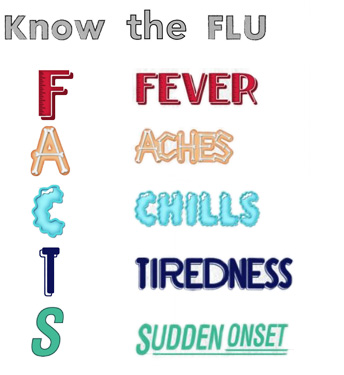
Influenza (‘the flu’) is a viral disease of the respiratory tract, characterised by fever, chills, headache, muscle aches and pains, a head cold and a mild sore throat. It can often cause a severe cough
How is the disease transmitted?
Influenza is very infectious. It can spread through the air by coughing and sneezing, as well as by hands, cups and other objects that have been in contact with an infected person’s mouth or nose
What is the incubation and exclusion period?
Is usually 1–3 days. The infectious period is probably from 1 day before the onset of symptoms to 3–5 days from the onset of symptoms. For young children, the infectious period is 7–10 days. Exclusion period for people with influenza is they should stay at home until they are feeling well.
How can the disease be managed? What is the recommended treatment?
Annual vaccination is available against influenza. People need to be vaccinated every year because immunity decreases, and new influenza strains circulate each year.
There is no specific treatment for influenza. Because it is caused by a virus, antibiotics will not help treat influenza. However, antibiotics may be prescribed if the person has a secondary infection or complication that is caused by bacteria. Decongestants and other cold remedies are widely promoted for relieving the symptoms of colds, but they are unlikely to help. In fact, they can cause side effects such as irritability, confusion and sleepiness. Oral decongestants are not recommended for children under the age of 2 years. Cough medicines do not reduce the frequency, severity or duration of a cough. The cough is there for a reason: it serves a useful function in clearing mucus from the child’s airways and preventing secondary infection
Strategies to prevent and minimise the spread of the disease?
Make sure staff and children practise cough and sneeze etiquette and effective hand hygiene. Teach children about cough and sneeze etiquette – Cough or sneeze into your inner elbow rather than your hand. If you used a tissue to cover your nose or mouth when sneezing or coughing, put the tissue in the bin straight away – Wash hands after using a tissue. Ensure that appropriate cleaning practices are being followed in the education and care service
What information do parents need to know and what is the most effective way to share this information?

Encourage children to use cough and sneeze etiquette and effective hand hygiene at home.
Provide information about Influenza vaccinations for eg A general information brochure
http://www.isg.org.au/assets/assets/ISG-Fact-Sheets/Brochure-Flu-Web.pdf?
(available in 14 different languages)
Now it's your turn to gather your information and get creative!
* before you proceed with your research have a look at the EVALUATION tab to see how you will be assessed
Here are some useful websites to research your disease:
http://www.schn.health.nsw.gov.au/parents-and-carers/fact-sheets
http://www.healthdirect.gov.au/
http://www.rch.org.au/kidsinfo/
Evaluation
A quiz (developed by the Director) will be conducted at the end of the staff meeting, which will provide feedback with what information your co-workers have gained through each presentation...... do they now know:
-What are the signs and symptoms of the disease?
- How is the disease transmitted?
-What is the incubation and exclusion period?
-How can the disease be managed? What is the recommended treatment?
-What are some strategies to prevent and minimise the spread of the disease?
- What information do parents need to know and what was the most effective way that you thought of to share the information?
After you have presented your information about your nominated communicable disease at the staff meeting you will meet with the Director (as part of your annual performance review) to discuss the feedback you recieved from your co-workers and your own self assessment.
Conclusion
The nature of how children interact with others in education and care settings (ie in close contact) can mean that illnesses spread quickly in a number of ways (National Health and Medical Research Council, 2012). When young children mouth toys, cuddle one another, do not cover their coughs and sneezes, germs are widely spread.
Quality area 2.1.3 of the National Quality Standards emphasises that "Maintaining high standards of hygiene is essential in preventing the spread of infectious diseases and ensuring good health. Effective hygiene practices assist significantly in reducing the likelihood of children becoming ill due to cross-infection or as a result of exposure to materials, surfaces, body fluids or other substances that may cause infection or illness" (ACECQA, 2013, p.53).
It is therefore imperative that all staff maintain a thorough knowledge of the services policies, practices and procedures relating to communicable illnesses and infection control and participating in this webquest is one way to work towards meeting the standards required for maintaining a safe and healthy environment for children.
Credits
References
Australian Children's Education and Care Quality Authority. (2013). Guide to the national quality standards. Retrieved 21/04/2015 from: http://files.acecqa.gov.au/files/National-Quality-Framework-Resources-K…
Godess Astra. (2011) . The safe sneeze by Mythbusters [Video file]. Retrieved from https://www.youtube.com/watch?v=3vw0hIs2LEg
National Health and Medical Research Council. (2012). Staying healthy: Preventing infectious diseases in early childhood and care services (5th ed.). Canberra: Author. Retrieved from http://www.nhmrc.gov.au/_files_nhmrc/publications/attachments/ch55_stay…