
Introduction
A cold war is a war in which fighting and engagement in conflict are not necessarily the focuses of the war. The Cold War was a war in which the Western world attempted to fight the ideology of Communism as it spread throughout Asia, Africa, and even Europe. The Earth was, for the first time, split into three 'worlds', the First (Democratic or US-allied), Second (Communist or USSR-allied), and Third (Decolonized) World.
Today, to learn more about the Cold War, you will complete a Webquest focused on these three essential questions:
- What mistakes were made in proxy wars (especially the Korean and Vietnam Wars) throughout the Cold War, and how did these mistakes affect the overall struggle against Communism?
- Why did the United States attempt an arms race against the Soviet Union, and how did this arms race affect the resources of each country?
- At the end of the Cold War, which groups were affect by the fall of the Soviet Union, and how did the fall of Communism affect these groups?
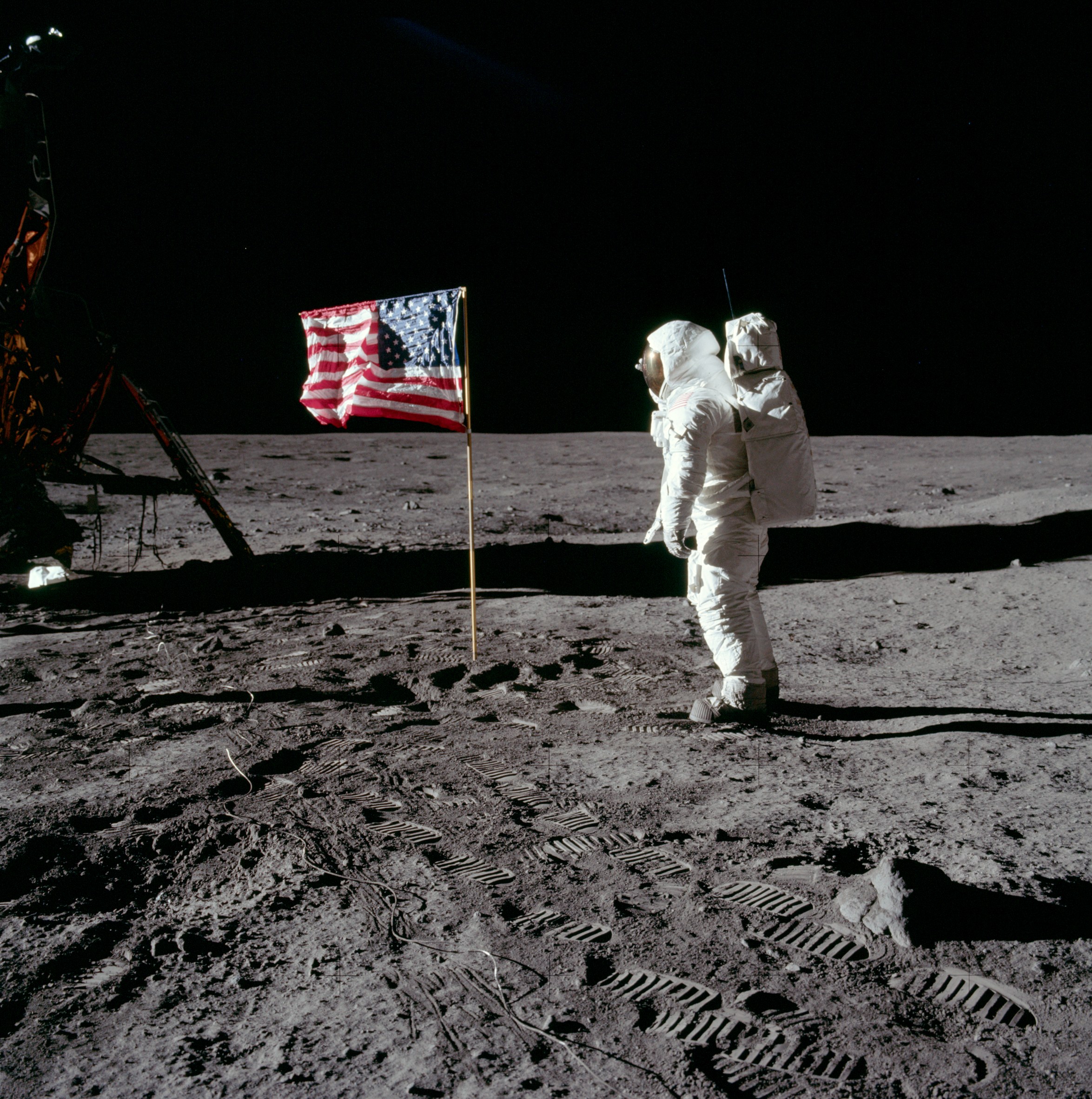
Buzz Aldrin salutes the US flag on the moon. The Space Race was a conflict within the Cold War in which the US and the USSR competed to see which society could first send a man to the moon. The United States, like in many Cold War conflicts, came out on top. The ultimate fall of Soviet technological advancement is very well displayed through this conflict.
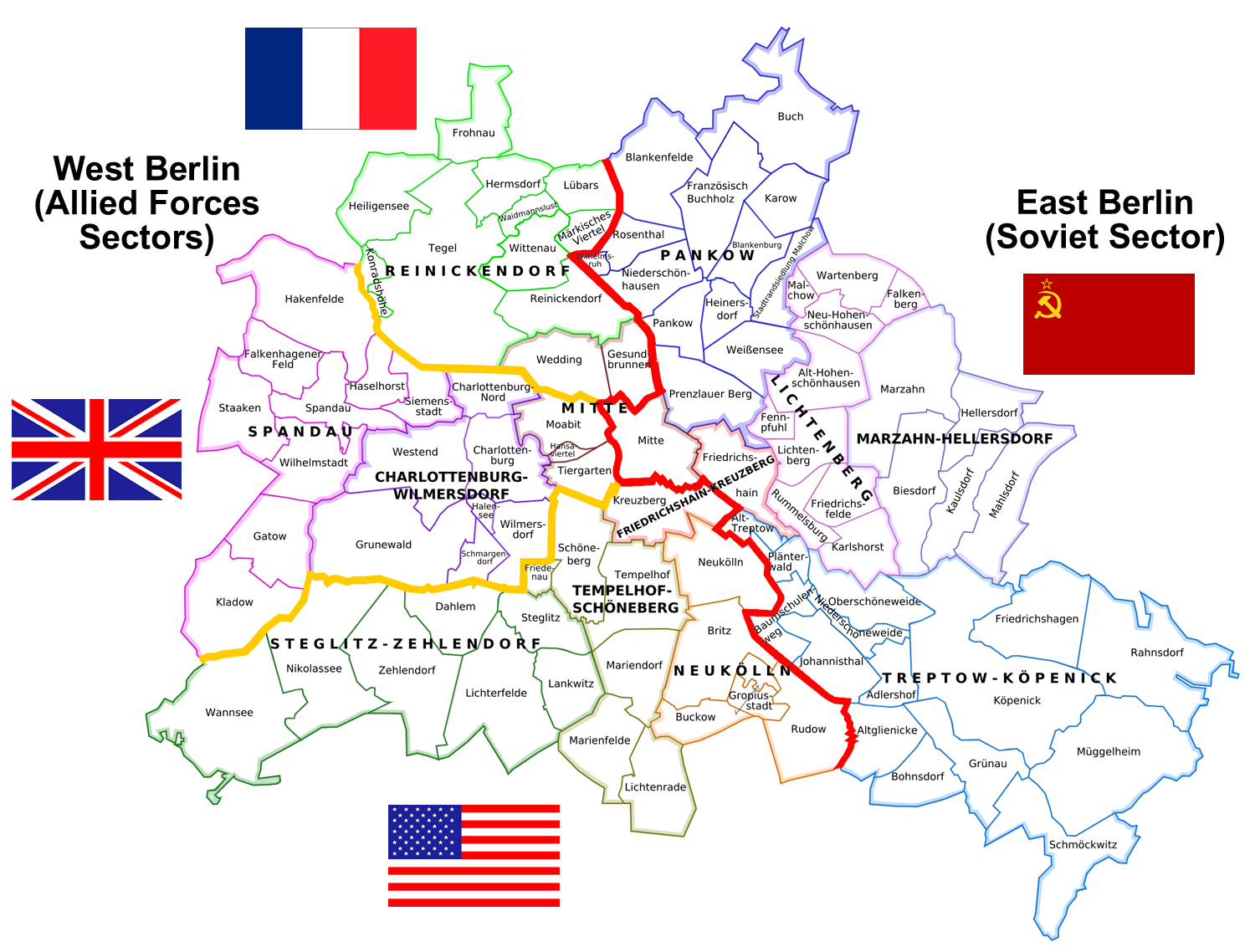
Although Berlin was split in four, the conflict between the East and West was predominant on all three borders on the West of the Soviet Sector. One very powerful cause of the Cold War is the conflict in Berlin. The way in which the communist government of the Soviet Sector worked was almost a competition with the Allied Forces Sectors. Effectively, the sides worked to defeat the opposing ideology. However, communist citizens were able to escape from East Berlin into West Berlin, causing the conflict that would cause the construction of the Berlin Wall which divided East and West Berlin until the end of the Cold War.
Task
Task
In order to better understand the essential question, you will complete a task using the following resources:
Question 1:
In his 1953 article, S.L.A. Marshall covers the mistakes which the US made during the Korean War. While details on these mistakes seem to be smaller scale, a majority of his analysis is larger-scale and more applicable to this project.
Noting the lack of real information on the beginning of the USA's involvement in Vietnam, Young believes the lack of truth between the government and the people during the war created division and confusion. Bombing in Vietnam was a cruel and unneccessary mistake which could easily have been avoided.
This article seems to be strongly opposed to the Vietnam War. The author presents evidence on several fronts as to not only why the USA should not have fought in Vietnam, but also why the USA did a poor job doing so.
Question 2:
This article covers the arms race between the USA and USSR with a focus on, as the essential question asks, the motives of the leaders. Also, the fall of the arms race is covered.
HISTORY gives an objective view of the arms race with information mostly about America's purpose. The limitations of the Soviet technologies are also covered.
The general principles of nuclear fear are well-covered in this article. Also, the arms race is detailed with dates and more specific information instead of generalities.
Question 3:
This source covers the interesting geopolitics after the Cold War. Americans, Europeans, Africans, and Asians are all covered thoroughly through their interactions with one another.
This article uses information about humanitarian efforts post-Cold War to illustrate the locations and natures of the geopolitical conflicts. Human rights arguments coexist within this source with interesting information about the end of the Cold War.
Using the surge in UN peacekeeping as evidence of the conflicts, this article covers (again) the geopolitical state of the world as a whole after the Cold War. What better way to cover the lack of peace than by analyzing the keeping of it?
Your task is to create a Webquest based on these three essential questions using createwebquest.com. Use the following steps to ensure that your Webquest is as expected.
- Read the resources and gather information from outside sources.
- Create an account for createwebquest.com and create an introduction.
- Create a task for the Webquest user, and provide a detailed process on how to complete the steps of the task.
- Create a rubric on which their task will be graded.
- Create a conclusion for the Webquest user to complete.
Process
- Reading the resources and finding a reasonable quantity of outside sources will take about 50 minutes. Your notes will not be graded. Be sure, nonetheless, to take notes good enough for completing your project.
- Creating your account shouldn't take a significant amount of time, but creating your introduction and questions may take 60 minutes or more. The expectation is that your introduction is 4 sentences not counting your two new questions. The two pictures on this page must have captions.
- Making your task and its process should take about 45 minutes. Ideas for tasks include Webquests, posters, and essays. The process must include information on how long each step will take and what information should be conveyed.
- Making your rubric will take approximately 30 minutes. Engagement, attractivenes, content, and analysis must be covered.
- Your conclusion should take about 30 minutes to complete. There must be at least four questions asked, and they cannot be yes-or-no questions.
Evaluation
| 0 |
1/2 |
3/4 | 5 | |
| Content |
The content is not relevant to the Cold War at all. |
The essential questions are adressed, but not adequately. |
The essential questions are adressed with adequate attention to detail. |
The essential questions are adressed perfectly, with both of parts of all three questions covered flawlessly. |
| Attractiveness |
The project does not have any appealing visual elements. |
The project has minor elements which bring little visual interest. |
The project has elements which engage the viewer and are relevant. |
The project has several elements which engage and interest the viewer, with relevant information and interesting captions. |
| Analysis |
The project takes all information at face value. |
The project analyzes imformation no more than once or twice. |
All information is analyzed, although imperfectly at times. |
All information is analyzed in a fashion which conveys understanding of the material. |
| Engagement |
The student did not pay attention whatsoever while working. |
The student frequently was off-task while working. |
The student often worked, but may have been occasionally off-task. |
The student was consistently on-task and working. |
Conclusion
FEEDBACK AND ANALYSIS:
Was the task too difficult, and did the creation of additional essential questions seem out of place?
Did the rubric adequately express the expectations of the student?
Which part of the webquest seemed the best, and why?
How accurately did the time estimations represent the task, and how clearly did the process assist in the creation of the product?
Why did you enjoy/not enjoy this Webquest?