
Introduction
Most organisms require a supply of oxygen and nutrients in order to survive. The transfer of oxygen and nutrients in the body and waste products out the body is controlled by the circulatory system. However, every organism is different and not all species have the same circulatory system or have one at all. This presentation will discuss the various sections of the circulatory system within different species.
Task
- Transport in Intervertbrates
- Transport in Vertebrates
- The Human Cardiovascular System
Process
Transport in Invertebrates
Open Ciculatory Systems
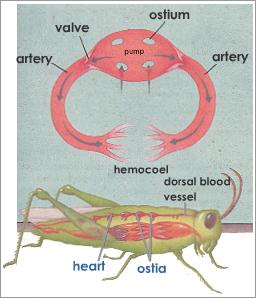
- Hemolymph is seen in animals that have an open circulatory system that consists of blood vessels and open spaces.
- Likely the first to evolve because it is present in evolutionarily older animals.
- For example, in some most molluscs and anthropods, the heart pumps hemolymph through vessels into tissue spaces. Like in grasshoppers, the dorsal tubular heart pumps hemolymph into a dorsal aorta which empties into the hemocoel. When the heart contracts, openings called ostia are closed; when the heart relaxes, the hemolymph is sucked back into the heart by way of the ostia.
- The hemolymph of a grasshopper does not contian hemoglobin or any other respiratory pigment.It carries nutrients but no oxygen. The tracheae provide transport and delivery of respiratory gases.
Closed Circulatory Systems
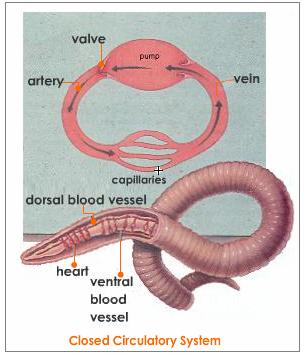
- In closed circulatory systems blood does not leave the vessels.
- For example, in annelids like earthworms and in some molluscs like squid or octupuses, blood consisting of cells and plasma is pumped by the heart into a system of blood vessels. And the valves prevent the backward flow of blood.
- Earthworms have hemoglobin which is dissolved into the blood and is not contained within blood cells. It does not have specialized organ for gas exchage, so gas exchange takes place across the body wall.
Transport in Vertebrates
Comparison of Circulatory Circuits in Vertebrates
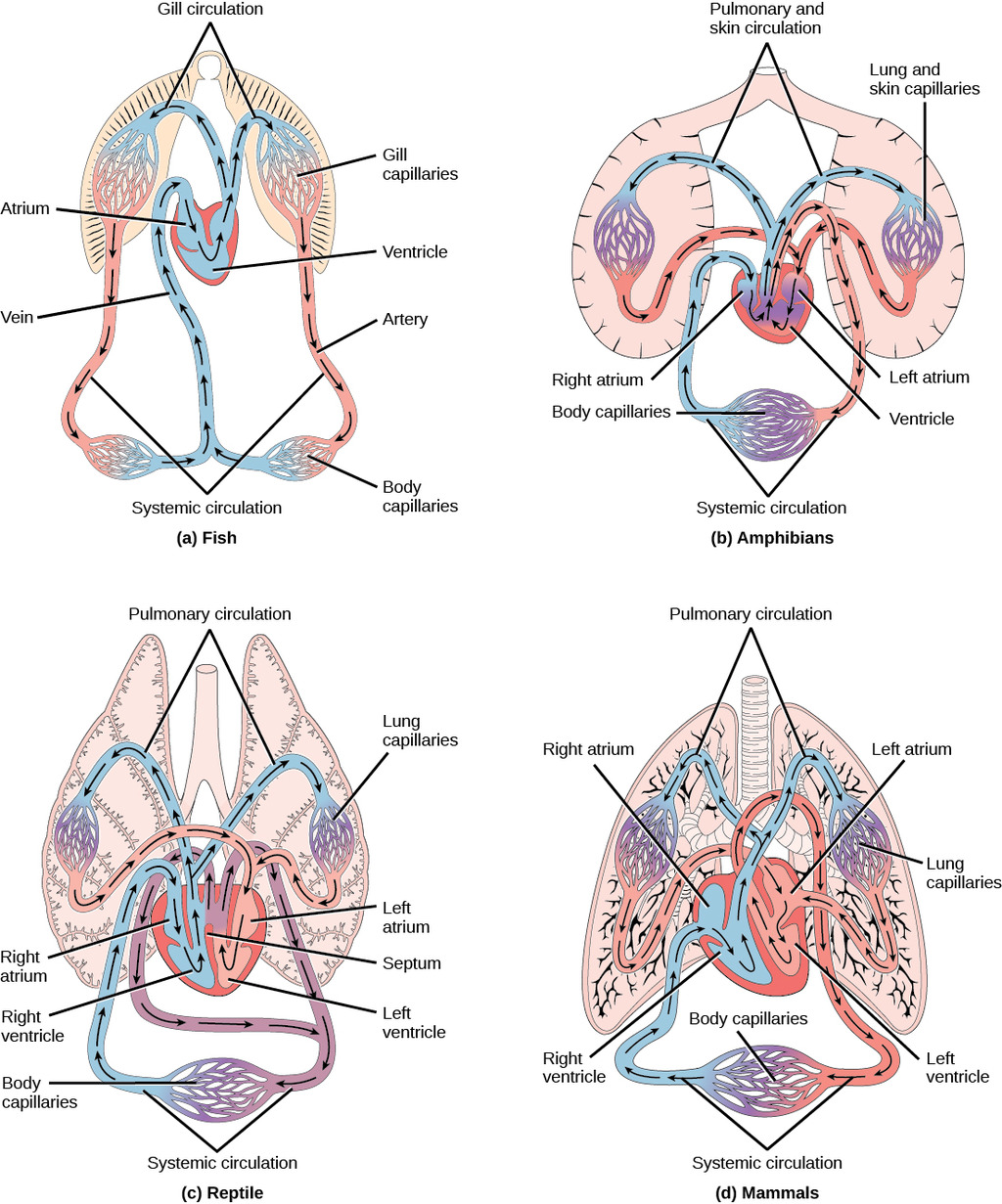
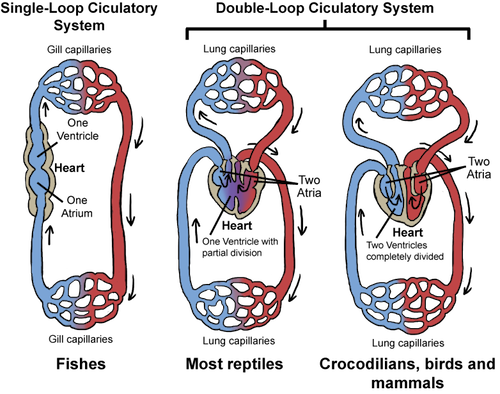
- In fishes, the blood moves in a single circuit. Blood pressure created by the pumping of the heart is dissipated after the blood passes through the gill capillaries. This is a disadvantage of this one circuit system.
- Amphibians and most reptiles have a two circuit system in which the heart pumps blood to both the pulmonary capillaries in the lungs and the systemic capillaries in the body. Although there is a single ventricle, little mixing of oxygen-rich and oxygen-poor blood takes place.
- The pulmonary and systemic circuits are completely seperate in reptiles and birds and mammals because the heart is divided by a septum into right and left halves. The right side pumps blood to the lungs and the left side pumps blood to the rest of the body.
The Human Heart
We can trace blood through the heart in the following manner:
- The superior vena cava and the inferior vena cava, which carry oxygen- poor blood that is high in carbon dioxide empty into the right atrium
- The right atrium sends blood through an atrioventricular valve to the right ventricle
- The right ventricle sends blood through the pulmonary semilunar valve into the pulmonary trunk and the two pulmonary arteries to the lungs.
- Four pulmonary veins, which carry oxygen- rich blood, empty into the left atrium
- The left atrium sends blood through an atrioventricular valve to the left ventricle
- The left ventricle send sblood through the aortic semilunar valve into the aorta and to the rest of the body
Comparison of Circulatory Circuits
Pulmonary Circuit
In the pulmonary circuit the path of blood can be traced this way: oxygen-poor blood from all regions of the body collects in the right atrium and then passes into the right ventricle, which pumps it into the pulmonary trunk. The pulmonary trunk divides into the right and left pulmonary arteries, which carry blood to lungs. As blood passes through pulmonary capillaries, carbon dioxide is given off and oxygen is picked up. Oxygen- rich blood returns to the left atrium of the heart, through pulmonary venules that join to form pulmonary veins.
Systemic Circuit
Systemic circulation refers to the part of the circulatory system in which the blood leaves the heart, services the body's cells, and then re-enters the heart.Blood leaves through the left ventricle to the aorta, the body's largest artery. The aorta leads to smaller arteries, arterioles, and finally capillaries. Waste and carbon dioxide diffuse out of the cell into the blood, and oxygen in the blood diffuses into the cell.Blood then moves to venous capillaries, and then the venae cavae: the lower inferior vena cava and the upper superior vena cava, through which the blood re-enters the heart at the right atrium.
Evaluation
Awnser these following questions:
- Do all animals have a circulatory system?
- What is the alternative means for transport of substances in animals without a circulatory system?
- What are the two types of circulatory systems?
- What is an open circulatory system?
- What is a closed circulatory system?
- What is the difference between octopuses and mussels regarding their circulatory systems?
- How does the heart impel the blood?
- How many heart chambers does the amphibian heart have?
- Why can the amphibian circulation be classified as double and incomplete?
- What is the difference between the pulmonary circuit and the systemic circuit?
Conclusion
Not all species are alike but we all require supply of oygen and nutrients and the removal of waste products to survive.These processes are done in different ways using different structures in diverse organisms.