
Introduction
You wake up in the morning and you feel unwell. You have had a cough a few days beforehand. Suddenly you get up and have a look at your skin. You see red, itchy spots and blisteres all over your skin. OH NO! You may have contracted chicken pox!
Chicken pox is a highly contagious disease that is most common in children. Throughout a persons lifetime, they will contract the disease but it is nothing to worry about. Chicken pox almost always gets better without extensive treatment.
How much do you know about chicken pox? Let me tell you some more information.
What are the causes and symptoms of chicken pox?
Chicken pox is caused by air-born dropets (such as when a person coughs or sneezes) that infect any person who comes into contact. A person who becomes infected is usually contagious for one to two days before the symptoms of chicken pox appears, and remains contagious until the blisters on the skin become scabs.
The symptoms of chicken pox include:
- a sore throat and headache prior to the rash appearing on the skin
- fever
- general illness
- itchy skin- a rash and small blisters will appear on the skin (these can appear anywhere, even in the mouth!)
- ulcers
It is important not to scratch the rash and blisters on your skin. Although this can be difficult, scratching can lead to extensive scarring on your skin.
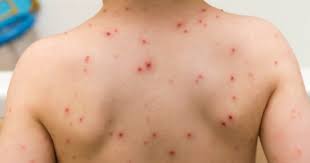
What does chicken pox look like?
The appearance of chicken pox varies from person to person, however the infect person is most likely to break out with red spots on their skin. After time, these spots will blister and then become scabby.
What do you do if you have chicken pox?
If chicken pox is suspected, the first thing that you should do is to make an appointment with your doctor. You will also need to contact any friends and family that you have be in contact with, as they may have become infected also.
Once confirmed, the most benecial treatment for chicken pox is rest, drinking plenty of fluids and the use of creams, such as calamine lotion to reduce itching and swelling.
If you do have chicken pox, it is vital that you do not return to school until the blisters have formed scabs and you are no longer contagious.
Task
Your task is to create a brochure that you will be able to take home to inform your parents and/or guardians about what chicken pox is, the symptoms of chicken pox and what they should do if a someone in your family contracts chicken pox.
Your brochure will need to have information to answer the following questions:
What is chicken pox?
What are the causes of chicken pox? What are some of the ways we can prevent the spread of chicken pox?
What are the symptoms of chicken pox?
What do I need to do if someone in my family contracts chicken pox?
Should i be kept away from school and others who have/have not had chicken pox?
Is there anty immunisation i can recieve for chicken pox?
The answers to some of these questions will appear in the introduction section of webquest. However, you will need to complete your own research in order to answer all of these questions thoroughly.
Process
1. In pairs, you will need to identify the information that you already have to complete your brochure. You may like to form additional questions to help you to find some more information. Useful websites that you may like to use to find additional information are:
http://kidshealth.schn.health.nsw.gov.au/sites/kidshealth.chw.edu.au/fi…;
http://www.rch.org.au/kidsinfo/fact_sheets/Chickenpox_Varicella/
http://kidshealth.org/kid/ill_injure/sick/chicken_pox.html
http://access.health.qld.gov.au/hid/InfectionsandParasites/ViralInfecti…
http://kidshealth.schn.health.nsw.gov.au/fact-sheets/chickenpox
You challenge is to use at least one additonal source (that is not a website) to find information. You may like to go to the library to help you find this source.
2. Once your research is completed, you will need to draft your brochure. Make sure that you have shown where your text will be (and it is informative information!), your images and your diagrams. You will need to show a teacher before you make a start on your good copy.
3. Get started on that good copy! Make sure you remember the purpose of this task- to inform the people at home about chicken pox and what they can do if someone in your house contracts the disease.
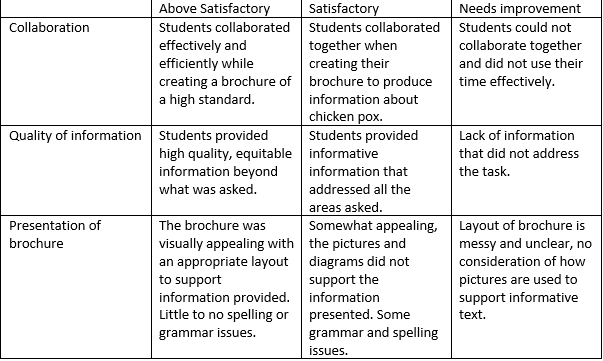
Evaluation
Conclusion
By the end of this task it is hoped that both you and the people in your home will have the information to be able to identify, treat and prevent chicken pox.
Please write a short paragragh stating how you believed you worked in this task (both independently and with your partner) and anything new that you have learnt from the research you conducted.
Credits
Victorian State Government: Health and Human Services and Better Health Channel. (2016). Infection: Chicken Pox. Retrieved from:https://www.betterhealth.vic.gov.au/health/conditionsandtreatments/chic…;
Victorian State Government: Health and Human Services. (2016). Disease Information and Advice: Chicken Pox and Shingles. Retrieved from: https://www2.health.vic.gov.au/public-health/infectious-diseases/diseas…;
Teacher Page
This task is designed for students in grade 5/6. It is expected that students will have learnt about some diseases in earliers years, however in this task students are encourgaged and required to use their knowledge and skills to design a brochure that will inform members of the community about maintaining health and wellbeing.
As a part of the 5/6 Curriuclum, students are supported to develop the knowledge, understanding and skills to create opportunities to take action to enhance their own an others' health and wellbeing (ACARA, 2016). The learning outcomes for this task are:
Students will be able to identify the causes and measures members of the community need to take to maintain health and wellbeing in the household and in the community (ACPPS058).
Students are able to plan and practise strategies that prevent the spread of infectious diseases and promote health, safety and wellbeing (ACPPS054).
Australian Curriculum Assessment and Reporting Authority [ACARA]. (2016). Health and Physical Education Curriculum. Retrieved from http://www.australiancurriculum.edu.au/health-and-physical-education/cu…